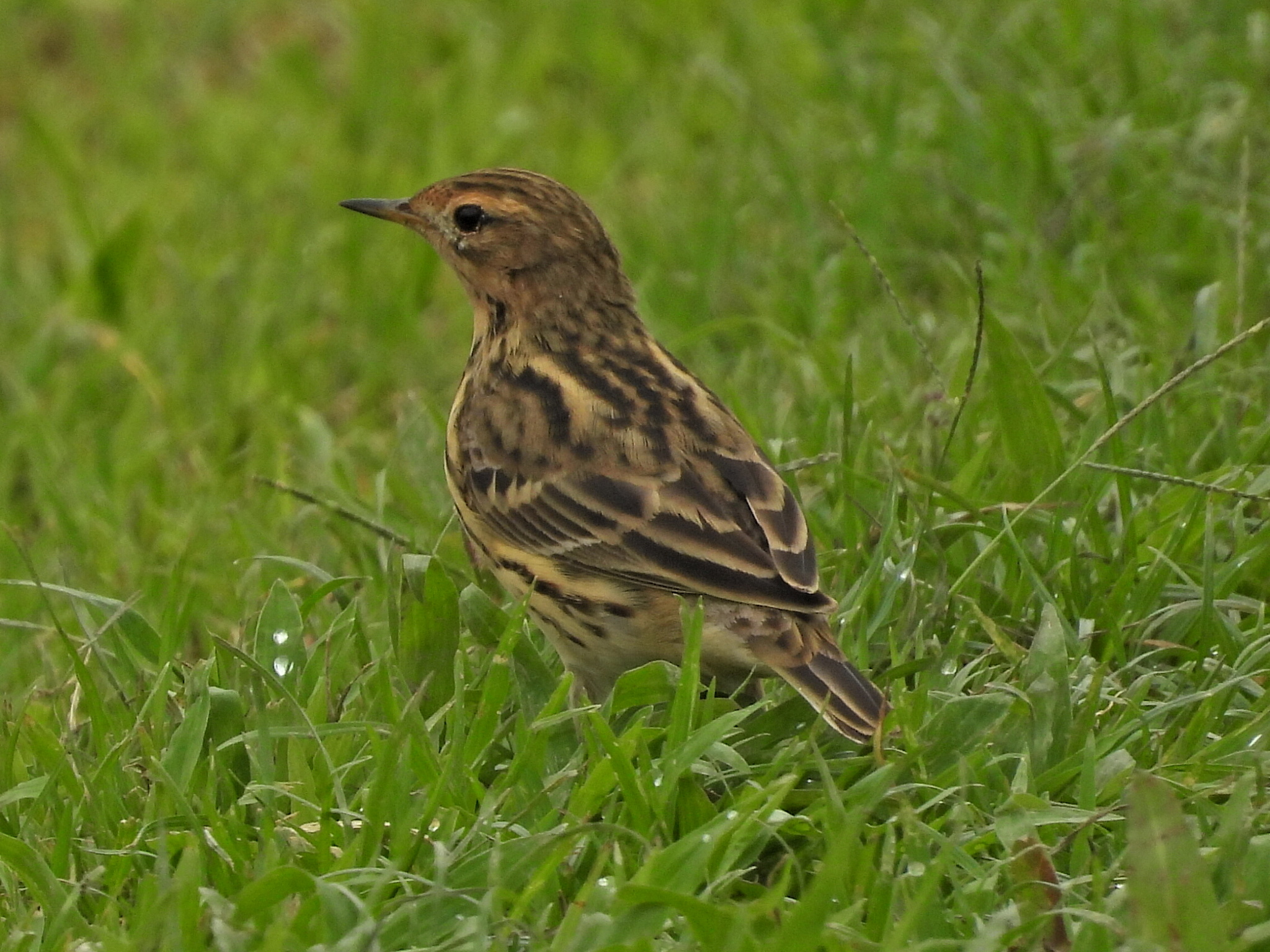
Anthus cervinus
Identity and identification
Red-throated Pipit is called الجشنة الحنائية, also الجشنة حمراء الزور, in Arabic, and Pipit à gorge rousse in French. Anthus cervinus belongs to Motacillidae in the order Passeriformes. Despite visiting wetlands, it is not a wader. About 15 cm long, it has a fine bill, pale legs and strongly streaked brown upperparts.
Breeding plumage includes rusty to pink colour on the throat, breast and face, generally most evident in males. Females and autumn birds are duller, and juveniles may lack red altogether. A white throat therefore does not exclude the species. Strong back stripes, a heavily streaked rump, breast and flanks, and two pale lines along the back help identification. Compare Meadow Pipit, Tree Pipit and other pipits, considering shape, streaking and calls rather than naming any streak-breasted bird from one character.
Habitat, food and behaviour
Northern tundra provides breeding habitat. On migration it uses fields, short meadows, damp cultivated land and watersides. Association with wetlands does not mean spending the day inside reeds: open, low vegetation allows walking and finding food. It can mix with other pipits, making individual examination important.
It takes insects and small invertebrates from the ground and low vegetation, walking and probing between plants. A sharp call during natural flight can help, but a single heard call does not replace visual evidence or a useful comparison recording. Wait at the field edge for birds to appear rather than following them through vegetation and displacing them from food.
Breeding and development
Breeding takes place far to the north, with a ground nest in concealing cover. Audubon gives five or six eggs as usual, with a range of three to seven. The female incubates for about 11–13 days and the male feeds her during incubation. Both parents feed the nestlings, which leave the nest around 11–15 days after hatching.
Nest departure is more precise than assuming every chick acquires full flight ability on one particular day. These intervals describe development, not an Arab breeding season. Red plumage likewise does not establish local breeding: a migrant can carry breeding feathers far from its nesting grounds.
Range and Arab occurrence
The breeding range runs from northern Norway across Russia and Siberia, with a small presence in northwestern Alaska; wintering areas extend into Africa and Southeast Asia. The 2026 Lebanon guide describes a common passage migrant and possible rare winter visitor. It occurs especially in damp and cultivated areas from sea level to about 1,800 m, with many records from the Beqaa and Aammiq. Passage from late February to mid-May is generally more conspicuous than September to mid-November, and few records fall in midwinter. Oman’s official list instead records a common passage migrant and winter visitor: uncertainty over Lebanese winter status should not be extended across Arabia. Kuwait’s committee list records a common passage migrant and scarce winter visitor, adding another regional distinction.
What November means
The first half of November remains within the Lebanese autumn passage window described, while Omani presence also fits wintering. These seasonal patterns do not guarantee arrival on a particular day. Repeat visits to damp fields, recording dates, counts and land use, are useful. One image, or simply seeing the species again, cannot distinguish successive migrating flocks from the same group staying.
Conservation and responsible observation
The global category is Least Concern (LC), but local populations depend on feeding habitat. Lebanon’s guide lists agricultural intensification, habitat loss, illegal hunting and climate change among pressures. Reducing pesticide use and preserving damp field margins help maintain food and cover. Watch from permitted routes, respect crops and private property, and avoid playback or following birds into fields. Withholding precise nest locations helps protect a life cycle that does not require visitor intervention.
References
British Trust for Ornithology — BirdFacts: Red-throated Pipit; Audubon — Red-throated Pipit; UNDP / ABCL / Ministry of Environment — Birds of Lebanon, second edition, 2026, p. 407; Oman Birds Rarities Committee — Official Bird List, seasonal table; Kuwait Ornithological Rarities Committee / AbdulRahman Al-Sirhan — Annotated Arabic checklist, 20 September 2026.
Illustrative species photograph: Aiken Lau, iNaturalist, CC0 1.0.