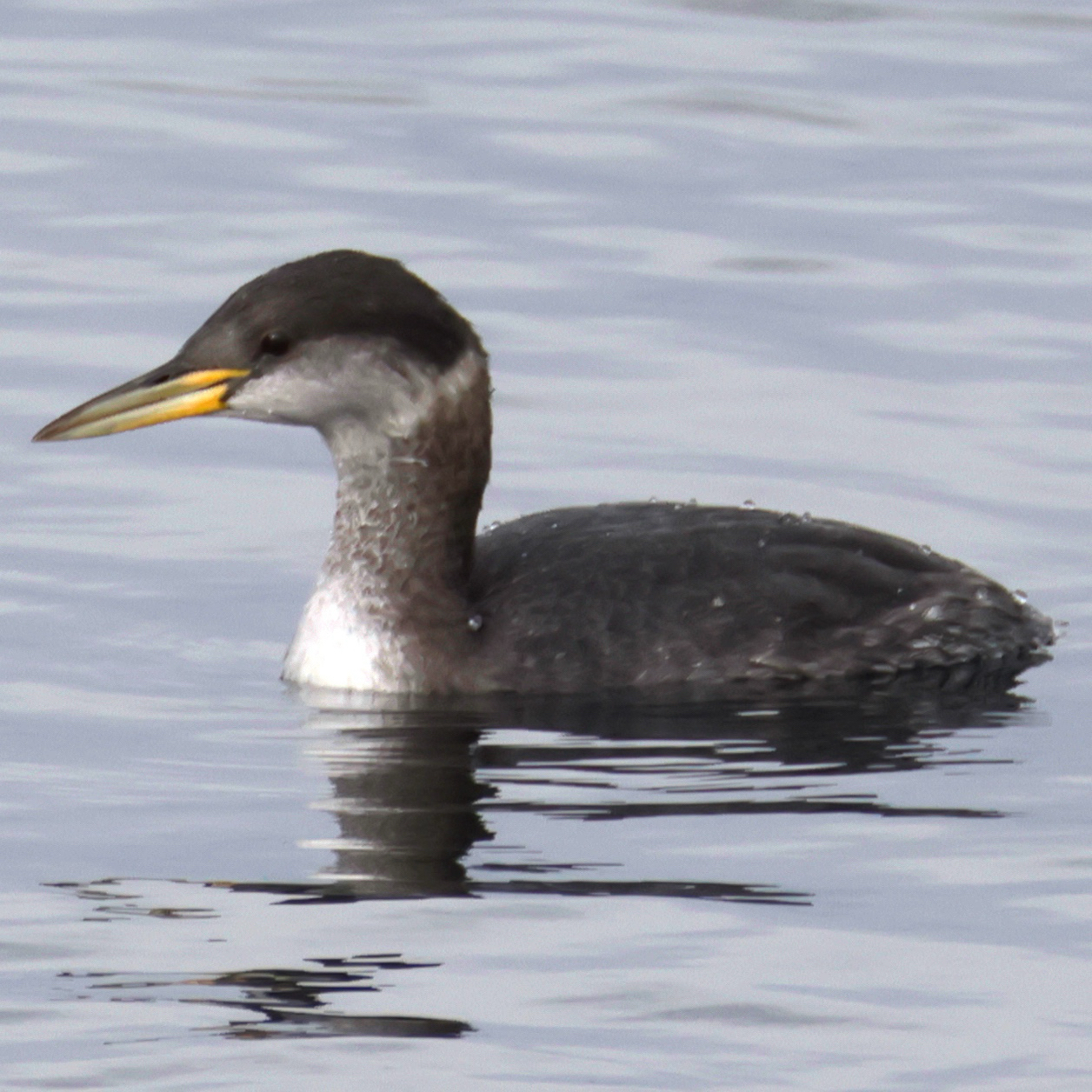
Podiceps grisegena
A waterbird with a changing appearance
The Red-necked Grebe, Podiceps grisegena, is a member of the grebe family, measuring about 45 centimetres. It has a substantial body and a strong, pointed bill, and spends most of its life on or below the water. Although superficially duck-like, it belongs to a different family, with diving and underwater pursuit shaping its movements and anatomy.
The species occurs in parts of Europe, Asia and North America, with geographical differences in size and bill colour. Western Eurasian birds are generally smaller than those from North America and eastern Asia. An American photograph can illustrate the species, but does not demonstrate occurrence in an Arab country or necessarily represent every detail of Eurasian populations.
What changes between summer and winter?
In breeding plumage the neck and breast become chestnut-red, while pale grey cheeks contrast with a black cap. Yellow at the base of the bill remains a useful feature. The sexes have similar plumage, although males average larger; apparent size in a single photograph is not enough to determine sex.
In winter the red fades and grey tones dominate the neck and face, making head and bill structure more useful than the common name. Juveniles may retain dark cheek stripes and traces of reddish colour. The transition is gradual, so not every autumn bird has a complete summer or winter appearance.
Separating it from similar grebes
Great Crested Grebe provides the most useful comparison: Red-necked usually has a shorter, thicker neck, a heavier-looking head and a stouter bill with a yellow base visible in good conditions. Great Crested looks longer-necked and slimmer. Losing its summer head ornaments does not turn a Great Crested into a Red-necked Grebe.
Horned Grebe is smaller, with a shorter, darker bill and red eyes, unlike the non-red eyes of Red-necked Grebe. Black-necked Grebe is also smaller and has a finer bill. Sound identification combines relative size, head and bill shape, and the boundary of the pale face rather than relying on a distant photograph or colours distorted by reflected light.
Food, habitat and movement
Its prey includes small fish, crustaceans and aquatic insects, with proportions changing between habitats and seasons. Insects are important on some breeding lakes, while fish become more prominent in coastal wintering waters. It dives for food, sometimes searching near the bottom or taking insects from the surface; its diet is not identical everywhere.
The feet propel it underwater, and lobed toes help it swim. During breeding it needs open water adjoining vegetation; in winter it uses bays, coasts and large lakes. An approach that repeatedly forces a bird to dive interrupts feeding. Disappearing underwater should not be treated as an invitation to pursue it until it resurfaces.
A floating nest and shared care
Courtship includes facing displays, raised bodies, offerings of aquatic plants and loud calls. Both partners build a plant platform in shallow water, usually anchored to standing vegetation. A successful nest needs water, cover and relative stability; changing water levels or disturbance along the margin can harm the site without anybody touching the eggs.
A typical clutch contains four or five eggs, incubated by both parents for around 20–23 days. Downy chicks can swim early, but still need food and care and may ride on a parent’s back. Early swimming, independence and flight are different developmental stages and should not be confused.
Arab occurrence: rarity matters
Major Eurasian wintering areas lie around the North, Baltic, Black and Caspian Seas, with smaller numbers reaching the Mediterranean. Lebanon’s national bird guide, published in 2026 and covering records through December 2025, treats it as a vagrant. It lists two records: Beirut harbour on 18 January 1942, and a bird found dead on Beirut’s seafront on 29 October 2002.
These records do not establish regular wintering in Lebanon and cannot be extrapolated to the Gulf or the whole Arab region. In November, recognising nonbreeding plumage is useful when watching grebes, but anticipating a possible encounter differs from proving one. An unusual record needs clear photographs, dated notes and specialist assessment.
Conservation and responsible observation
The global category published by BTO is Least Concern, LC. This evaluates worldwide extinction risk, not the security of every local population. Threats include wetland degradation, pollution and accidental capture in fishing nets. Lebanon’s guide also identifies illegal hunting as a threat requiring attention.
Useful observation starts from the shore or an appropriate hide, without forcing take-off or interrupting rest and diving. Record diagnostic features instead of pursuing a closer photograph, and notify the appropriate authorities about trapped or injured birds. Rarity is a reason to protect and document a bird, not an added incentive to shoot it.
Further reading: Birds of Lebanon, second edition, 2026; British Trust for Ornithology; RSPB; Cornell Lab of Ornithology; Audubon; University of Michigan Animal Diversity Web; Minnesota Department of Natural Resources; California Department of Fish and Wildlife.
Photo: Ben (ben142) / iNaturalist, CC0 1.0, Snohomish County, Washington, United States, 24 October 2026.