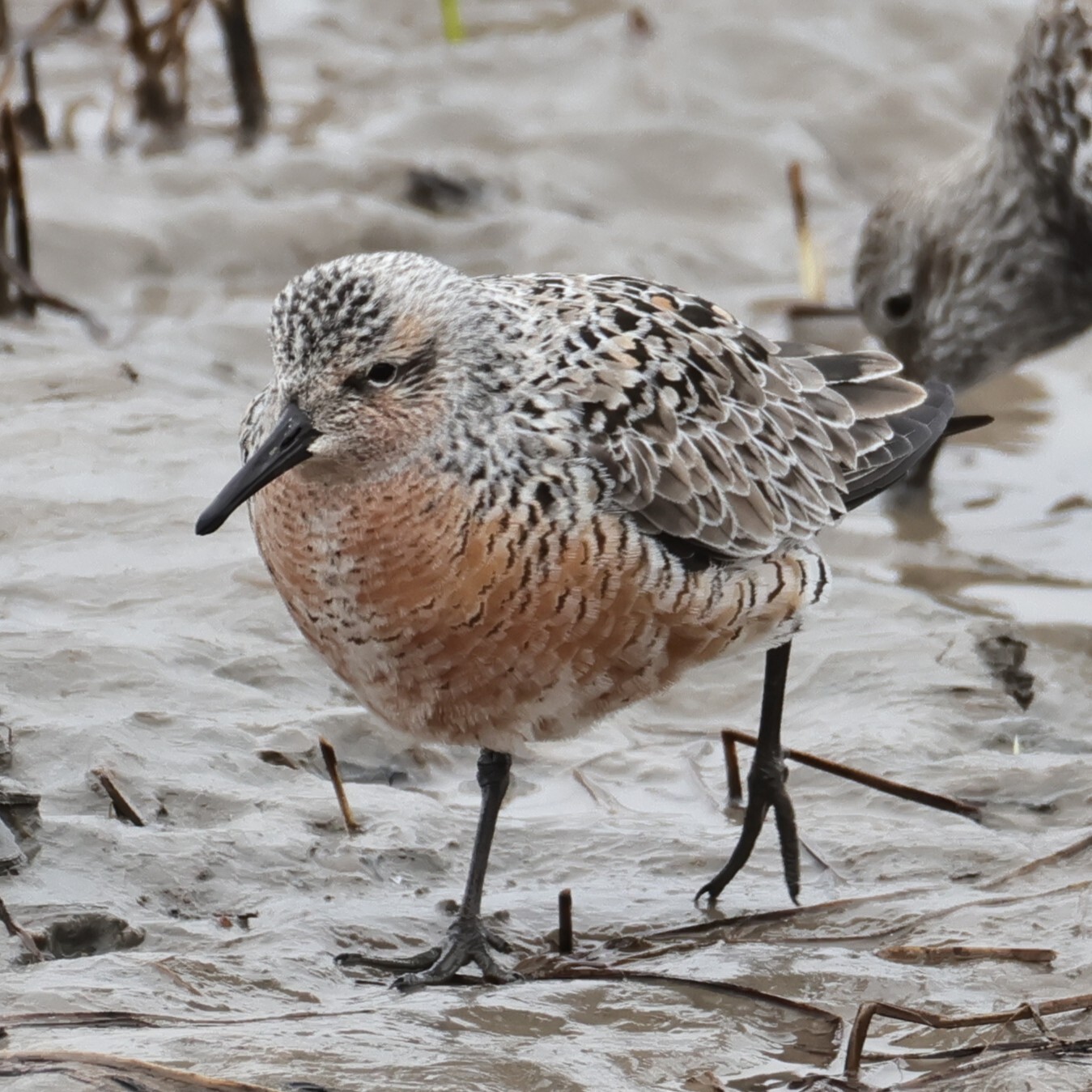
Calidris canutus
Identity and names
Red Knot, Bécasseau maubèche in French, is Calidris canutus, a wader in Scolopacidae and the order Charadriiformes. About 24 cm long, it breeds in the High Arctic and migrates between tundra and distant coasts. Its name can mislead observers searching in winter: the brick-red colouring is a feature of breeding plumage, whereas most winter birds are grey above with pale underparts.
Identification
It is stocky, with relatively short dark legs and a straight, medium-length black bill rather than the long curved bill of some other sandpipers. Breeding birds develop red faces, breasts and underparts and more patterned upperparts. In winter the upperparts are pale grey and the underside white; juveniles have outlined, scalloped-looking feather edges. Males and females look similar during ordinary field observation, so colour alone should not be used to assign sex. Identification against other sandpipers requires size, structure and bill shape together, allowing for age, plumage and viewing distance.
Habitat, food and behaviour
Outside breeding, it uses sandy shores, tidal mudflats, estuaries and bays exposed at low tide. It picks or probes for small molluscs, crustaceans, marine worms and other invertebrates. Food changes on the tundra, where birds exploit insects during the short season. Flocks move between feeding flats and roosts as the water rises. Their habitat requirements therefore include two complementary elements: productive feeding surfaces and quiet places where they can wait through high tide without repeated displacement.
Range and Arab occurrence
Different populations follow several flyways and use coasts worldwide; they are not a single uniform winter population. In the Arab region, Banc d’Arguin in Mauritania is a particularly important wintering site. Tracking research there has documented birds returning to the same roosts and using relatively local feeding areas. This contrasts with extreme rarity farther east: the 2026 Lebanon guide treats it as a vagrant, citing a bird at Khaldeh pool on 2 April 1955, and Oman’s published list also calls it a vagrant. Eastern rarity should not be projected onto the Arab Atlantic coast, nor Mauritania’s importance onto every Arab beach.
Breeding and development
The female lays in a shallow ground nest on the tundra. BTO gives a typical clutch of four eggs, incubation by both parents for about 21–22 days and flight capability at approximately 18–20 days after hatching. The downy chicks can move early, but development still depends on food and protection. These are reference intervals, with estimates varying between studies and populations. They do not imply that the species nests on Arab wintering shores: its presence there belongs to a different part of its annual cycle.
November and responsible observation
November at Banc d’Arguin falls within use of non-breeding habitat, not evidence of local nesting. A bird in an area where it is rare deserves careful notes, clear photographs and specialist review, without pursuing the flock. Record the tidal stage, numbers, bill shape and plumage while maintaining a distance that avoids repeated flushing. Do not walk directly towards roosting groups or position vehicles between birds and water. Good observation leaves birds feeding and resting normally; it is not measured by the closeness of a photograph or the spectacle of a flock taking flight.
Conservation
The global category is Near Threatened (NT), not Least Concern. Conservation depends on the continued availability of linked migration, feeding and resting sites. Pressures include loss and deterioration of coastal habitats, climate change, pollution, disturbance and depletion of shellfish resources in some regions. A study of Banc d’Arguin’s waterbird community between 1980 and 2017 found a significant decline in Red Knot numbers; that is a finding for the study period, not a new 2026 census. Protecting one important stopover cannot compensate fully for losing another on the same migration route.
References
British Trust for Ornithology — BirdFacts: Knot; Cornell Lab of Ornithology — Red Knot Life History; UNDP / ABCL / Ministry of Environment — Birds of Lebanon, 2026, p. 162; Oman Birds Rarities Committee — Oman Official Birdlist; Leyrer et al. — Small home ranges and high site fidelity in red knots wintering on the Banc d’Arguin, Mauritania, Journal of Ornithology, 2006; van Roomen et al. — Changes in the waterbird community of the Parc National du Banc d’Arguin, Mauritania, 1980–2017, Bird Conservation International.
Illustrative species photograph: Lihai Song, iNaturalist, CC0 1.0.