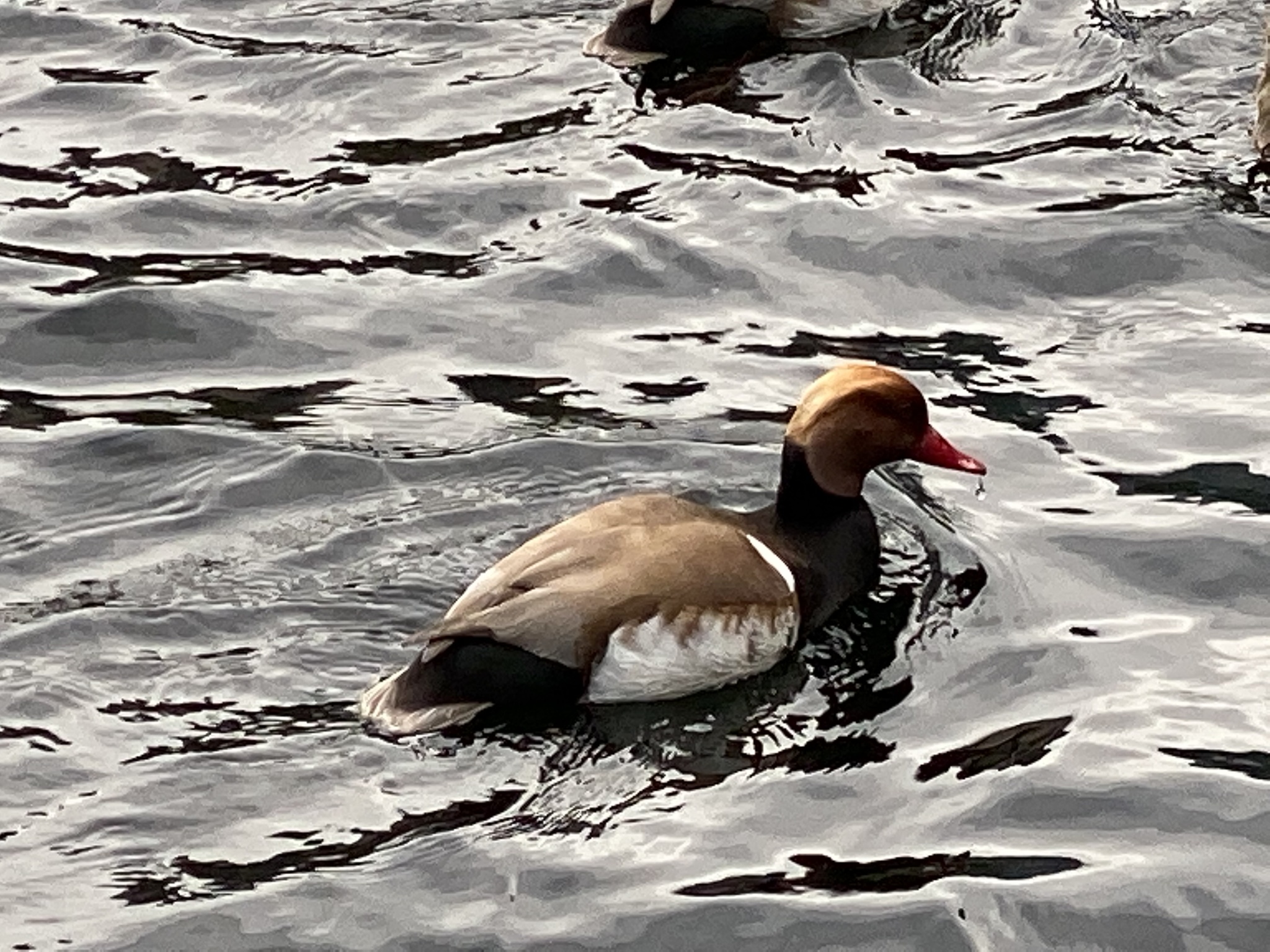
Netta rufina
Identification and plumages
The Red-crested Pochard, Netta rufina, is a substantial diving duck whose breeding male has an unusually rounded orange-rust head and a vivid red bill. The black breast and pale flanks strengthen the contrast. The female is much quieter in colour: brown above, with pale cheeks beneath a darker cap. The rounded head is as useful as the colour when birds are seen among other ducks. The species belongs to the Anatidae, but its feeding repertoire is broader than the word “diving” might suggest. Body length is about 53–57 cm.
Common Pochard males also have reddish heads, but their grey body and dark bill produce a different overall pattern. Female Red-crested Pochards have a dark bill with pink near its tip; juveniles have an entirely dark bill. Males in eclipse become female-like but retain the red bill and eye. These features are more reliable than judging sex from subdued plumage alone. In flight, a broad white wing stripe and pale underwings are conspicuous.
Wetlands and feeding
Lakes and lagoons with abundant aquatic plants and sheltered, vegetated margins are characteristic habitats. The species uses fresh as well as brackish water and may visit deltas and estuaries, particularly outside the nesting season. A reed-fringed lake offers different resources at once: open water for resting, submerged plants for feeding, and concealed margins for nesting and broods. The mere presence of water is therefore a poor substitute for the structural variety of a functioning wetland.
Roots, seeds and other parts of aquatic plants dominate the diet. The birds can dive, reach down from the surface or tip forward with the hindquarters raised. Aquatic invertebrates and occasional small vertebrates supplement the plant food. These different techniques let the duck exploit food at several depths. Water management that removes submerged vegetation or repeatedly exposes feeding areas can alter the usefulness of a site even when a sizeable pool remains.
Breeding and the annual cycle
The female builds a nest of vegetation and down within protective cover near water. In Spain, SEO/BirdLife places the breeding season broadly between April and August, especially the central months; this calendar should not be transferred unchanged across the range. Its account gives a typical clutch of 8–10 eggs and incubation by the female lasting 26–28 days. Females sometimes lay in other ducks' nests, so the eggs found together need not all come from one mother.
Ducklings leave the nest soon after hatching and feed themselves under the female's care. SEO/BirdLife describes a chick-development period of 45–50 days, without explicitly identifying this as the age of first flight. Adults also undergo a wing moult that temporarily prevents flight. Some move to separate moulting waters, where undisturbed open water and cover are especially valuable. Thus breeding, brood-rearing and moulting can use different parts of the wetland network.
Global range and movements
The natural range extends through parts of Europe and western and central Asia. The EURING/CMS migration atlas describes a mixture of resident populations, short-distance movements and longer seasonal migrations. European birds may winter around the Mediterranean, Black Sea and Caspian Sea; the wider winter range reaches the Indian subcontinent. Individuals do not all follow one route or share a single departure calendar.
The species is widely kept in waterfowl collections, and some European populations, notably in Britain, have an introduced origin. Assessing an exceptional sighting therefore includes checking rings, behaviour and the circumstances of arrival, as identification alone cannot establish wild origin.
Arab countries: breeding, wintering and dated records
Morocco holds documented breeding sites as well as wintering birds. The North African literature identifies Sidi Boughaba, the lower Loukkos wetlands and other localities among its breeding areas. Algeria has both historical nesting evidence and rare winter occurrence. Boutabia and colleagues documented a female with ducklings at Mekhada marsh in June 2025, establishing breeding in the El Kala wetland complex; this was a regional confirmation, not the first breeding record for all Algeria.
Tunisia can no longer be described solely through older accounts of rare winter visits. Hamza, Dlensi and Chokri reported two breeding pairs at Khniss during 2025 in Go-South Bulletin in 2026, presenting this as the country's first confirmed nesting. That finding demonstrates local breeding, not a large established national population.
Iraq's checklist by Salim and colleagues describes a very local breeding resident in the southern marshes, alongside more widespread but generally uncommon winter and passage occurrence. Syria's 2008 checklist documents nesting at Sabkhat al-Jabbul in 2005 and winter presence in suitable waters. These dated sources establish different national patterns; they should not be read as a current census of either country's breeding population.
Egypt's EORC checklist of 2019 includes the species in category A, establishing accepted wild occurrence after 1950 without assigning a season. The CMS account also lists records from Lebanon, Libya, Bahrain and the United Arab Emirates; no seasonal pattern is inferred here from that inclusion. Qatar is classified as a vagrant destination. The Birds of Saudi Arabia describes a rare winter visitor and a rare, erratic summer visitor in Saudi Arabia; summer occurrence does not itself establish breeding.
Oman's national list, compiled by the Oman Bird Records Committee, gives a different and more specific status: a rare to uncommon passage migrant and winter visitor. This national assessment is preferable to the broader CMS vagrant label for Oman.
Conservation and responsible observation
The global category reported by BTO is Least Concern. Local breeding concentrations can nevertheless be vulnerable to drainage, deteriorating water quality, hunting and disruptive changes in water level. Global status and the condition of an individual marsh answer different questions. The recent North African studies emphasise habitat protection and sound water management rather than treating a new nest record as proof that the species is secure.
Observe from existing paths or hides and keep clear of broods and concealed shoreline nests. Record a count, date, precise locality and observed behaviour; distinguish a pair, a downy brood and a fully grown juvenile. Repeated observations from a distance are more informative than repeated approaches. Maintaining vegetation and undisturbed water serves this duck throughout its life cycle, not only when the colourful male is most conspicuous.
SEO/BirdLife — Pato colorado · Naturalis — Red-crested Pochard · Boutabia et al. — Breeding at Mekhada, Algeria · Hamza et al. — First confirmed breeding in Tunisia · Salim et al. — Annotated checklist of the birds of Iraq · Murdoch & Betton — A checklist of the birds of Syria · EURING/CMS — Migration Atlas: Red-crested Pochard · BTO — Red-crested Pochard BirdFacts · Egyptian Ornithological Rarities Committee — Checklist 2019 · CMS — Netta rufina: geographic range · Oman Birds Records Committee — Official Oman Birdlist · The Birds of Saudi Arabia — Volume 2
Photo: Nick Blewden