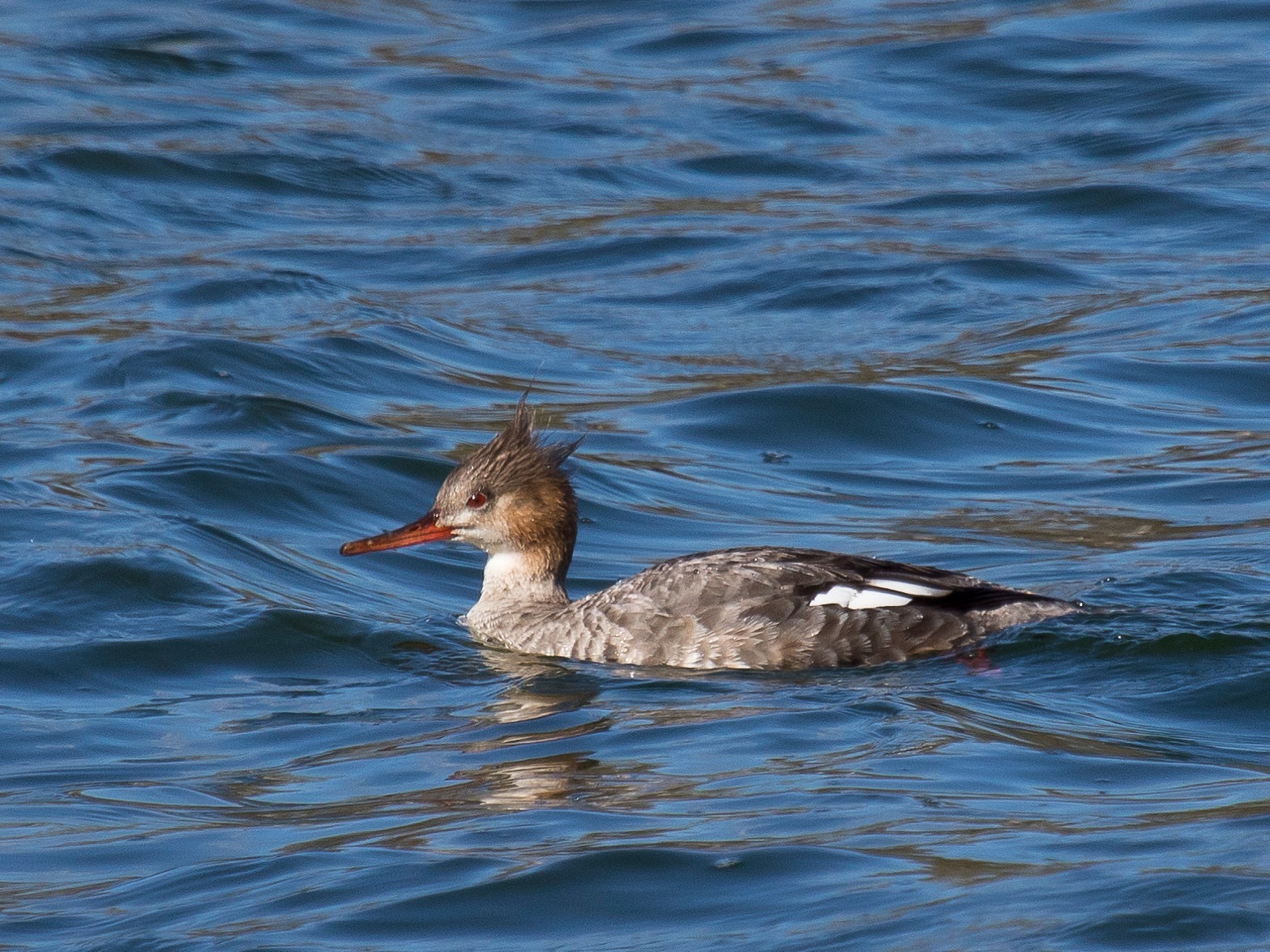
Mergus serrator
Identity and similar species
Red-breasted Merganser, Mergus serrator, is a long-bodied, fish-eating duck with a narrow reddish bill and a loose, spiky crest. Adults measure roughly 51–65 cm. In breeding plumage, the male has a dark green head, a contrasting white neck collar, a rusty, dark-marked breast and grey flanks. The crest can appear dishevelled or flattened according to posture. Its fine bill separates its silhouette from the broad-billed ducks commonly feeding beside it.
Females have a brown head and greyish body. Juveniles resemble females, and males become much less distinctive outside their full breeding plumage. Female Common Mergansers are a particular source of confusion. Red-breasted Merganser usually has a slimmer bill and a less sharply defined transition between the brown neck and pale breast. Common Merganser has a more solid-looking bill and typically stronger contrast at the throat and lower neck. Young birds can be difficult, so the whole head-and-neck pattern matters more than the presence of a crest alone.
Waters and fishing behaviour
The breeding habitat includes northern lakes and rivers within boreal forest and tundra landscapes. Outside that season, the species is strongly coastal, using bays, estuaries and other marine waters, though some birds remain on large ice-free inland waters. It can forage around rocky shores, piers and sheltered coastal inlets. A marine winter habitat does not imply that nesting takes place on the same shoreline.
Small fish form the main adult food. The narrow bill has serrated edges that help hold slippery prey; these are specialised bill structures, not mammalian teeth. The birds search and pursue underwater, returning to the surface between dives. They also take aquatic invertebrates, and insects are important to young ducklings. Groups sometimes appear to drive fish towards shallow water, where prey can be caught without a full dive. The availability of fish and access to clear feeding water are more informative than the simple distinction between freshwater and salt water.
Courtship, nesting and young
Several males may display around a female, using repeated movements of the head, neck and forebody. Display can begin away from the eventual nesting area. Unlike the familiar cavity-nesting pattern of Common Merganser, Red-breasted Merganser usually nests on the ground. The female selects a sheltered place near water, under dense vegetation or protective debris, and lines a depression with down. Islands and shore margins provide potential nest sites where suitable cover is available.
BTO gives a typical clutch of 8–10 eggs and female incubation of 31–32 days. The downy ducklings enter the water soon after hatching and find food for themselves while the female tends them. Broods can combine, and female care may end before the young become airborne. Typical fledging is around 60–65 days. These figures describe development on the breeding grounds; they are not evidence that a bird observed in a Mediterranean winter flock bred locally.
A northern range with coastal wintering
The species has a broad northern distribution across North America and Eurasia, with breeding areas including Iceland, Scandinavia and northern Russia. Winter movements connect northern nesting waters with extensive stretches of temperate coast. In western Eurasia its winter range includes the North Sea, Baltic, Mediterranean, Black Sea and Caspian regions. Migration may be visible as lines or V-shaped groups moving over water.
There is no single “Arab status” that captures this distribution. A bird can be a recognised winter visitor in one country and an exceptional arrival in another. The distinction is particularly important between the Atlantic–Mediterranean sector and much of the Arabian Peninsula. Geographic proximity to a wintering coast does not establish annual occurrence at every neighbouring wetland.
Country records in the Arab world
Morocco's national rare-bird committee lists Red-breasted Merganser as a winter visitor, using a category explicitly defined as regular winter presence. Egypt's Ornithological Rarities Committee includes it in category A of its 2019 national checklist, meaning accepted wild occurrence since 1950; that category alone does not quantify abundance or assign a season.
Lebanon has particularly informative published records. Ramadan-Jaradi and colleagues reported seven birds on an islet off Tripoli on 7 March 1998, then five at Qleiaat on 5 November 2018, describing the latter as the country's second record at the time. Three of the five birds in 2018 were killed by hunters. These dated observations establish exceptional occurrence, not regular Lebanese wintering. OSME's regional list version 10.2 subsequently adds a third Lebanese record, at Tripoli in December 2021.
OSME's regional list version 10.2 records Jordan's first observation in the Jordan Valley in December 2016. It treats Oman as a vagrant destination and cites its fifth record at Al Mouj, Muscat, in January 2021. Kuwait's third record was at Jahra Pools in January 2021, following a second in February 2015; the sixth United Arab Emirates record was at Al Barsha in March 2019. These dated records illustrate occasional eastern arrivals, contrasting with Morocco's winter-visitor status; their ordinals describe the cited records, not a live national total.
Conservation and careful observation
Global Least Concern status, as reported by BTO, does not mean every population is stable or every site safe. Concentrations at feeding and migration sites make local disturbance consequential. Fishing areas, sheltered roosting waters and nesting margins are connected parts of the bird's annual requirements. The documented Lebanese losses also show why identification and enforcement against illegal killing matter for scarce visitors.
Watch from a fixed point and allow feeding birds to approach naturally. Avoid driving a boat between a flock and the water it is using, and never disturb nests to verify species identity. For a regional rarity, photographs showing the bill profile, throat, neck and wing pattern are especially helpful. Record the date, locality, count and behaviour without converting a single visit into a claim of regular seasonal presence.
BTO — Red-breasted Merganser BirdFacts · Audubon — Red-breasted Merganser · Animal Diversity Web — Mergus serrator · Commission d’Homologation Marocaine — Report 27 · Egyptian Ornithological Rarities Committee — Checklist 2019 · OSME — Regional List 10.2, non-passerines · SPNL — Ramadan-Jaradi et al.: Lebanese bird records
Photo: Hamilton Turner