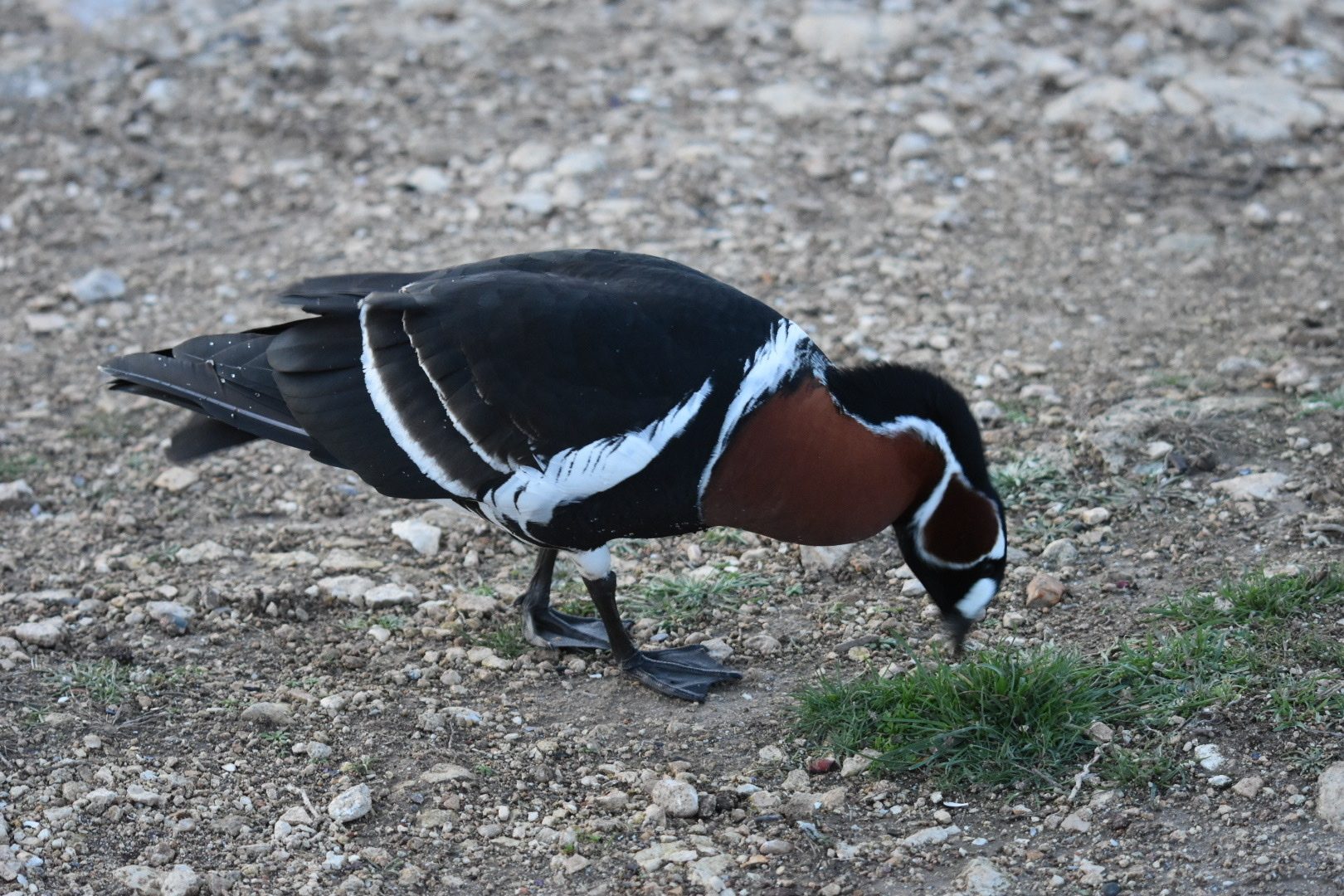
Branta ruficollis
Striking plumage on a small goose
Red-breasted Goose Branta ruficollis is a small, short-necked goose whose chestnut breast, fore-neck and cheek patches are outlined by bold white lines against black plumage. A pale patch between the bill and eye and the contrasting flank pattern add to its distinctive appearance. Both sexes share this colour scheme; the richness of the chestnut alone does not identify a male.
Young birds are duller and less cleanly patterned. AEWA's monitoring guidance describes smaller, less sharply defined cheek patches, a paler mottled breast and neck, and greyer wing feathers with less distinct white bars. Ageing becomes harder as young birds acquire adult-like body plumage. At a distance the chestnut can disappear into the dark body, allowing confusion with Brent Goose or causing a bird to be overlooked in a flock of Greater White-fronted Geese. Its short bill and compact silhouette are useful supporting features.
Tundra in summer, farmland and lakes in winter
The breeding range is concentrated in Arctic Russia, notably the Taymyr, Gydan and Yamal peninsulas. Nesting habitat includes tundra near rivers, sloping banks and elevated ground. Winter life is very different: grassland and agricultural fields supply food, while lakes and other waterbodies provide drinking and roosting places. The species often mixes with Greater White-fronted Geese outside breeding.
In the western Black Sea region, conservation organisations describe feeding on winter wheat and barley, maize stubble, spilled grain and pasture plants. Birds commute between these fields and water rather than feeding exclusively at the shore. In Bulgaria, roosts can be on lakes, on lake ice when frozen, or occasionally on the sea. Thus the quality and safety of the surrounding farmland are part of wetland conservation for this goose.
Nesting near formidable neighbours
One of the species' best-known behaviours is nesting near birds of prey, especially Peregrine Falcons; associations with Snowy Owls are also reported. The territorial defence of these neighbours can reduce access by ground predators such as Arctic Foxes. The geese may form loose nesting groups, but the relationship is not a guarantee against predation and varies with the local predator community.
A long-term Taymyr study by Kostin and Mooij showed that breeding success depends on several interacting factors: the condition of adults on arrival, temperature, precipitation, snow cover and predation. Lemming abundance can also influence the pressure exerted by predators on geese. This makes reproduction sensitive not only to events on the nesting grounds but also to the feeding opportunities available before the birds arrive.
Eggs, young and the annual cycle
The nest is on the ground and lined with vegetation and down. Reference tables in Clinical Avian Medicine give clutches of 3–7 eggs and incubation of 23–25 days. These are broad reproductive reference values, not measurements from every wild population. The female incubates, and the downy young leave the nest while still unable to fly, continuing to feed and grow under parental care.
The short northern summer must accommodate nesting, growth of the young and the adults' wing moult. Weather affects the timing of arrival, incubation and hatching, as the Taymyr field study demonstrated. A delayed snowmelt and poor adult condition can consequently alter the proportion of birds that breed and their productivity. Annual variation in the number of juveniles reaching wintering flocks is therefore an important part of the species' population dynamics.
Migration clarified by tracking
The principal migration links Siberian breeding grounds to wintering areas around the Black Sea, with major staging regions in Kazakhstan and Russia. It is a journey made in stages, with repeated use of lakes and feeding areas, rather than a single continuous flight. The distribution of wintering birds can shift with conditions, so the entire population is not necessarily concentrated in the same country each winter.
Petkov and colleagues' study published in October 2026 analysed GPS tracking from 2019–2023. It identified important staging areas in northern Kazakhstan and the Orenburg region, and winter cores around coastal Romania with adjacent Bulgaria and Ukraine, the Sivash area in Crimea, and the Veselovskoie region of southern Russia. The tracked sample provided no evidence of a major previously unknown wintering area. These findings sharpen understanding of the main flyway without making every rare record elsewhere part of a regular route.
Iraq, Syria, Oman and historical Egypt
OSME describes Red-breasted Goose as a rare winterer in Iraq. This is marginal winter occurrence, not an Arab breeding population. In Syria, its regional list cites a vagrant pair at Sabkhat al-Jabboul in February 2010. Oman is also a vagrant destination: the first record dates to November 2013, and the official list continues to classify the species as accidental rather than a regular winter visitor.
Egypt's EORC checklist of 2019 places the species in Category B, for wild records before 1950 with none later accepted in that list. Historical Egyptian presence must therefore be kept separate from modern records in Iraq, Syria and Oman. The species is also maintained in captivity; unusual sightings need assessment of wild origin, especially where they are distant from established migration and wintering areas.
Conservation and unobtrusive observation
AEWA and BTO report the global category Vulnerable. Hunting pressure, disturbance, habitat loss and changes in climate and land use affect different parts of the annual cycle. Concentration at a limited set of staging and winter sites makes the loss of safe feeding grounds or roosts particularly consequential. Protecting water alone leaves the birds exposed if adjoining fields are heavily disturbed.
International monitoring combines counts, assessment of the proportion of young birds and tracking of movements. Observers can contribute clear photographs and precise records without approaching feeding flocks or forcing birds to fly. Where mixed goose flocks are present, patient scanning from a distance is more useful than repeated pursuit, and allows the Red-breasted Goose's striking pattern to be appreciated without interrupting its feeding.
AEWA: Red-breasted Goose monitoring methods · WWT: Red-breasted Goose · Wildlife Conservation Society Bulgaria: Red-breasted Goose · Kostin and Mooij, 1995: breeding ecology on Taymyr · Clinical Avian Medicine: waterfowl reproductive reference data · Petkov et al., 2026: GPS tracking from Siberia to the Black Sea · OSME Region List 10.2: non-passerines · EORC: Checklist of the Birds of Egypt, 2019 · BTO BirdFacts: Red-breasted Goose
Photo: Лариса Артемьева