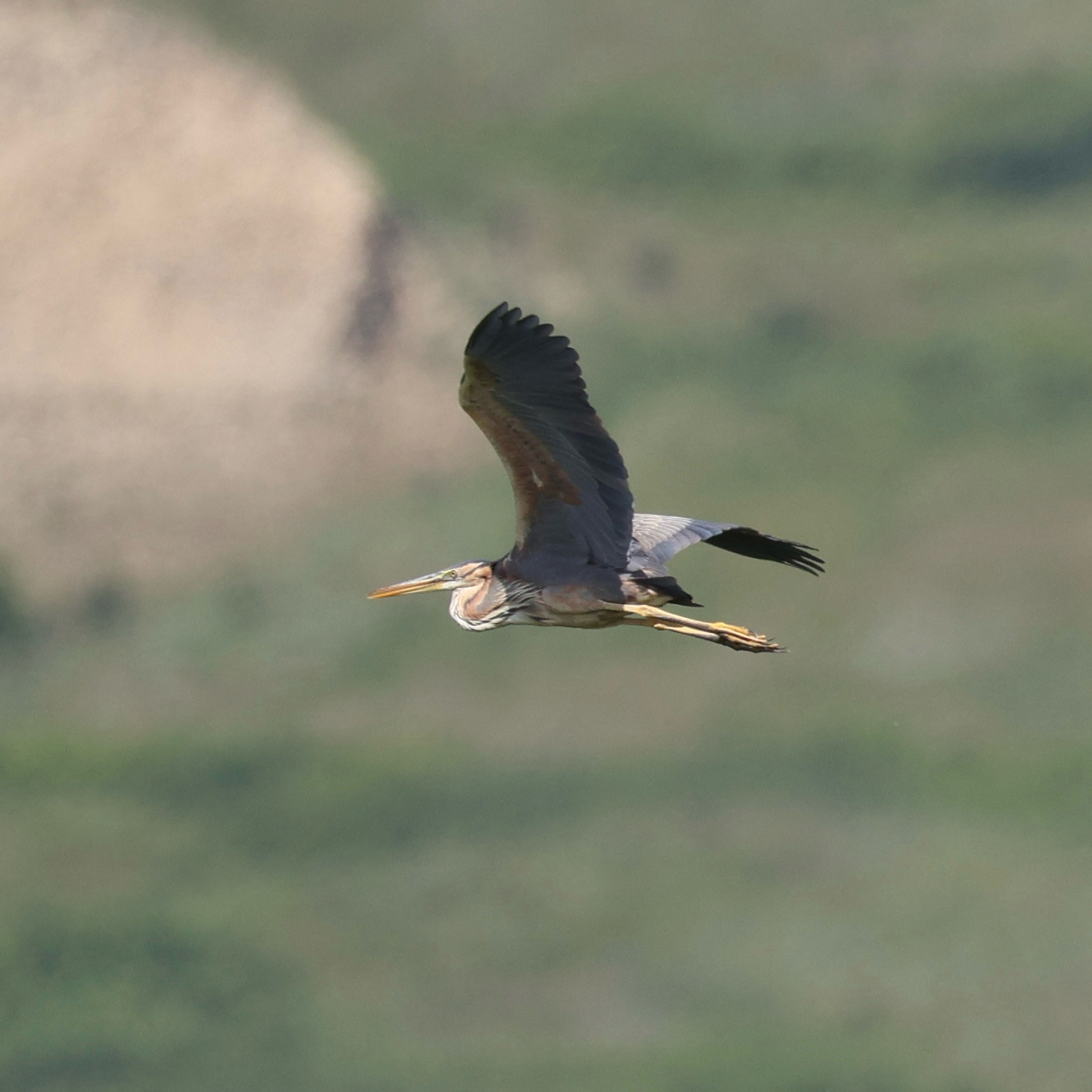
Ardea purpurea
Identity and identification
Purple Heron Ardea purpurea belongs to Ardeidae. More slender than Grey Heron, it has a long neck, pointed bill and adult chestnut-brown plumage with dark neck stripes. Juveniles are browner and less contrasting. Like other herons, it retracts its neck in flight, unlike extended-necked storks. It is placed in the order Pelecaniformes. The IUCN category carried in AviList 2026 is Least Concern (LC).
Habitat, food and behaviour
Dense reed marshes, shallow water, lakesides and channels provide habitat. Concealed among plants or waiting still, it takes fish, amphibians, insects and other small animals. Reed-coloured plumage and immobility can hide a large bird surprisingly effectively.
Breeding and parental care
A nest of reed stems and twigs stands within dense wet cover, sometimes in shrubs. BTO gives three to five eggs and shared incubation around 25–30 days. Both parents feed young, which may climb vegetation before full flight. Leaving the nest platform does not mean independence.
Range and Arab occurrence
Its range spans parts of Europe, Africa and Asia. Arab wetlands serve breeding, passage or wintering functions according to location. Lebanon’s updated checklist describes coastal, island and inland passage; frequent sightings alone do not establish breeding.
Seasonality and observation
Lebanese passage extends from mid-March to mid-June and, in larger numbers, early August to late November. November therefore falls within expected autumn occurrence. Neck, bill and wing details distinguish Grey Heron without entering reeds.
Ecological role and conservation
Reed cover, water and food are essential. Drainage, reed burning, pollution and disturbance are pressures. Reed management should respect bird seasons and retain safe areas; cosmetic pond edges cannot replace the functions of a complete marsh.
References
Ramadan-Jaradi et al. — Updated checklist of the birds of Lebanon, Sandgrouse 42 (2020), 186–238.
British Trust for Ornithology — BirdFacts: Purple Heron.
IUCN SSC Heron Specialist Group — Purple Heron, HeronConservation.
AviList Core Team — AviList: The Global Avian Checklist, v2026 (20 October 2026).
Photo: Istvan Sipos — CC0 1.0.