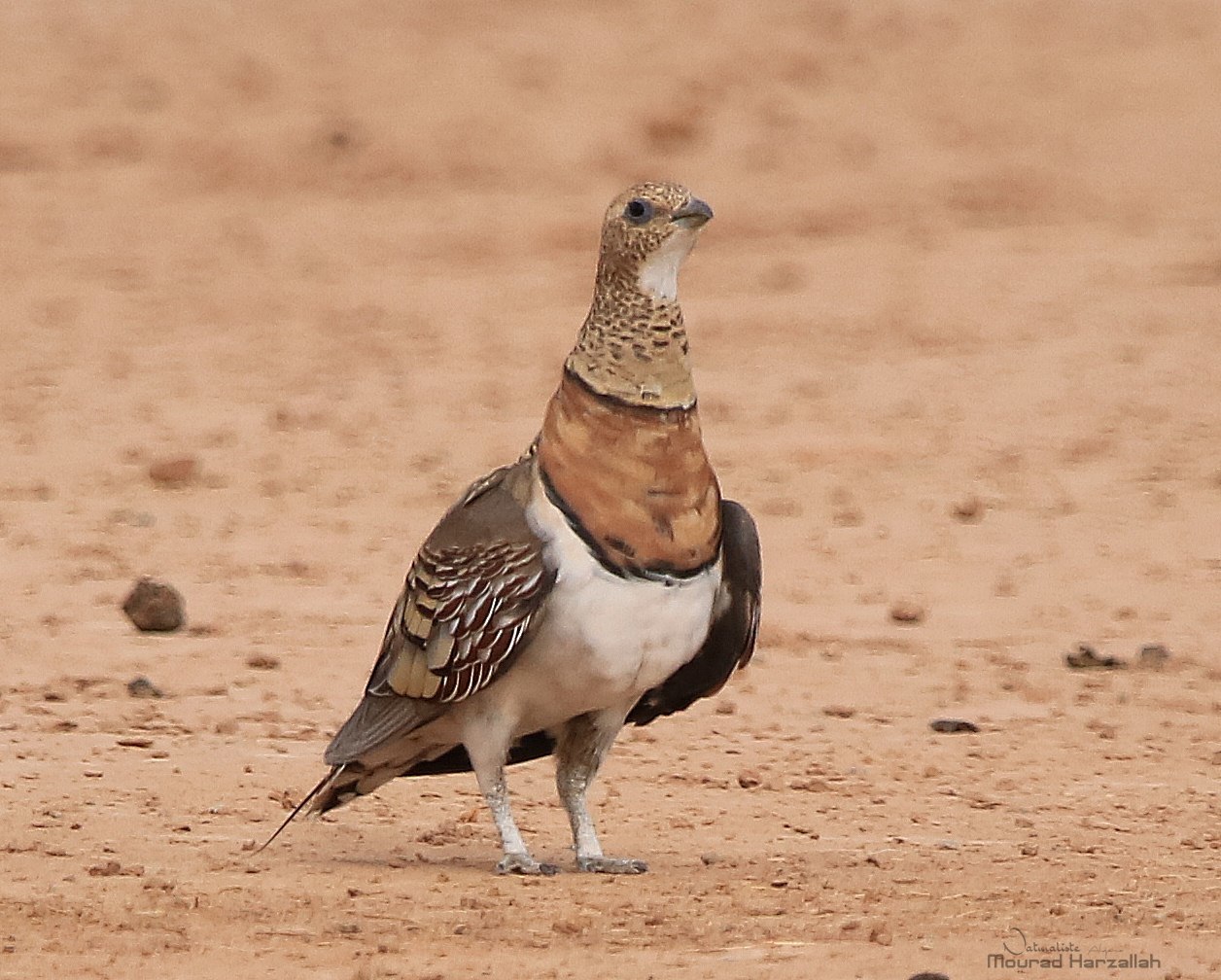
Pterocles alchata
Identity and identification
Pin-tailed Sandgrouse Pterocles alchata belongs to Pteroclidae. Pointed central tail feathers and a white belly distinguish it from Black-bellied Sandgrouse. Males have stronger breast colours and bands, females more cryptic markings. Identification combines belly, tail and head rather than a single feature. It is placed in the order Pterocliformes. The IUCN category carried in AviList 2026 is Least Concern (LC).
Habitat, food and behaviour
It uses steppe, dry plains and open, sparsely wooded farmland. Small seeds are collected on the ground; birds drink regularly and may gather at water. Long pointed wings produce fast flight. A desert flock travelling in one direction is not necessarily undertaking continental migration.
Breeding and parental care
A simple ground scrape usually holds three eggs. Field studies confirm alternating male and female incubation. Mobile chicks collect their own food, while the male transports water in specialised feathers and both parents protect them. Rainfall, food and regional conditions influence timing.
Range and Arab occurrence
Its range includes North Africa and parts of the Middle East, including Iraqi steppe populations, as well as Europe and Asia. Lebanon’s 2020 checklist treats it as very rare. Its Arab importance therefore centres on steppe regions rather than common Lebanese occurrence.
Seasonality and observation
Residence and movements differ among populations. November observation should use distant views of steppe and water, noting arrival and departure directions. Long tail tips may be hidden in a frontal view; several angles help without pursuing birds.
Ecological role and conservation
Steppe conversion, agricultural intensification, disturbance and hunting are pressures. Nest studies demonstrate sensitivity to human visits; random searching on foot or by vehicle can threaten eggs. Feeding, drinking and nesting habitats require protection together.
References
Ramadan-Jaradi et al. — Updated checklist of the birds of Lebanon, Sandgrouse 42 (2020), 186–238.
Ferraz et al. — Using GPS and accelerometer data to remotely detect breeding events in two elusive ground-nesting steppe birds, Animal Biotelemetry 12 (2024), 30.
AviList Core Team — AviList: The Global Avian Checklist, v2026 (20 October 2026).
Mourad Harzallah — original photograph, unmodified · CC BY 4.0
Photo: Mourad Harzallah — CC BY 4.0.