Vanellus vanellus — Wet fields, autumn passage and winter visitors
Identity and recognition
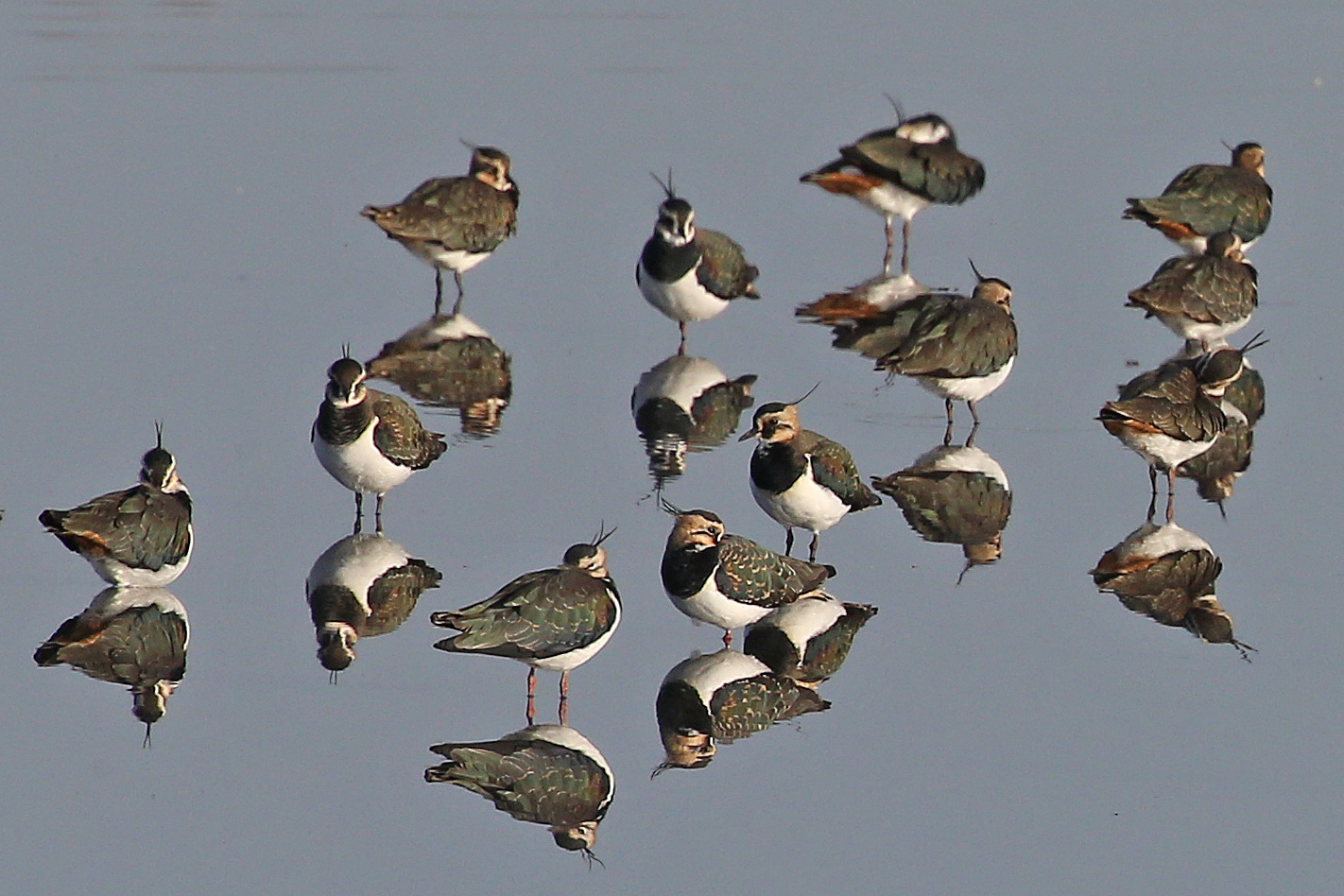
Northern Lapwing Vanellus vanellus belongs to the plover family Charadriidae. Arabic names include al-zaqzaq al-shami and al-qatqat al-shamali; the Qatar checklist also records Dahrouj. A narrow crest, dark upperparts with green and purple iridescence, and white underparts contrasting with the dark breast distinguish it. Its wings look broad and rounded in flight. Colour intensity and crest length vary with age and season, so identification uses a combination of features.
Habitat and food
It uses open fields, short pasture, wetlands and shallow water margins, sometimes gathering in flocks outside the breeding season. It searches the ground for earthworms, insects and their larvae. Short vegetation and moist soil make food accessible, linking its farmland habitat to a mosaic of wet patches and open ground.
Breeding and chick development
It nests on the ground in open habitats. BTO gives a typical clutch of four eggs and incubation of about 25–34 days, mainly by the female with occasional male participation. Chicks hatch downy and mobile, reaching fledging at about 35–40 days after hatching. Early departure from the nest site differs from acquiring flight. These are general reference durations. Egg-laying dates depend on region and habitat conditions; British breeding dates should not be transferred to Arab countries.
Arab occurrence and seasonality
In Lebanon, the updated checklist published in Sandgrouse in 2020 describes it as a widespread, abundant passage migrant and a common winter visitor to the Beqaa Valley. Records extend from mid-August to mid-May, especially late October to mid-April. In Qatar, the Qatar Bird Observation Group checklist lists it as a scarce winter visitor. November observation in Lebanon therefore coincides with passage and winter arrivals, while Qatar has a less common winter presence. These descriptions do not establish resident or breeding status in either country. Status varies across Arab countries and should be read from each national checklist.
Watching and conservation
Drainage and changes in agricultural land management put pressure on its habitats. Wet pasture, open habitat and low disturbance around feeding and resting flocks are valuable. Photographers should keep enough distance for birds to continue their normal behaviour; repeated disturbance flights cost feeding time and energy. The accompanying photograph was taken in Britain. It illustrates the species and does not document occurrence in an Arab country.
BTO — Lapwing, biology and identification · RSPB — Lapwing, habitats and recognition · Ramadan-Jaradi et al. 2020 — Updated checklist of the birds of Lebanon, Sandgrouse 42, p.197 · Qatar Bird Observation Group — current checklist, accessed 4 November 2026 · Arabic bird-name reference, Plate 52
Photo: Roy Lowry — CC BY 4.0, via iNaturalist. Britain, 1 November 2017; unmodified. · 1 · https://creativecommons.org/licenses/by/4.0/