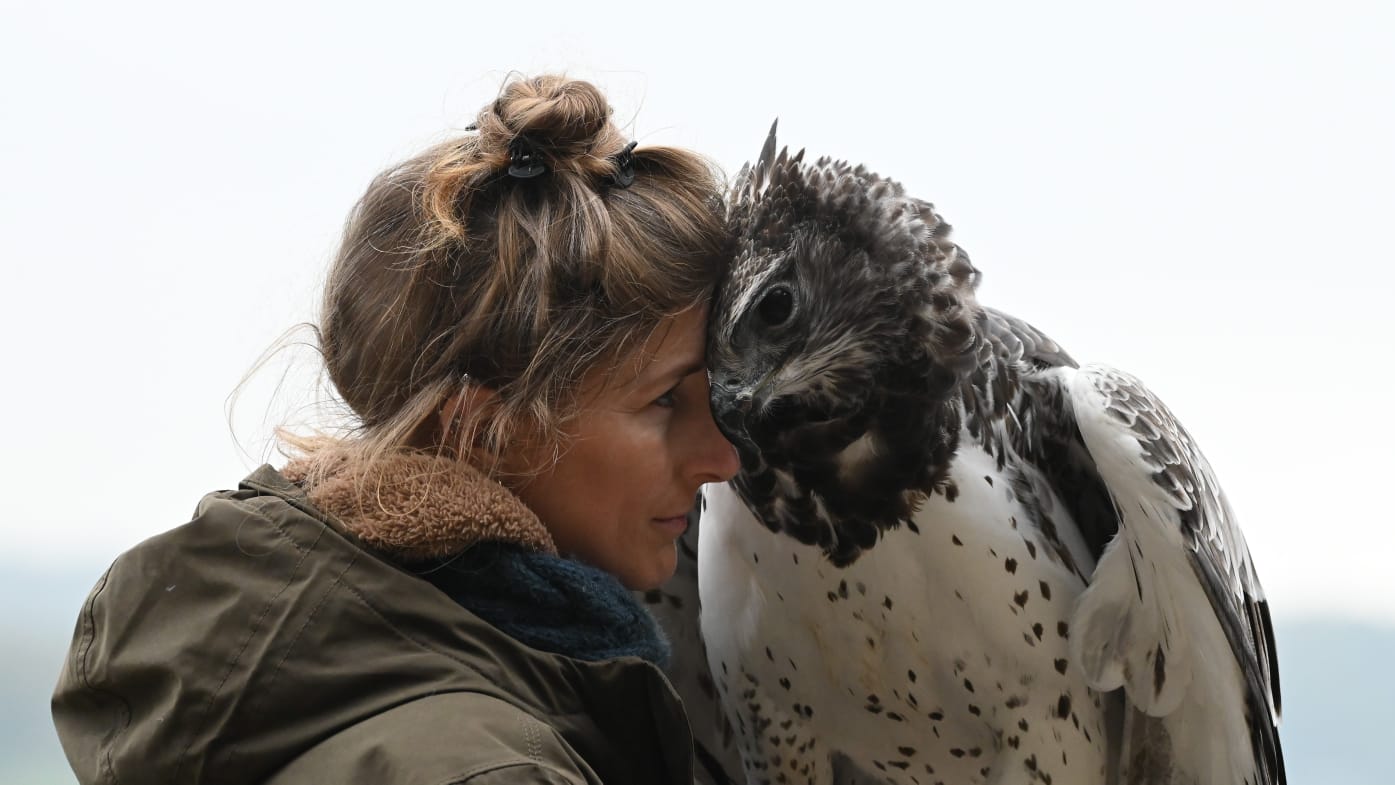
From a childhood fascination with birds of prey to almost seventeen years of work across several European countries, Nathalie Denolf speaks to SAYD about trust, the intelligence that continues to amaze her, and the line between care and exploitation. She shares experiences with her eagle Oropherion and advocates responsible falconry that puts birds’ welfare first, alongside conservation that reaches across borders.
Nathalie, how did your journey with birds of prey begin? What inspired you to dedicate your life to these magnificent creatures rather than pursue another career?
My fascination with birds of prey began when I was a very young child. There was always something about these magnificent creatures that captivated me, long before I ever imagined making a career out of working with them.
The real turning point came when I found myself face to face with my Golden Eagle. At that moment, I knew without a shadow of a doubt that this was what I wanted to dedicate my life to.
Growing up, I was actually a very shy person. But working with birds of prey gave me a confidence I had never known before. Around these animals, I felt completely at ease and didn’t need to be anyone other than myself.
Almost 17 years later, having worked with raptors across several European countries, that passion has only grown stronger.
Birds of prey didn’t just give me a career. They gave me a purpose.
In your videos, we see an extraordinary bond between you and the eagles, particularly Oropherion. How does such trust develop between a human and such a powerful bird of prey? Do you believe these birds are capable of expressing emotions similar to love and affection?
I believe the foundation of any meaningful relationship with a bird of prey is trust, patience, respect, and above all, understanding.
You cannot force an eagle to trust you. You have to earn that trust through consistency, communication, and by learning to understand the world from their perspective rather than expecting them to adapt to ours.
With Oropherion, that relationship has developed over years of working together. He knows what to expect from me, understands my intentions, and feels comfortable expressing his own preferences and boundaries.
As for love and affection, I absolutely believe birds of prey are capable of forming strong emotional bonds. Whether they experience love in exactly the same way humans do is something we cannot scientifically establish, but that doesn’t make their relationships any less meaningful.
Oropherion voluntarily seeks physical closeness, greets me by touching his beak to my nose, and often wraps me in his enormous wings.
These are behaviours he chooses to express, not something I demand from him.
And for me, that is what makes our relationship so extraordinary. He is an incredibly powerful, independent animal who has learned to trust me, and who chooses to share that closeness with me.
“You cannot force an eagle to trust you.”
Throughout your years of working with birds of prey, have you ever experienced a moment with a particular bird that completely changed your perception of their intelligence or personality? Is there a story you will never forget?
After almost 17 years of working with birds of prey, their intelligence still manages to intrigue and fascinate me.
One experience that stands out with Oropherion, my Martial Eagle.
On several occasions, strong winds have carried him into dense woodland. With a wingspan of approximately 2.2 metres, he cannot simply fly down through the tightly packed branches to reach me.
But rather than becoming distressed, he finds his own solution.
He moves through the forest canopy, following me from tree to tree while I walk underneath. We essentially navigate the forest together until we reach a clearing, where he immediately flies back onto my glove.
What fascinates me is his ability to assess the situation, adapt his behaviour, and work with me to overcome an obstacle.
Experiences like these remind me that birds of prey are far more intelligent and resourceful than many people give them credit for.
Or when given enrichment toys, they are so quick and problem-solving to figure them out.
And even after all these years, I still feel there is so much more for us to discover about their remarkable minds.
Some people believe that birds of prey belong in the wild, flying freely in the sky, rather than being trained or kept under human care. How do you respond to this debate? Where do you draw the ethical line between caring for a bird and exploiting it?
I absolutely agree that birds of prey belong in the wild, and ideally, that is where every species should be able to thrive. Unfortunately, the reality is that we humans have made much of their natural world increasingly unsafe.
We’ve destroyed habitats, depleted prey populations, poisoned food chains, and created countless dangers through human encroachment and persecution.
However, simply opening an aviary door and releasing a captive-bred bird is not necessarily giving it freedom. Without the appropriate survival skills and preparation, it could be a death sentence.
Responsible human care can play an important role in conservation breeding, education, research, and providing a safe home for birds that cannot survive in the wild.
I also strongly believe in the educational value of responsible, well-conducted flight displays. There is something incredibly powerful about witnessing a bird of prey in flight, seeing its natural abilities up close, and learning about the challenges its wild counterparts face.
That firsthand experience can turn curiosity into admiration, admiration into understanding, and ultimately, understanding into action. If someone leaves a display inspired to speak up for birds of prey or support their conservation, then we have achieved something truly meaningful.
But there is a very clear ethical responsibility attached to keeping these animals.
For me, the line between care and exploitation is crossed when human ambitions, entertainment, or financial interests are placed above the bird’s physical and psychological welfare.
A responsible falconer must understand the species, respect the individual bird’s needs and boundaries, provide appropriate living conditions, and allow opportunities to express natural behaviours.
My birds are not props that exist purely for human entertainment. They are living, intelligent individuals whose wellbeing must always come first.
The privilege of working with a bird of prey should never outweigh the responsibility we have towards it.
“My birds are not props that exist purely for human entertainment.”
You work closely with eagles, falcons, and owls, each with very different characteristics and behaviors. What surprises you most about their intelligence? Do you believe every bird has its own personality and a unique way of interacting with humans?
Absolutely! One of the things I love most about working with birds of prey is discovering just how different they all are, even individuals of the same species.
Some are incredibly confident and curious, others are cautious or shy. Some enjoy interacting closely with their falconer, while others prefer their independence. They all have their own personalities, preferences, and ways of communicating.
I find them remarkably perceptive. They notice subtle changes in our behaviour, body language, and routines, often responding to things we don’t even realise we’re communicating.
What surprises me most is that their intelligence is still so frequently underestimated, sometimes even by people who work with them professionally.
I believe we have barely scratched the surface of understanding their cognitive abilities.
The more opportunities we give these birds to think, explore, make choices, and express their individual personalities, the more they reveal to us just how extraordinary they truly are.
Based on your experience, what are the greatest threats facing birds of prey today? Do you believe current international conservation efforts are sufficient to protect them from illegal hunting, poisoning, and habitat loss?
Without a doubt, the greatest threats facing birds of prey today are caused by humans.
Habitat destruction, declining prey populations, illegal hunting, deliberate poisoning, electrocution on unsafe power lines, and wildlife trafficking are all taking a devastating toll on raptor populations worldwide.
What I find particularly heartbreaking is that these birds are often persecuted simply for doing what nature designed them to do: hunting to survive.
And no, I don’t believe our current conservation efforts are sufficient.
There are extraordinary organisations and individuals working tirelessly to protect these species, often with very limited resources. But conservationists cannot keep fighting an uphill battle while habitat destruction, persecution, and illegal wildlife trade continue around them.
We need stronger enforcement of existing wildlife protection laws, greater international cooperation, better education, and more investment in protecting habitats and addressing human-wildlife conflict.
We also need to recognise that conservation doesn’t stop at national borders. Migratory birds can travel thousands of kilometres, crossing numerous countries, and they need protection throughout their entire journey.
A bird protected in one country should not face being shot or trapped the moment it crosses into another.
Ultimately, conservation cannot succeed through the efforts of a few dedicated organisations alone. It requires governments, local communities, falconers, hunters, and the wider public to take responsibility.
We already know many of the threats these magnificent birds face. What we desperately need now is the collective determination to do something about them.
Falconry is an ancient tradition dating back thousands of years, with deep historical roots in both Europe and the Arab world. How can falconry and responsible hunting coexist with wildlife conservation? In your opinion, what distinguishes a responsible falconer from someone who exploits birds of prey?
Falconry has an extraordinary history, and I believe there is something very special about a tradition that has connected humans and birds of prey for thousands of years.
But tradition should never be used as an excuse to disregard animal welfare or conservation.
I believe responsible falconry and sustainable hunting can coexist with wildlife conservation, provided they are practised ethically, within the law, and with genuine respect for both the birds and the wider ecosystem.
For me, a responsible falconer is someone who puts the welfare of their bird above personal ambitions, understands its physical and behavioural needs, and is willing to dedicate the enormous amount of time and effort these animals require.
A responsible hunter must also understand the impact their activities have on wild populations and recognise that sustainability means taking only what nature can genuinely afford to lose.
What concerns me is when birds of prey become status symbols, disposable possessions, or tools for entertainment, rather than being treated as the extraordinary living creatures they are.
I also believe falconers have a unique opportunity to contribute to conservation. Our knowledge, experience, and passion can be powerful tools for education, research, and protecting wild raptors.
To me, the difference between a responsible falconer and someone who exploits birds of prey is simple: one asks what they can do for the bird, while the other only considers what the bird can do for them.
Ultimately, preserving the tradition of falconry should go hand in hand with preserving the birds and natural habitats that make that tradition possible.
Lebanon lies along one of the world's most important migration routes for birds of prey traveling between Europe and Africa. Unfortunately, some of these birds are illegally shot during their migration, sometimes simply for entertainment or photographs. What message would you like to send to those who shoot these magnificent birds?
Let me be absolutely clear: shooting a magnificent bird of prey for amusement, a photograph, or a trophy is an act of sheer cowardice. There is no skill, no bravery, and certainly no honour in killing a defenceless animal simply because you can.
Pulling a trigger against a creature that poses no threat to you does not make you powerful, brave, or more of a man. Quite the opposite. It exposes a complete lack of respect for life and everything that true courage and honour should represent.
These birds have travelled thousands of kilometres, overcoming extraordinary challenges, only to have their lives needlessly ended for someone’s entertainment.
A real measure of character is not how much power you have over a vulnerable creature, but whether you have the decency and compassion to let it live.
If you truly want to demonstrate strength and courage, put down the gun and stand up for the wildlife that cannot defend itself against you.
The Middle East Center for Sustainable Harvest and Anti-Poaching (MECSHAP), through its Anti-Poaching Unit (APU), works to protect migratory birds and combat illegal hunting. How important do you believe international cooperation between falconers, wildlife experts, and field conservation organizations is in protecting these birds throughout their migration routes?
International cooperation is absolutely essential. Wildlife does not recognise political borders, and neither should our conservation efforts.
We cannot expect to protect migratory birds successfully if we only safeguard them in certain countries while leaving them vulnerable elsewhere along their journey.
Falconers, wildlife researchers, conservation organisations, and anti-poaching teams all bring different expertise to the table. By sharing knowledge, migration data, resources, and practical experience, we can achieve far more together than any organisation could accomplish alone.
I have enormous respect for the people working on the ground to combat illegal hunting. Organisations such as MECSHAP and their Anti-Poaching Unit play an important role because protecting wildlife requires more than raising awareness. It also requires people willing to take action where these crimes actually occur.
As someone working in both falconry and conservation, I strongly believe we have a responsibility to bridge the gap between these communities and work towards a common goal.
Conservation should never be about individual recognition or competing organisations. It should be about combining our strengths to achieve what matters most: keeping these magnificent birds alive in the wild.
“Organisations such as MECSHAP and their Anti-Poaching Unit play an important role…”
Finally, if you could change just one thing about the relationship between humans and birds of prey, what would it be? And what message would you like to share with the readers of SAYD Magazine, particularly hunters and nature lovers across the Arab world?
If I could change just one thing, it would be the way humans perceive their place in the natural world.
We need to stop seeing ourselves as masters of nature and start recognising that we are part of it, with a responsibility to protect it.
Birds of prey have fascinated humanity for thousands of years. They represent strength, freedom, and extraordinary beauty, yet we continue to destroy the very habitats they depend upon and persecute them for simply following their natural instincts.
To the readers of SAYD Magazine, particularly the falconers, hunters, and nature lovers across the Arab world, I would say this: you have an extraordinary cultural connection to birds of prey, and with that heritage comes an equally extraordinary opportunity to help protect them.
Whether you are a falconer, a hunter, or simply someone who admires wildlife, your choices matter. Respect the animals you encounter, challenge illegal persecution, and pass on a genuine appreciation for nature to the next generation.
Tradition and conservation should never be enemies. The greatest legacy we can leave is not simply preserving our traditions, but ensuring that the wildlife which inspired them will still exist for generations to come.
And perhaps most importantly, remember that these magnificent birds do not belong to us. We are simply privileged to share this planet with them.
Photograph supplied by Nathalie Denolf for this interview.