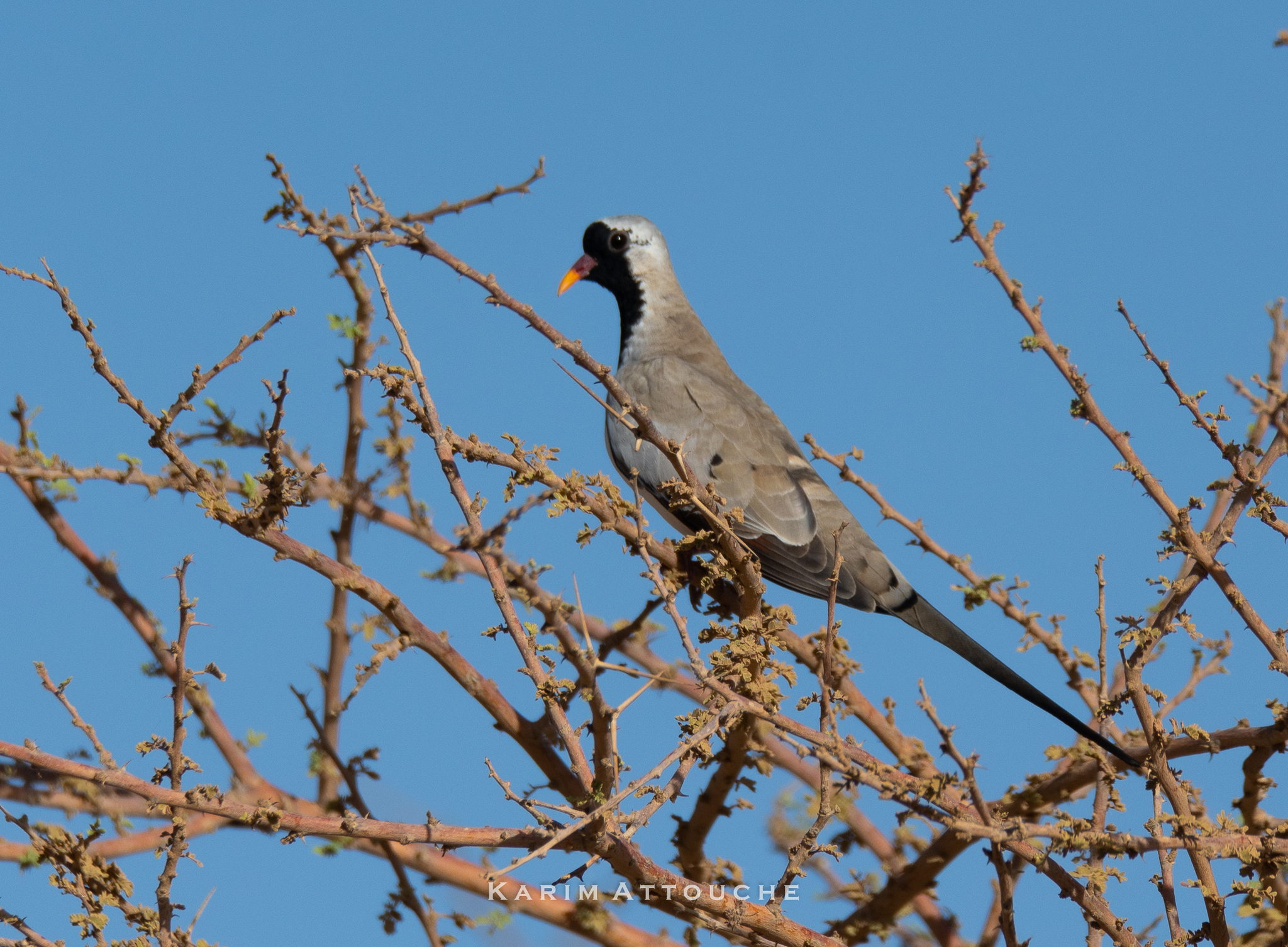
Oena capensis
A small dove with an unusually long tail
The Namaqua Dove, Oena capensis, belongs to the pigeon and dove family, Columbidae, but its proportions are quite unlike those of a familiar domestic pigeon. Its total length is about 28 centimetres, much of which is contributed by a long, pointed tail. The body itself is small and slender, with a little head and a delicate appearance. On the ground it walks in short steps while collecting seeds. Total length therefore gives a misleading impression of bulk when this bird is compared with a much heavier dove.
The adult male has a striking black face, throat and upper breast, contrasting with grey on the head and neck and white on the belly. His bill has reddish or orange colouring and a yellow tip. Dark spots on the wing can show blue or purple iridescence when the light catches them. That sheen is not visible from every angle, so its absence in a distant photograph is not an exclusion feature. Both sexes show chestnut colouring in the wings in flight, together with the distinctive trailing tail.
Females, young birds and possible confusion
The female lacks the male's extensive black mask and has a darker bill and less conspicuous overall colouring. Juveniles have more spotted or pale-edged plumage and can resemble the female more closely than an adult male. A bird without a black face is therefore not necessarily another species, and absence of the mask alone does not distinguish an adult female from a juvenile. Wing and shoulder feather patterns, bill colour, good photographs and the date all help to resolve that question.
Laughing and Eurasian Collared Doves are more substantial birds and do not combine this very long, narrow tail with such a small body. A rapidly passing Namaqua Dove can initially suggest a long-tailed songbird, particularly if its face is hidden. Identification should combine head size, wing shape, chestnut flight feathers and tail proportions. A damaged tail or the incompletely grown tail of a young bird can obscure the most obvious feature, making patient observation more useful than reliance on a single mark.
Uneven occurrence across Arab countries
The species ranges widely across sub-Saharan Africa, including the Sahel from southern Mauritania eastwards, Sudan, Somalia and other parts of eastern and southern Africa. Its Asian range includes the Arabian Peninsula and the southern margins of the Levant. Current taxonomy distinguishes the widespread African and Arabian subspecies from the Madagascan subspecies. An isolated observation beyond the familiar range should not automatically be interpreted as a new, established breeding population.
In Saudi Arabia it is a common breeding resident in suitable habitat. Its former concentration in the southwest, particularly the Tihamah and the edges of the highlands, has expanded with agricultural development into central and eastern areas and north towards Tabuk. Kuwait presents a different picture: it is described as an uncommon resident, a rare breeder and a scarce disperser in spring and autumn. Neither description justifies calling it uniformly common throughout the Gulf.
The range includes parts of Yemen, Oman and the wider peninsula, but numbers and persistence vary with habitat. It also reaches adjacent southern Jordan. The current taxonomic reference treats occurrence on Socotra as occasional, so a record on an island or at an isolated oasis is not in itself evidence of permanent residence. November can bring encounters with residents as well as local or winter movements. The species should not be assigned a single autumn migration schedule that supposedly explains every Arabian observation.
Habitat, seeds and access to water
Namaqua Doves use dry and semi-arid open country where exposed feeding surfaces occur alongside bushes or small trees offering shelter and nest sites. In southwestern Saudi Arabia they occupy acacia scrub and cultivation near villages; in central regions they are particularly associated with farmland. Bare dunes alone are not their typical habitat. Equally, the presence of a tree does not make a site suitable without accessible food and appropriate ground around it.
Small grass and herb seeds form the main diet, collected largely from the ground. Birds are often seen alone or in pairs, but water and particularly rich feeding patches can attract larger gatherings. Such concentrations do not establish that the birds nest colonially or occur at the same density across the surrounding landscape. Agriculture and reliable water can allow settlement in previously unsuitable places, while natural patches remain important parts of the species' habitat.
Pair formation and nest construction
Breeding birds form socially monogamous, territorial pairs. The male's low, quiet vocalisations can reveal a bird perched on an exposed branch before it is noticed visually. Breeding timing varies geographically and with conditions, including food associated with rainfall or cultivation. A breeding peak documented in southern Africa cannot simply be transferred to every Arabian site. The useful question is what the birds are doing locally, rather than whether a distant calendar says they should be nesting.
Both adults help construct a thin platform of twigs and rootlets, with finer material inside, usually low in a bush. The Saudi account records nests approximately 0.2–1.5 metres above the ground. The structure can appear remarkably slight compared with a deep songbird nest, but that is normal for this dove. Moving branches for a better view or trying to reinforce the platform is inappropriate: intervention can expose the eggs and alter the shelter chosen by the birds.
Eggs, nestlings and continued development
The Saudi account describes the usual clutch as two eggs, while African references include clutches of one or two. Both parents incubate, with incubation lasting about 13–16 days. They also share care of the young. The Saudi account gives a nestling period of roughly 12–16 days. These are approximate developmental intervals, not deadlines for handling or removing a chick. Leaving the nest also does not demonstrate complete feeding independence at that same moment.
Two or three broods may be produced when conditions permit, but this does not mean every pair succeeds that often each year. Replacement nesting after failure is different from raising successive successful broods, and distinguishing the two requires careful, non-disruptive observation. Young birds begin with plumage unlike that of fully developed adults, and their appearance changes as they grow and replace feathers. A recently fledged youngster being fed is stronger evidence of local breeding than the presence of an adult pair alone.
Conservation and responsible November observations
The global conservation category is Least Concern, LC. Its extensive range and ability to benefit from some agricultural development do not guarantee the security of every local population. Indiscriminate shooting is identified as a local threat in Kuwait. Finding birds near a farm does not grant access to that property, and a global threat category does not determine national hunting law. Scientific status, land access and legal protection remain separate questions.
For a useful November record, note the number of birds, apparent sex and age, the resource they are using and whether they remain on subsequent visits. Observe from a distance that leaves routes to water open and does not cause repeated flushing. Avoid playback and close inspection of bushes that may hold nests, and do not publicise active nest locations. These details turn an attractive photograph into a record that helps distinguish established residents from birds simply passing through.
Photo: karim Attouche / iNaturalist (CC0 1.0)