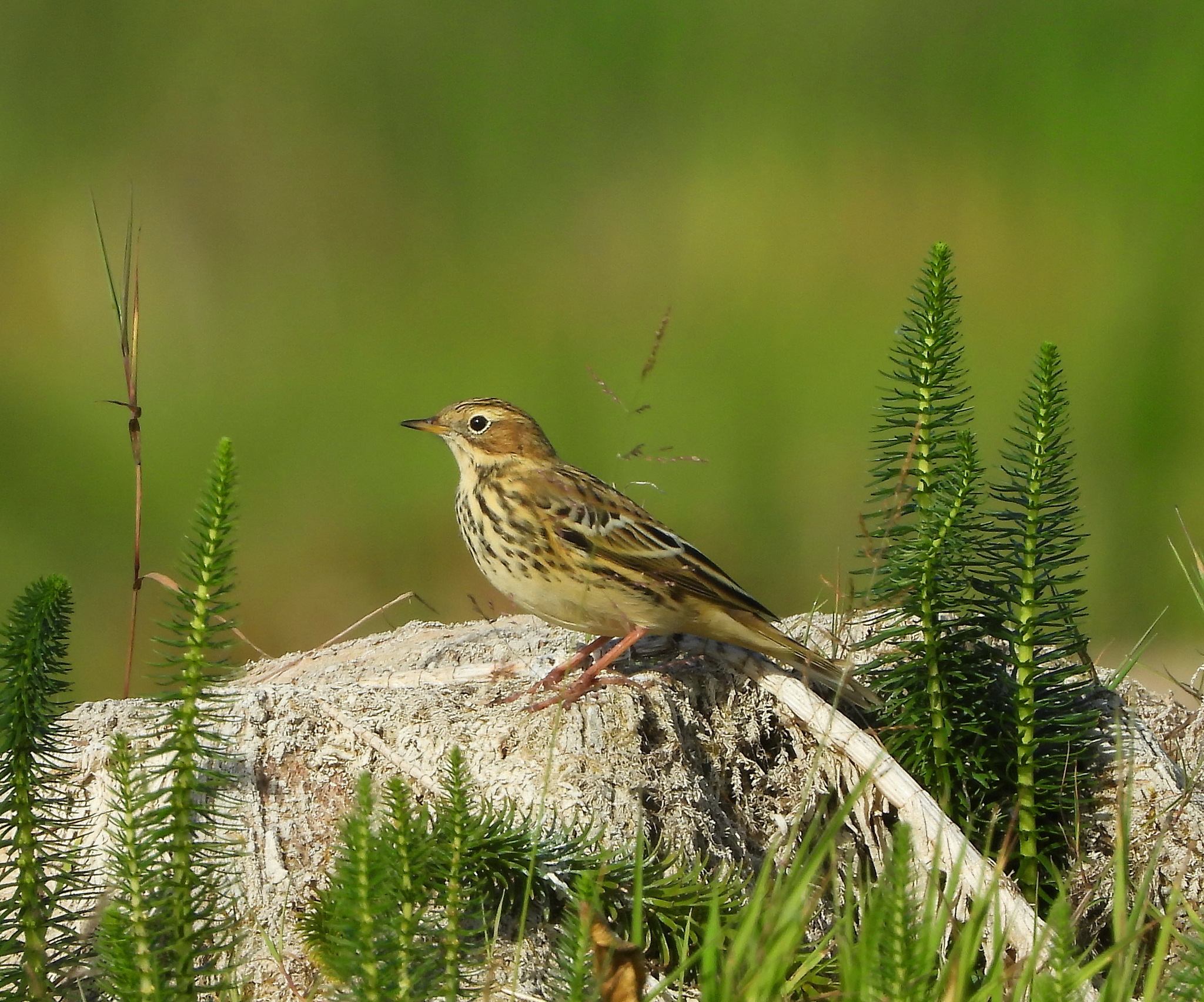
Anthus pratensis — An open-country passage migrant and winter visitor
Name and identity
The Meadow Pipit belongs to the wagtail and pipit family Motacillidae, order Passeriformes. AviList 2026 recognises Anthus pratensis. Kuwaiti references use the Arabic name Jushnat al-muruj, while the Lebanese guide uses Jushnat al-huqul. The scientific name connects records made under these different names. Pipits can look remarkably similar at a distance: plumage, proportions, voice and habitat work together in identification, rather than the mere presence of a small brown bird in a field.
Identification
Olive-brown upperparts contrast with pale underparts bearing conspicuous breast streaks that continue down the flanks. The legs are pinkish, the bill fine and the hind claw long and relatively straight. The sexes look alike in the field; separating first-year birds from adults requires close examination of moult limits and wing and tail feathers, not a distant photograph. Tree Pipit has a heavier bill, finer flank streaks and a shorter, more curved hind claw. The unstreaked rump also helps separate Meadow Pipit from first-winter Red-throated Pipit. Pale outer tail feathers show in flight, although several pipits share this feature.
Habitat, food and behaviour
It uses pastures, meadows, open farmland, wetland margins and grassy saltmarshes. Walking through low vegetation, it picks up insects, larvae, spiders and other small invertebrates, adding seeds especially outside breeding. A mixture of short grass and denser cover provides neighbouring feeding and sheltering places. Small flocks occur in autumn and winter; disturbed birds rise with thin calls. On the breeding grounds, the male climbs into the air and descends slowly in a parachuting song display, often making an otherwise inconspicuous bird easier to locate.
Breeding and parental care
The grass-built cup nest lies on the ground, usually screened by surrounding vegetation. British BTO records give a typical clutch of four or five eggs, incubated by the female for 13–14 days, with young leaving at roughly 12–14 days after hatching. Both parents provision them and care continues after nest departure, which is not immediate nutritional independence. Two broods may be raised. These reference durations from breeding areas are not evidence of nesting in Lebanon, where the species is principally relevant on passage and in winter. Ground nests and young should be left undisturbed.
Distribution and migration in the Arab region
Its breeding range extends from northwestern and northern Europe to western Russia, with wintering populations moving south into North Africa and Asia. The 2026 Lebanese guide classifies it as a common winter visitor and passage migrant, recorded from early October to mid-April, particularly on the coast and in the Beqaa. Early November therefore falls within its expected season. Kuwait’s rarities committee instead describes it as a scarce passage migrant and winter visitor. Open country in North Africa and the eastern Mediterranean forms part of its winter range, but arrival dates and abundance vary with country, site and weather; this does not imply residence throughout the Gulf.
Ecological role and conservation
It participates in grassland food webs as an invertebrate consumer and prey for raptors. Conservation data incorporated in AviList 2026 classify it as Least Concern, although declines are documented in parts of Europe. Pressures include altered grazing management, habitat loss, agricultural intensification and illegal hunting. Retaining varied vegetation, field margins and wetland edges is preferable to creating uniform ground cover. Arab-region observers contribute useful records by documenting dates, locations, numbers and diagnostic photographs of birds using winter habitats.
References
AviList Core Team — AviList v2026, 20 October 2026.
Ramadan-Jaradi & Itani — Birds of Lebanon: A Photographic Guide to 409 Species, second edition, UNDP, 2026.
Kuwait Ornithological Rarities Committee — Kuwait Bird List.
British Trust for Ornithology — BirdFacts: Meadow Pipit.
LPO PACA — Le Pipit farlouse.
Game & Wildlife Conservation Trust — Meadow pipit: farmland habitat management.
Blasco-Zumeta & Heinze — Aranzadi bird identification, ageing and sexing guide: Anthus pratensis.
Photo: Лариса Артемьева — CC0 1.0.