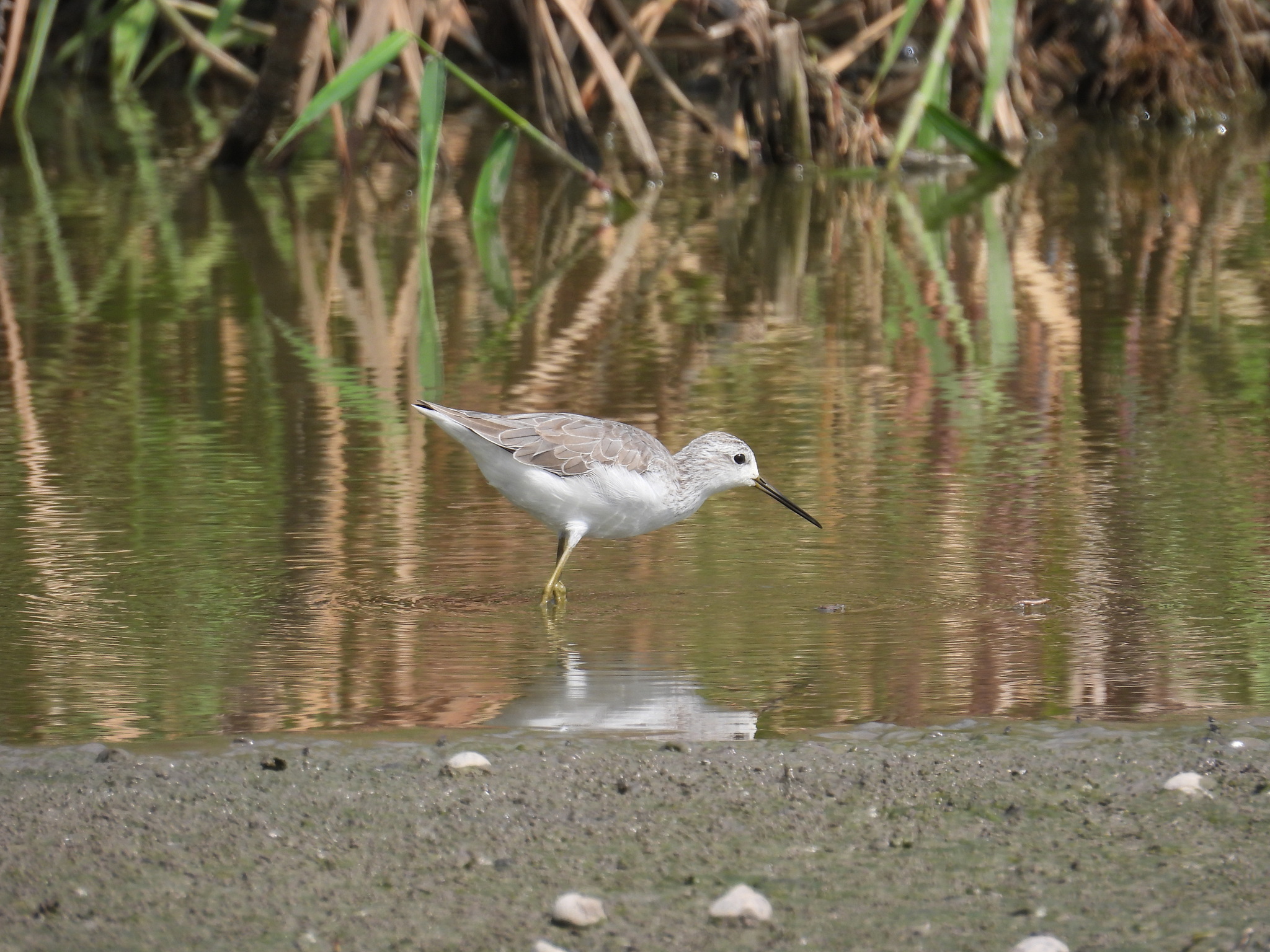
Tringa stagnatilis — a slender migrant of shallow wetlands
Name and classification
The Marsh Sandpiper, Tringa stagnatilis, belongs to the family Scolopacidae and order Charadriiformes in AviList 2026. The Lebanese guide calls it Darijat al-mustanqaʿat; Kuwaiti references also use names meaning marsh or wetland sandpiper. These regional names identify the same notably slender wader. Its breeding range extends across parts of eastern Europe, Russia and Kazakhstan to north-eastern China, while wintering populations occupy a broad belt from Africa through southern Asia to Australia.
Field identification
Its straight black bill is exceptionally fine, its long legs greenish or yellowish, and its slender neck gives it an upright, graceful stance. Winter adults have pale grey upperparts, white underparts and a pale face; breeding plumage gains darker spotting. The sexes look similar. Juveniles are browner, with pale margins to the back feathers. In flight, white extends from the rump up the back and the feet project beyond the tail. Common Greenshank is more heavily built, with a thicker, slightly upturned bill. Bill structure considered together with leg length also helps separate it from Wood Sandpiper.
Habitat, food and behaviour
It uses lake margins, marshes, pools and flooded grasslands, feeding in shallow water and exposed mud. Inland wetlands are particularly important, although coastal sites also support migrants and winter visitors. It takes insects and their larvae, molluscs and other small invertebrates, and its long legs allow it to wade deeper than smaller, shorter-legged waders. Birds search while walking, alone or in gatherings that can include other species. Suitable feeding patches shift with water levels: an entirely flooded basin does not necessarily offer the same opportunities as its shallow margins.
Breeding and life cycle
In its northern breeding range it selects open marshes and wet grassland, nesting from late April into June according to locality and weather. The nest lies low among vegetation or on a small rise and is lined with dry grass. Pairs may occur in loose aggregations, sometimes close to other waders. The Romanian Ornithological Society describes clutches of three to five eggs, incubated by both sexes. Timing varies across the breeding range. Its winter presence in the Gulf belongs to a different stage of the annual cycle, centred on feeding, survival and preparation for the next migration.
Both parents continue caring for the young after hatching. The scientific account of Kazakhstan’s birds records hatching in June and early July, followed by the onset of flight in late July within that geographical range. Juveniles there migrate later in summer, after adults have begun leaving. This sequence follows development from parental care to flight and migration without turning the Kazakh calendar into a fixed chick age or a universal breeding schedule.
Arab distribution and November
The 2026 Lebanese guide treats it as a scarce passage migrant and very rare winter visitor, using the coast, estuaries, islands and wetlands. Kuwait’s endorsed national list classifies it as a common passage migrant and winter visitor, as does the Oman database. In Saudi Arabia it is an uncommon passage migrant and winter visitor; the national reference specifies winter occurrence from November to February. Egypt and the Nile Valley form part of its African range; range lists also document it in other Arab countries of the Levant, Arabian Peninsula and North Africa. Early November is therefore an appropriate winter observation period in Kuwait and Oman, whereas a Lebanese winter record merits careful documentation. Abundance within a country varies with water, food and disturbance.
Conservation and responsible observation
Its current global category is Least Concern, LC. Pressures include wetland drainage, pollution, altered management and disturbance. Feeding links aquatic invertebrates with higher levels of the food web, while conservation benefits from protecting a network of passage and wintering sites. Observers should wait at an existing viewing edge rather than follow a bird through its feeding area, and stop approaching if it repeatedly moves away or interrupts feeding. Record the date, location and number present, ideally with a side view showing the bill and legs; these details are more useful than a close image obtained by chasing it.
References
AviList Core Team — AviList v2026, 20 October 2026.
Ramadan-Jaradi & Itani — Birds of Lebanon: A Photographic Guide to 409 Species, second edition, UNDP, June 2026, p. 174.
Kuwait Ornithological Rarities Committee — Kuwait Bird List; Birds of Oman — national species database.
Societatea Ornitologică Română — Tringa stagnatilis species account.
Naturalis Biodiversity Center — Birds of Europe: Tringa stagnatilis.
National Parks Board, Singapore — Marsh Sandpiper; Convention on Migratory Species — Tringa stagnatilis.
National Center for Wildlife — The Birds of Saudi Arabia, volume 2, Marsh Sandpiper, p. 149.
Gavrilov, E. & Gavrilov, A. — The Birds of Kazakhstan, Tethys Ornithological Research II, 2005, p. 66, species 184.
Photo: Stephen Matthews — CC0 1.0.