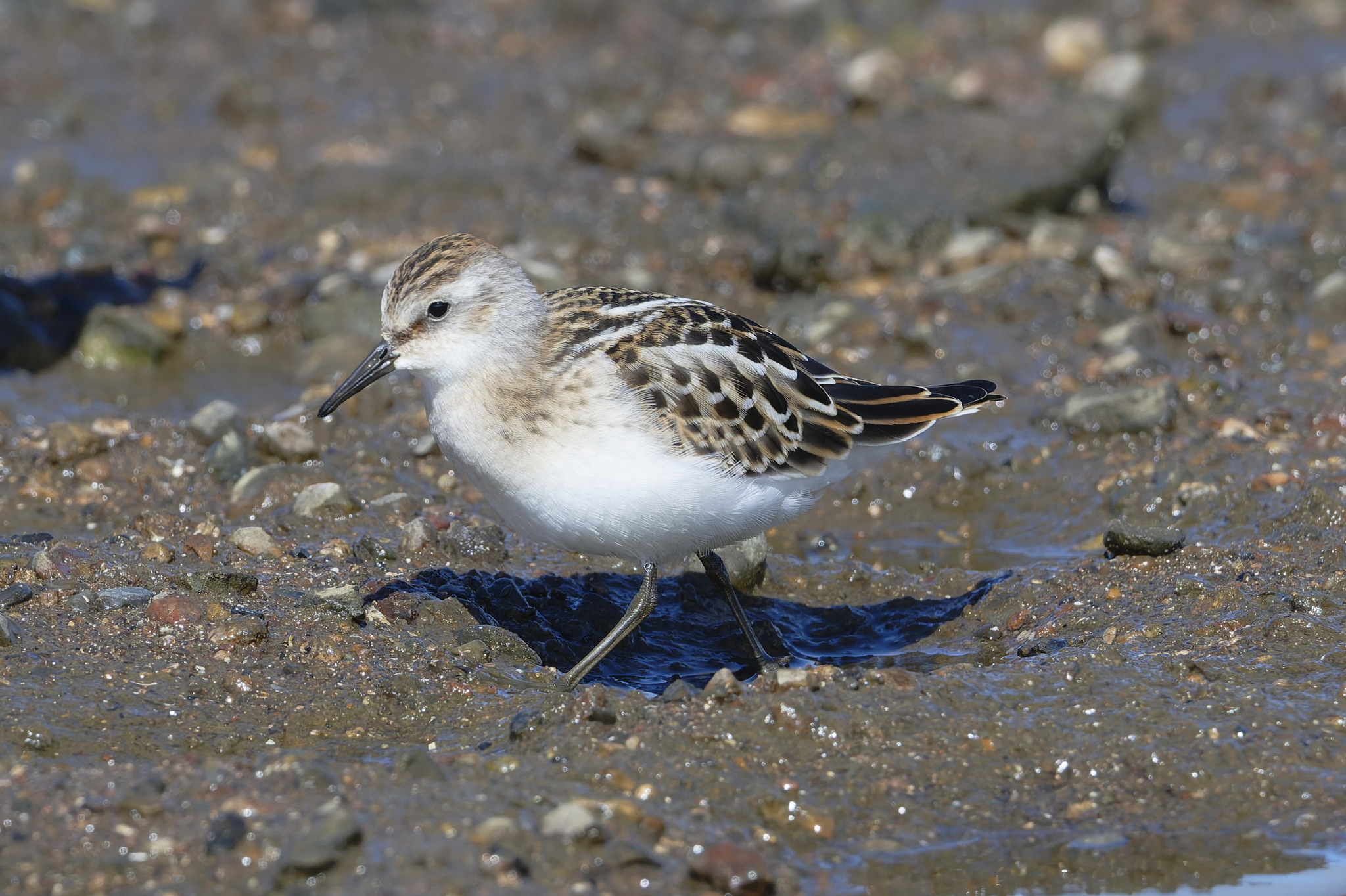
Calidris minuta — A tiny shorebird linking Arctic tundra with Arab passage and winter shores
Identity and recognition
The Little Stint, Calidris minuta, is a tiny shorebird in the family Scolopacidae, with a fine straight black bill, black legs and white underparts. Approximately 12–14 cm long, it is markedly smaller than the Dunlins that may accompany it. Plumage changes seasonally: breeding birds show rufous tones on the head and upperparts with dark markings, while winter birds become predominantly grey above. Bill, body and leg proportions remain useful when the warm colours have faded.
Age, sex and similar species
The sexes look similar in the field. Juveniles have pale feather edges and light lines on the back that can form a V-shaped pattern, appearing more patterned than winter adults. Temminck’s Stints have paler olive or yellowish legs; Dunlins have longer, more curved bills. Sanderlings are larger and much paler in winter. Red-necked Stints can be particularly similar outside breeding plumage. Unusual records therefore benefit from clear photographs showing several views rather than identification based only on breast colour.
Habitats, diet and behaviour
Exposed mud, lake margins, lagoons, saltpans and intertidal flats provide feeding habitat in fresh and saline water. It runs quickly and picks small prey from the surface or extremely shallow water. Foods include insects and their larvae, crustaceans, small molluscs and worms. It may join mixed flocks, then gather at resting sites when rising water covers the feeding flats. A bare shore is consequently not empty ground for this bird: it is a feeding surface supported by small animals and the timing of mud exposure.
Breeding and life cycle
Breeding takes place on northern Eurasian tundra, far from Arab passage and wintering sites. A typical clutch contains four eggs; incubation lasts roughly 20–25 days and young fly at approximately 15–21 days. Chicks hatch down-covered and mobile. Arctic studies describe a system in which one parent can care for a clutch alone; a female may leave one clutch with a male and tend another. Summer invertebrate availability provides resources for rapid chick growth.
Arab-region distribution and seasonality
Lebanon’s 2020 checklist records common spring and autumn passage, the latter from early August to late October. In Qatar it is a common passage migrant and winter visitor recorded in every month; Oman lists abundant passage and winter occurrence. The UAE national assessment distinguishes birds staying for winter from those continuing south, with some immatures remaining through summer. Western wintering sites extend to Mauritania, where waterbird counts document its presence. Late October may thus mark the end of passage in one country and the beginning of a longer stay in another.
Ecology and conservation
Its global category is Least Concern, but dependence on successive safe sites makes shore and roost protection important throughout the journey. The UAE assessment identifies potential pressures from changing coastal land use and oil pollution. As an invertebrate consumer and prey for raptors, it participates in wetland food webs. Unreclaimed mudflats, clean shallow water and quiet resting sites help maintain habitat functions. A crowded flock at one location does not by itself establish the trend across an entire migratory flyway.
References
Naturalis — Birds of Europe: Calidris minuta
RSPB — Little Stint identification
New Zealand Birds Online — Little stint
BTO — BirdFacts: Little Stint
Tulp and colleagues — Body mass patterns of Little Stints, Ibis (2002)
Ramadan-Jaradi and colleagues — Updated checklist of the birds of Lebanon, Sandgrouse 42 (2020)
Qatar Bird Observation Group — Little Stint
Birds of Oman — species database
UAE National Red List of Birds (2021) — Calidris minuta
Revue Marocaine des Sciences Agronomiques et Vétérinaires 2(1) (2014) — Mauritanian waterbird counts
CMS — Calidris minuta species account
Photo: Лариса Артемьева — CC0-1.0.