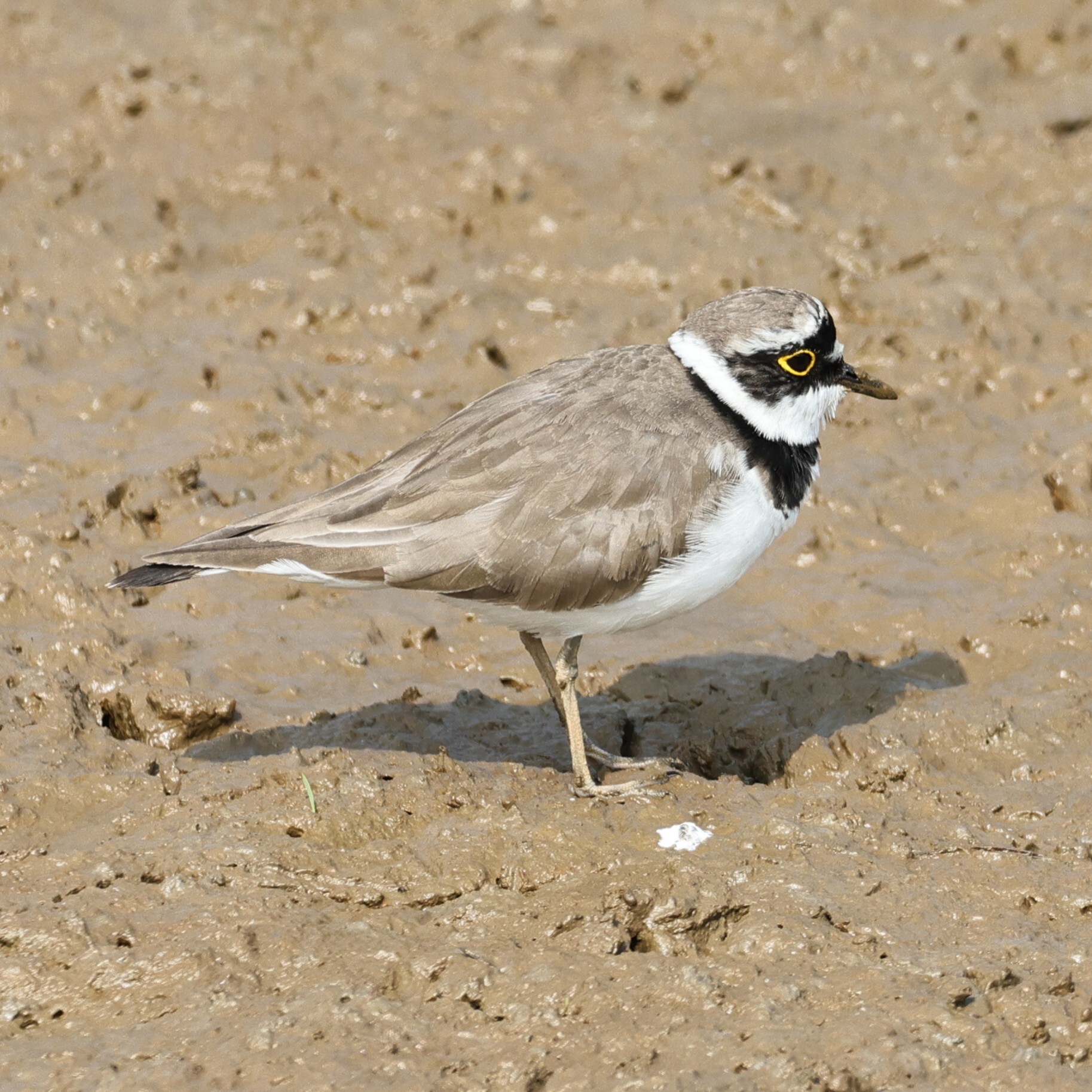
Thinornis dubius
Identity and identification
Little Ringed Plover belongs to Charadriidae in the order Charadriiformes. Its Arabic name is الزقزاق المطوق الصغير and its French name Petit Gravelot. The accepted scientific combination is Thinornis dubius; many references use the older Charadrius dubius for the same species. At about 14–17 cm, it is a delicately built plover with a slender dark bill, grey-brown upperparts and white underparts. Its yellow eye-ring is particularly conspicuous in breeding plumage.
Breeding adults show a dark breast band and a black-and-white head pattern. The female’s markings are usually less black; juveniles and non-breeding birds are duller and their breast band may weaken or become incomplete. An incomplete band alone therefore does not establish Kentish Plover. Compared with Common Ringed Plover, look for the dark bill, finer build, eye-ring and absence of a conspicuous white wingbar. Use several characters rather than leg colour alone.
Habitat, food and behaviour
Open freshwater margins are important: river shingle, small islands, and the edges of pools and reservoirs. Flooded gravel workings and other artificial sites can provide habitat where suitable bare ground remains. Coastal and muddy habitats are also used during movements; a freshwater preference does not mean exclusive dependence on fresh water.
It hunts small invertebrates with short runs, pauses and picking movements, sometimes trembling a foot to disturb hidden prey. Small, loose groups may gather. Watching feeding behaviour explains why a shallow, exposed edge matters, rather than simply the area of open water. Water can remain while the usable margin disappears.
Breeding and development
The nest is a simple ground scrape, with eggs that blend remarkably well with stones. BTO gives a usual clutch of four eggs, with recorded extremes of three to five. Both parents incubate, typically for 24–25 days; young normally reach flight age about 25–27 days after hatching.
Downy chicks become mobile early. Leaving the egg site therefore does not mean independence or an ability to fly. These are general developmental intervals, not a universal breeding calendar. A summer adult alone is not proof of nesting: evidence should be reliable and collected without endangering birds.
Range and Arab occurrence
The range extends from Europe and North Africa across Asia. Northern populations migrate to Africa, southern Asia and Southeast Asia, while parts of southern Asia hold resident populations. In the Arab region, the 2026 Lebanon guide describes a rare summer breeder and common passage migrant on wetlands, islands and shores. Oman’s official list records an uncommon breeder, passage migrant and winter visitor. These categories describe genuine national differences; the Omani breeding category does not establish that every individual is resident. Kuwait’s rarities committee list describes an uncommon passage migrant, scarce winter and summer visitor, with breeding recorded previously.
What November means
In November, passage and wintering should be distinguished. A bird at suitable Omani habitat fits the recorded winter status, whereas Lebanon’s seasonal description does not justify expecting a regular winter population. Record numbers, dates, shoreline conditions and water levels: a single visit cannot distinguish a brief stop from a longer stay. Duller November plumage still retains useful identification characters.
Conservation and responsible observation
Globally the species is Least Concern (LC), but individual sites remain vulnerable. The Lebanon guide identifies habitat loss, pollution and illegal hunting among pressures. Walking across gravel or reshaping banks can affect the places it needs. Observe with binoculars from an established route, avoiding exposed islands and searches for eggs. If a bird repeatedly retreats or alarms, move away rather than press closer for a photograph. A quiet shoreline is a significant conservation resource.
References
British Trust for Ornithology — BirdFacts: Little Ringed Plover; BOURC — 58th Report, Ibis 168, 2026; Bird Society of Singapore — Little Ringed Plover; UNDP / ABCL / Ministry of Environment — Birds of Lebanon, second edition, 2026, p. 146; Oman Birds Rarities Committee — Official Bird List, seasonal table; Hong Kong Wetland Park — Little Ringed Plover; Kuwait Ornithological Rarities Committee / AbdulRahman Al-Sirhan — Annotated Arabic checklist, 20 September 2026.
Illustrative species photograph: Lihai Song, iNaturalist, CC0 1.0.