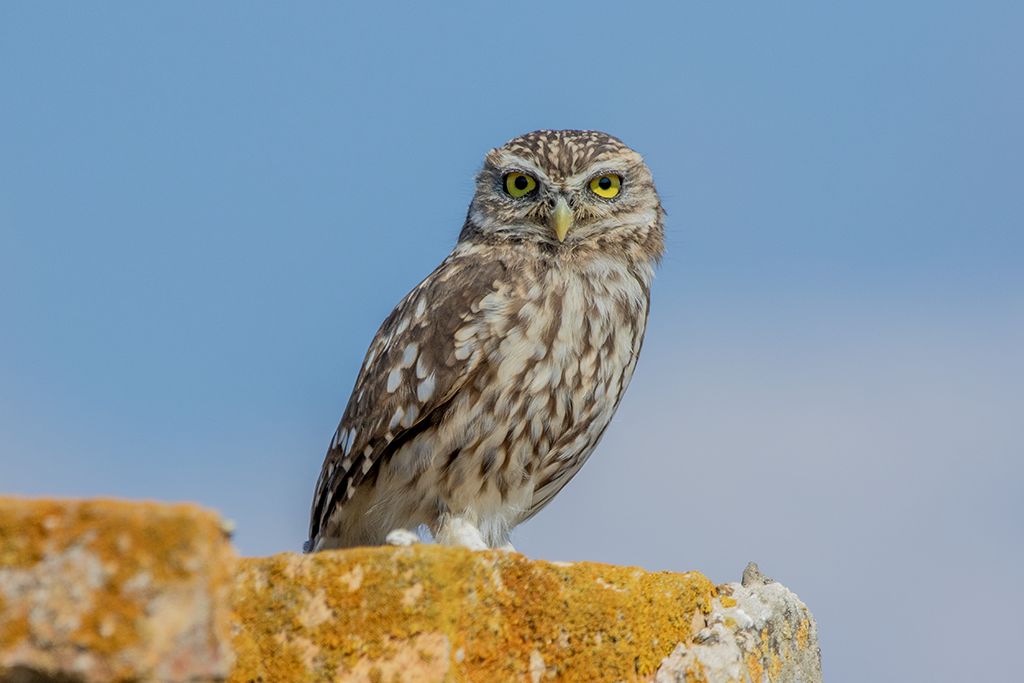
Athene noctua — A small resident owl in diverse Arab habitats, active at night and dusk and sometimes visible by day
Identity and recognition
The Little Owl, Athene noctua, belongs to the family Strigidae and is also called sada in Saudi references. A compact body, short tail and broad, flat-looking head combine with yellow eyes and pale eyebrows to give it a stern expression. Brown to grey-brown plumage is spotted with white above and streaked below. Birds may sit openly by day on rocks, trees or buildings, bobbing their heads when alert. The species inhabits diverse environments across North Africa, the Levant, Arabia and much of Eurasia.
Age, sex and similar species
Males and females share similar plumage; females tend to be slightly larger, with considerable overlap in measurements. Young birds have softer, shorter and relatively paler feathers, and facial appearance and markings develop with growth and moult. The broad head without prominent ear tufts, spotted upperparts and undulating flight help distinguish it from small Otus owls with a different outline. Plumage shades vary among regions and subspecies, with many dry-country birds relatively pale. Subspecific identification requires locality and detailed characters, since colour alone can mislead.
Habitat, food and behaviour
Semi-open country, farmland, orchards, rocky ground and semi-desert provide habitat, together with cavities and lookout perches. Activity is especially marked around dusk and at night, although birds may also hunt in daylight. Prey includes beetles and other invertebrates, small mammals, reptiles and birds, taken from a perch or during a short ground pursuit. Its small size accompanies considerable dietary flexibility. Low vegetation facilitates access to prey, while old trees, walls and rock crevices provide hiding and nesting places close to feeding areas.
Breeding and life cycle
Eggs are laid in a cavity such as a rock crevice, tree hole or building, and sites may be reused. The Saudi reference describes a typical single brood of three to five eggs, approximately 28–33 days of incubation and about 30–35 days in the nest. The female incubates and tends small chicks while the male brings food; both parents’ participation in care expands as the young grow. These are reference values that vary among populations and conditions. Pairs may remain in their territory year-round, while young disperse in search of places to settle.
Arab-region distribution and seasonality
Lebanon’s 2020 checklist records a breeding resident in many mountain areas and the Beqaa; Jordan’s list also records residence. In Saudi Arabia it is a widespread but uncommon breeding resident, using low rocky areas and cultivated land. AviList 2026 illustrates substantial regional differentiation: glaux occurs in North Africa; saharae in parts of the Maghreb, western Egypt and Arabia; lilith in the inland Levant south to southern Sinai; and bactriana reaches Iraq. Other subspecies occur on Sudan’s coast and in Somalia. Late October forms part of resident occurrence in these habitats; visibility may change with activity and local dispersal of young rather than the arrival of distant migrants.
Ecology and conservation
Little Owls consume rodents and invertebrates within natural and agricultural food webs, requiring both prey and safe cavities. AviList 2026 lists global Least Concern, while some European populations have documented declines associated with changing habitats and resources. Retaining hollow trees, rocky nesting sites and prey-rich margins helps support them. Quiet observation from a suitable distance allows people to enjoy the birds while leaving resting sites and nests undisturbed.
References
AviList Core Team — The Global Avian Checklist, v2026
British Trust for Ornithology — Little Owl: identification, ecology and conservation
British Trust for Ornithology — Little Owl Monitoring Guide
RSPB — Little Owl
Saudipedia — Little Owl (2023), citing The Birds of Saudi Arabia
Ramadan-Jaradi and colleagues — Updated checklist of the birds of Lebanon, Sandgrouse 42 (2020)
Jordan BirdWatch — Jordan Bird List (2020)
UK Little Owl Project — Spotter’s Guide
Photo: Carlo Caimi — CC0-1.0.