Egretta garzetta — Identification, habitats, breeding and occurrence in the Arab region
Identity and identification
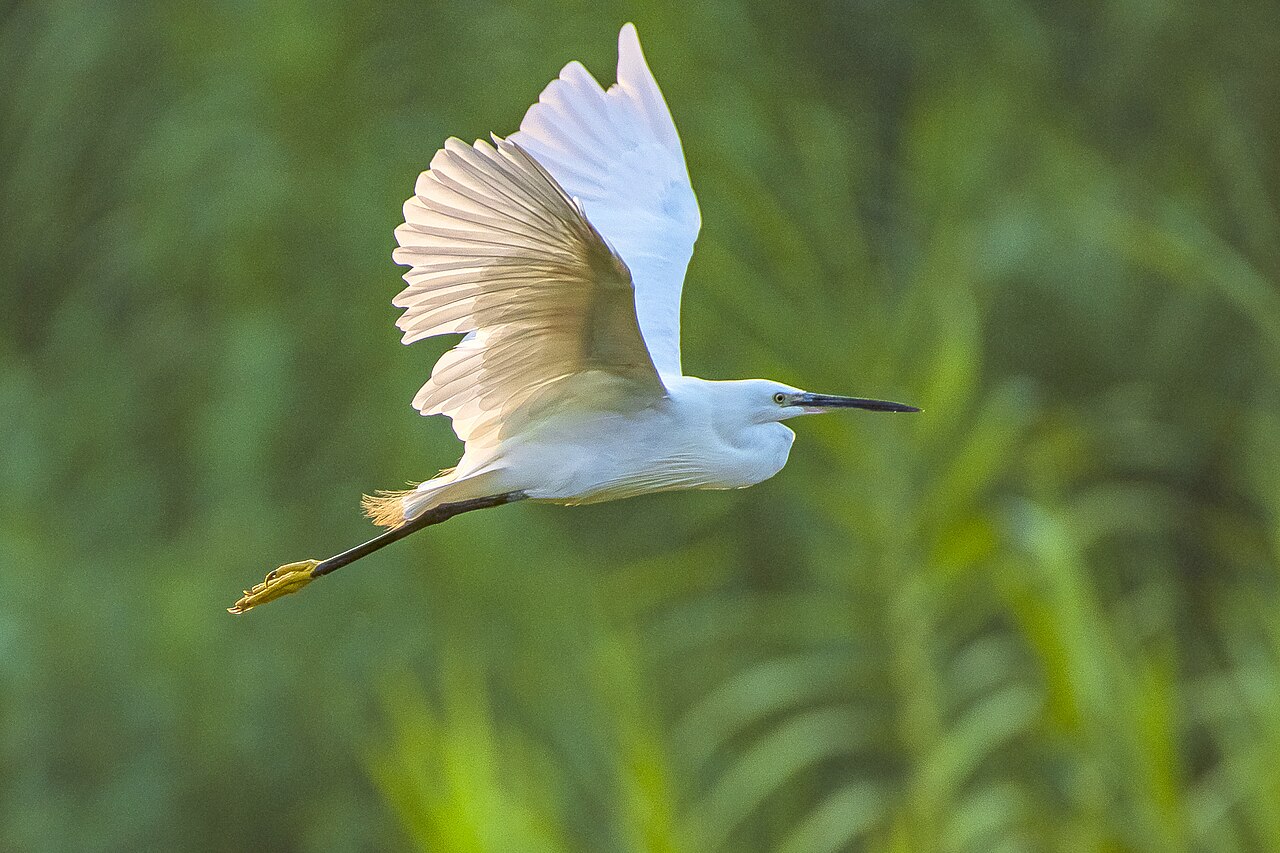
The Little Egret, Egretta garzetta, belongs to the heron family Ardeidae in the order Pelecaniformes. It is a slender white waterbird, approximately 55–65 cm long, with a fine dark bill, long neck and dark legs. In the regional nominate population, yellow feet usually contrast sharply with the black lower legs. Mud, shade and immersion can conceal this useful feature.
Male and female look alike; a solitary bird cannot normally be sexed confidently from plumage. Breeding adults acquire two long, narrow nape plumes and delicate ornamental feathers on the breast and back. Bare facial skin and feet can become more brightly coloured during courtship. Young birds lack the adults’ full ornaments and may have greener legs and duller feet. A white bird without long plumes is therefore not necessarily a juvenile.
Great Egret is much larger and longer-necked. Cattle egrets are more compact, with shorter, thicker-looking necks and usually yellow bills outside the youngest stages. On Arabian and Red Sea coasts, white Western Reef Herons require particular care: bill shape, leg proportions and the complete combination of features matter more than white plumage or yellow feet alone. This account treats reef herons separately rather than following older sources that lumped them with Little Egret.
Habitat, food and behaviour
It favours accessible shallow water: marsh edges, river margins, lagoons, estuaries, mudflats and irrigation channels. Rice fields and fishponds can also provide feeding sites. Suitable roost trees and secure nesting cover may be separate from the feeding area, so conserving one small pool is not always enough.
Its hunting is often lively. The bird walks, pauses, runs after prey or stirs the bottom with a foot to flush hidden animals. Small fish, crustaceans, aquatic insects and other small aquatic animals are taken with quick bill strikes. It can feed alone or in loose gatherings while defending a productive patch. At night, birds may gather at shared roosts. In flight the neck folds back and the legs extend behind. Rough calls are most evident when birds are disturbed or interacting.
Breeding and life cycle
Little Egrets often nest colonially, sometimes with other herons, in trees or shrubs and occasionally other sheltered vegetation. A platform of twigs supports the eggs. Breeding dates depend on local climate and water conditions rather than a single calendar throughout the range. A typical clutch contains 4–5 eggs. Both parents incubate for about 21–22 days and feed the dependent young. First flight is generally around 40–45 days; climbing away from the nest can precede this. These are useful typical figures, not guarantees for every nest.
Distribution and regional seasonality
The species occurs widely across Africa, Europe and Asia into Australasia. Some populations migrate; others remain resident or disperse after breeding. Arabia receives passage and winter visitors, but local breeding occurs, including a documented Saudi breeding record in 2020. In the Mashriq, Lebanon supports passage and wintering birds and has confirmed local breeding. Egypt combines resident breeders with seasonal movements; Lake Nasser colonies are documented. In the Maghreb, breeding populations and seasonal visitors coexist, including confirmed nesting in Morocco. Presence throughout a year does not by itself prove that the same birds stayed.
Ecology and conservation
This small predator participates in wetland food webs and responds to the availability of shallow feeding water. Its global status is Least Concern, despite local pressures. Wetland drainage, coastal reclamation, pollution and removal or disturbance of nesting vegetation can reduce suitable habitat. Protecting roosts, colonies and feeding shallows together is more useful than protecting a photograph opportunity. Watch quietly from a distance and avoid flushing birds or approaching nests.
References
British Trust for Ornithology. BirdFacts: Little Egret.
New Zealand Birds Online. Little egret.
IUCN. Atlas of the Coastal and Seabirds of Lebanon, 2021.
OSME. Region List, version 10.1, 2024.
Hering and collaborators. Large breeding colonies of herons, egrets and Glossy Ibis at Lake Nasser, Egypt. Alauda 88, 2020.
Ramadan-Jaradi and collaborators. Updated Checklist of the Birds of Lebanon. Sandgrouse 42, 2020.
Fareh and collaborators. Phénologie des Ardéiformes de la zone humide Fouarat de Kénitra, Maroc. 2015.
Qninba and collaborators. Nidification de l’Aigrette garzette dans la retenue de barrage d’Al Massira-Laâyoune en 2009. Go-South Bulletin 6.
IUCN SSC Heron Specialist Group. Little Egret: natural-history account; historical taxonomy not followed.
Photo: Stefania.foto6 / Iaia quark — CC0 1.0.