Anser erythropus
A small goose requiring careful identification
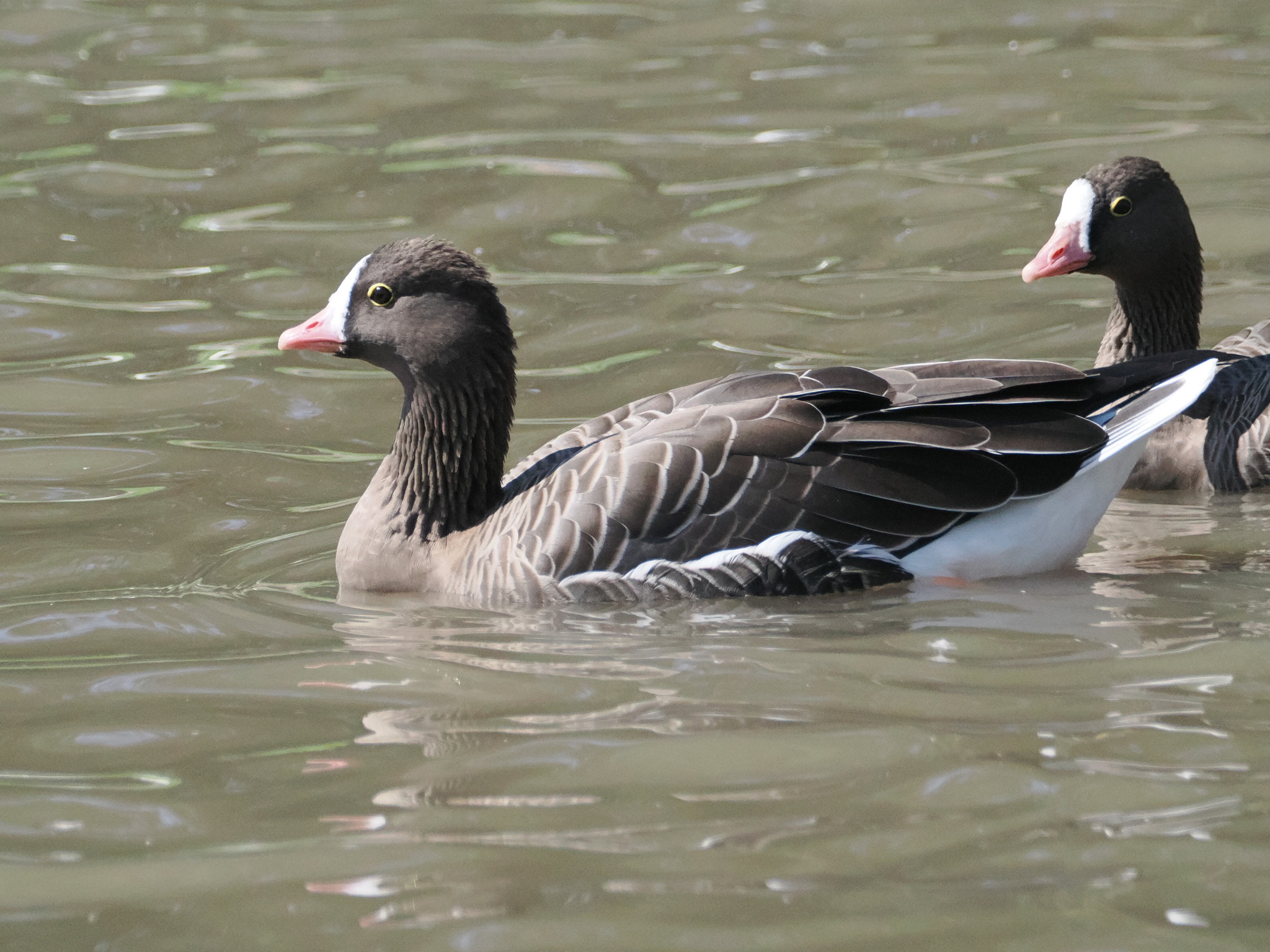
Lesser White-fronted Goose Anser erythropus is a compact grey-brown goose with a short pink bill, steep forehead and conspicuous yellow eye-ring. Adults have a white blaze rising above the bill and irregular dark marks across the belly. The sexes are similar in plumage; males average somewhat larger, but this is not a reliable character for sexing a lone bird in the field.
The principal confusion is Greater White-fronted Goose. Lesser has a shorter bill and a more compact head and neck, while the adult forehead blaze usually reaches higher. Body size alone is unsafe without a useful comparison, and the eye-ring must be seen clearly rather than inferred from a blurred photograph. Juveniles lack the full adult white forehead and dark belly pattern, making age an important part of identification. A young Lesser should not be rejected merely for lacking adult markings.
Tundra breeding habitat and winter feeding grounds
Its breeding environments include low-Arctic tundra and forest-tundra, often with dwarf shrubs, lakes, streams and sedge marshes. Some birds nest in hilly or rocky terrain rather than on a uniform flat tundra plain. Nearby wet meadows and low vegetation provide feeding opportunities. The species therefore links terrestrial grazing habitat with water used for refuge and rest.
During migration and winter it uses short vegetation in coastal meadows, saltmarshes, steppes and other open ground. Agricultural land has replaced much natural habitat in parts of its non-breeding range. A field used for grazing and a wetland used for roosting can be separate parts of the same essential daily landscape; safeguarding one without the other may leave an important gap.
Food, flocking and family life
The diet is predominantly plant-based, including grasses, sedges and other terrestrial or aquatic vegetation, with agricultural grains also taken in winter. The short bill allows close cropping of low growth. Feeding habitat is not interchangeable simply because it looks green: plant composition, accessibility and disturbance affect its value. Birds may feed alongside other geese, which can conceal a few Lesser White-fronted Geese within a much larger flock.
Pairs maintain strong bonds, and young can remain associated with their parents until the next breeding season. Outside nesting, flocking brings individuals together at feeding and resting sites. These family associations are useful to observers but should not encourage approaching closely; repeated displacement costs feeding time and can separate birds from suitable cover or refuge.
Breeding and the flightless period
Nesting is generally by separate pairs, with a ground nest near water, sometimes sheltered by low shrubs or rocky terrain. It is not characteristically a colonial breeder nesting around raptors. The female incubates while the male remains nearby. The British Waterfowl Association gives a usual clutch of 4–6 eggs and incubation of 25–28 days; other reference works give wider clutch ranges. These figures describe normal variation rather than a fixed output for every pair.
The downy young leave the nest before they can fly and must grow while moving between feeding and resting areas. Adults also have a flightless wing-moult period. Quiet refuges with accessible food consequently matter beyond the days of egg incubation. Seeing birds in a northern wetland during summer does not by itself show that they are successful breeders: non-breeders can make separate moulting movements.
Several migration systems
The breeding range runs discontinuously from northern Fennoscandia across Russia into eastern Siberia. Eastern birds largely winter in China, while western populations use routes towards south-eastern Europe, the Caspian region and the Middle East. Kazakhstan provides important staging areas for western birds. The small Fennoscandian population is a distinct conservation focus within this wider picture, and its movements should not be used as a template for every individual of the species.
Tracking and field surveys have clarified routes, but gaps remain, particularly across parts of the wintering range. Reintroduced Swedish birds wintering in the Netherlands also need to be distinguished from naturally established migration systems. Such distinctions matter when interpreting observations: the same species name does not mean that every flock has the same origin, route or conservation history.
Arab-country occurrence: wintering and vagrancy
Iraq is a documented wintering country in the OSME regional synthesis and international species accounts. It forms part of the western population's non-breeding range, not its Arctic nesting range. The available evidence does not justify extending this wintering status to every neighbouring Arab country or assuming that all Iraqi wetlands hold the species regularly.
Oman's official list classifies Lesser White-fronted Goose as a vagrant; OSME records a bird at Khawr al Mughsayl in January–March 2023. For Jordan, OSME cites the first record at Aqaba in February 2017. It also notes occurrence in the United Arab Emirates without establishing regular seasonality. Egypt's EORC 2019 checklist accepts wild occurrence in Category A, but that category is not a wintering-frequency classification. These are different kinds of evidence and should remain separate in any regional account.
Threats, documentation and responsible observation
The global category reported by BTO is Vulnerable. Unsustainable killing, loss or alteration of feeding and roosting habitat, and disturbance affect populations across their migration routes. Resemblance to the more numerous Greater White-fronted Goose makes identification relevant to conservation as well as birdwatching. Protection has to follow the birds between breeding grounds, staging sites and winter refuges.
BTO also notes escapes from waterfowl collections, so an unusual record requires consideration of origin as well as identification. Record rings if visible without disturbing the bird, companions, behaviour, date and locality; neither tameness nor the absence of a ring proves origin. The photograph accompanying this account shows a captive bird and illustrates appearance, not wild occurrence at an Arab locality.
BTO BirdFacts: Lesser White-fronted Goose · British Waterfowl Association: Lesser White-fronted Goose · University of Nebraska–Lincoln: Lesser White-fronted Goose · WWF Finland: Lesser White-fronted Goose ecology · Japan Biodiversity Center: Lesser White-fronted Goose · OSME Region List 10.2: non-passerines · EORC: Checklist of the Birds of Egypt, 2019 · Oman Bird Records Committee: official bird list
Photo: andrew2285