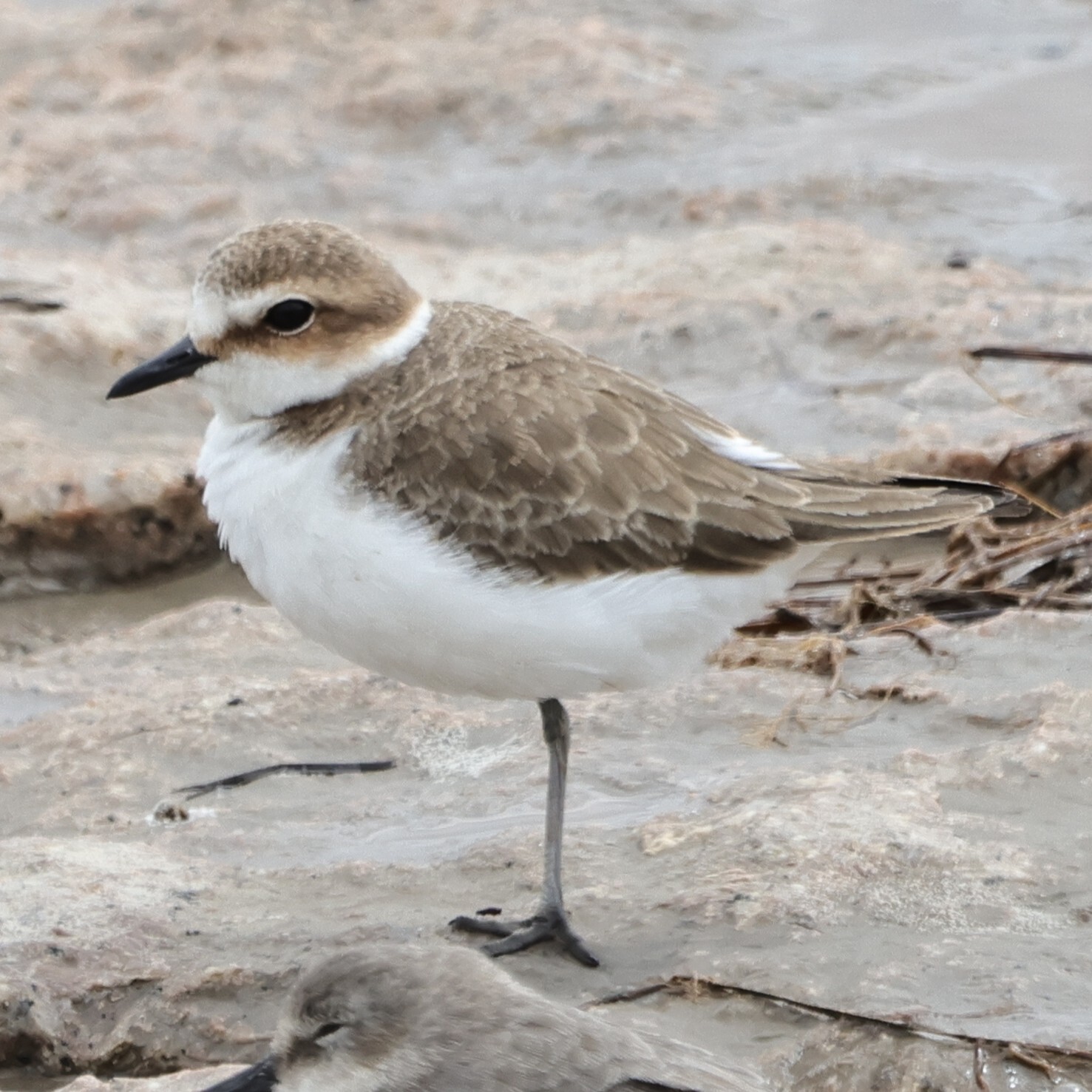
Anarhynchus alexandrinus
Identity and identification
Kentish Plover is a small coastal bird of Charadriidae, order Charadriiformes. It is called الزقزاق الإسكندري in Arabic and Gravelot à collier interrompu in French. Its scientific name is Anarhynchus alexandrinus; older references place it in Charadrius. About 15–18 cm long, it has sandy upperparts, white underparts, a slender black bill and dark legs. Its most striking breast character is the gap between two lateral patches, instead of a continuous black band.
Breeding males have black head and breast markings and reddish colouring on the head and nape; females are browner and less contrasting. Pale feather edges give juveniles a scaled appearance above. Ages and sexes become less distinct in autumn, so a distant photograph does not justify confident assignment. A white wingbar shows in flight. Non-breeding Little Ringed Plover requires care because its breast band can also be incomplete: eye-ring, bill, legs and wings complete the comparison.
Habitat, food and behaviour
Sandy or shingly beaches, saltflats, saltpans, saline lake margins and estuaries provide habitat, generally with low, sparse vegetation. Apparently empty sand contains food, resting places and sometimes exceptionally well-camouflaged nests. Suitable inland sites are used too; the species is not confined to the sea edge.
Its food includes insects, spiders, worms, small crustaceans and molluscs, varying with locality and season. It picks prey from the surface and damp sand, alternating short runs with searching pauses. Outside breeding, groups may join other waders. Looking across the whole flock reveals the different small-scale feeding habitats shared by its members.
Breeding and development
The usual clutch is three eggs, occasionally four, in a shallow ground depression. A BirdLife Cyprus review gives incubation of 24–27 days and flight at 27–31 days after hatching. Both parents incubate. Downy chicks move soon after hatching but need protection and care before they can fly.
These figures describe development, not a single breeding calendar for every Arab coast. Walking chicks are not necessarily abandoned: approaching may separate them from their parents. Nesting areas are best protected by leaving them undisturbed, rather than seeking nests or exposing eggs for photographs.
Range and Arab occurrence
The range spans substantial parts of Eurasia, North Africa and the Arabian Peninsula. Northern populations move south in winter while others remain closer to their breeding areas. Oman’s official list records a common breeder and abundant passage migrant and winter visitor. The 2026 Lebanon guide instead describes a rare-to-scarce passage migrant and rare summer visitor, with occasional non-breeders in June and July on the coast and at Palm Islands, Aammiq and Lake Qaraoun. This does not establish Lebanese breeding or regular wintering. Kuwait’s committee list describes a common resident breeder, another clear indication that the Lebanese pattern does not represent the whole region.
What November means
The distinction matters in November. Suitable Omani coasts may support winter arrivals alongside regional birds, while a late Lebanese observation should not automatically become evidence of winter residency. Repeat visits recording tides and numbers are more useful than assuming one seasonal pattern everywhere. Check breast and wing characters on each bird rather than relying only on its sandy appearance.
Conservation and responsible observation
The global category is Least Concern (LC), although local populations may decline without a change in that category. Pressures include loss of natural shores, pollution, disturbance and illegal hunting. Vehicles, dogs and recreational groups crossing open ground can make otherwise suitable resting or nesting habitat unusable. Respect closures and safe distances, keep dogs restrained, and never chase flocks into flight. Quiet ground above the waterline matters alongside wet feeding habitat.
References
British Trust for Ornithology — BirdFacts: Kentish Plover; Oiseaux.net — Gravelot à collier interrompu, 2026; BirdLife Cyprus — JEF Report, December 2024, species ecology section; UNDP / ABCL / Ministry of Environment — Birds of Lebanon, second edition, 2026, p. 149; Oman Birds Rarities Committee — Official Bird List, seasonal table; Kuwait Ornithological Rarities Committee / AbdulRahman Al-Sirhan — Annotated Arabic checklist, 20 September 2026.
Illustrative species photograph: Lihai Song, iNaturalist, CC0 1.0.