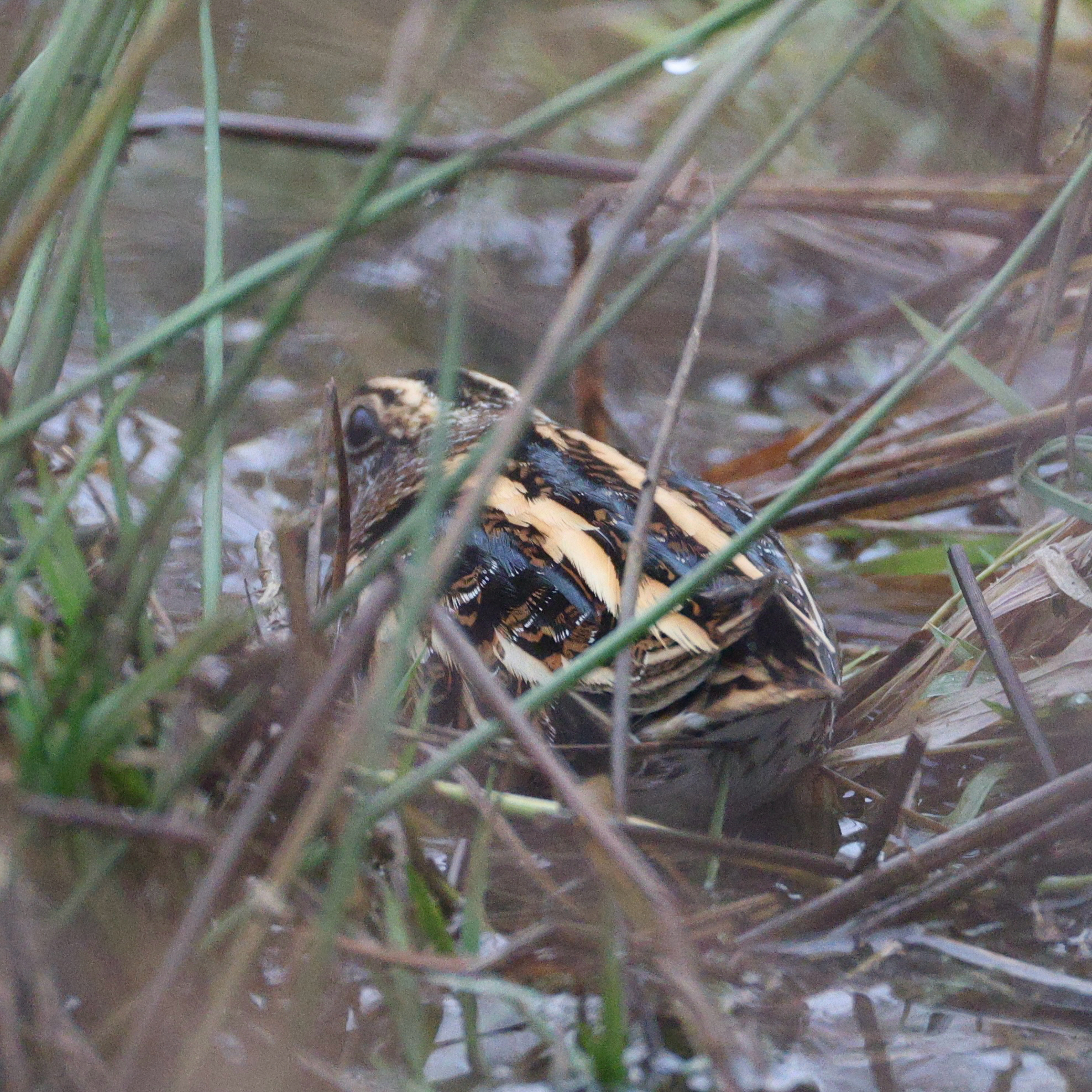
Lymnocryptes minimus
Identity and identification
Jack Snipe Lymnocryptes minimus belongs to Scolopacidae. Smaller and shorter-billed than Common Snipe, it has a compact body, conspicuous pale back stripes and a dark crown lacking Common Snipe’s pale central stripe. Camouflage plumage does not permit sex or exact age to be assigned from every photograph.
Habitat and food
It hides in damp vegetation, eating insects, worms and snails. Repeated body-bobbing accompanies feeding. It may remain still until danger approaches; deliberately flushing it to test this behaviour is inappropriate.
Breeding and development
It breeds in northern marshlands with a concealed ground nest. BTO gives a typical clutch of four eggs and female incubation of 17–24 days. Downy chicks become mobile early; movement does not establish flight capability.
Arab occurrence and seasonality
Lebanon’s 2020 checklist describes a rare migrant and scarce winter visitor from mid-October to late April, noting that concealment may suppress sightings. Qatar’s current list also gives scarce winter status. November falls within its winter visitor period; few records do not establish absence.
Observation and conservation
Waterlogged soils and vegetation provide food and concealment. Quiet photography at a distance is preferable to repeatedly forcing the bird into flight.
British Trust for Ornithology — BirdFacts: Jack Snipe · RSPB — Jack Snipe · Ramadan-Jaradi et al. — Updated checklist of the birds of Lebanon, Sandgrouse 42 (2020) · Qatar Bird Observation Group — Qatar Bird List · AviList Core Team — Global Avian Checklist v2026, 20 October 2026
Species illustration: Istvan Sipos — CC0 1.0. · 1 · https://creativecommons.org/publicdomain/zero/1.0/