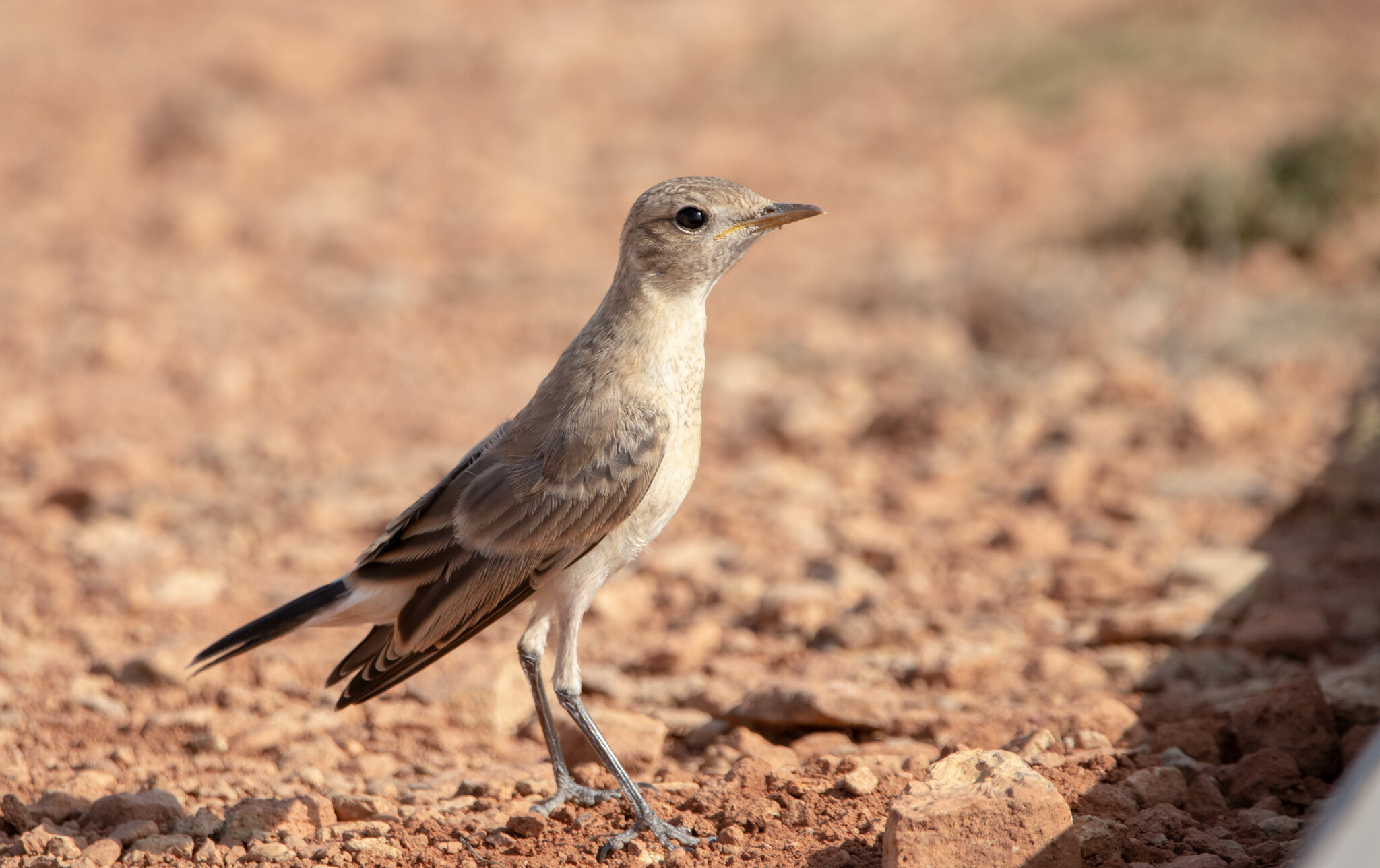
Oenanthe isabellina
Identity and identification
Isabelline Wheatear Oenanthe isabellina belongs to Muscicapidae. Pale sandy plumage accompanies an upright stance and relatively long legs. A dark wing patch and black-and-white tail are useful. Unlike Desert Wheatear, the tail is not predominantly black; head shape, eyebrow and voice help with other wheatears. It is placed in the order Passeriformes. The IUCN category carried in AviList 2026 is Least Concern (LC).
Habitat, food and behaviour
It uses steppe, dry open ground and sparsely vegetated pasture. Running and pausing on the ground, it collects insects and small invertebrates. Stones and soil clods provide lookouts. Dependence on ground invertebrates links it to habitat quality even in apparently sparse terrain.
Breeding and parental care
A suitable burrow or ground cavity holds the nest, sometimes using small-mammal burrows. Plant material lines the chamber and adults bring food to young. Care continues after nest departure. A bird near a hole does not prove that it excavated it or occupies it for breeding.
Range and Arab occurrence
It breeds across steppe from southeastern Europe through western and central Asia and migrates or winters farther south. Lebanon has summer breeding in the northern Beqaa and passage. Winter records occur in parts of the Arab region, but national statuses should not be transferred indiscriminately.
Seasonality and observation
Lebanon’s checklist places spring passage from mid-February to early May and autumn passage beginning in August. November sightings require country and site context rather than the breeding calendar alone. Tail, wing and bill photographs improve documentation.
Ecological role and conservation
It consumes invertebrates and is affected by steppe conversion, grazing that removes habitat variety and vehicles over burrow sites. Varied open ground is preferable to uniform levelling. Leave holes unopened: they may shelter birds or other animals.
References
Ramadan-Jaradi et al. — Updated checklist of the birds of Lebanon, Sandgrouse 42 (2020), 186–238.
Royal Commission for AlUla — Birds of AlUla, Isabelline Wheatear.
AviList Core Team — AviList: The Global Avian Checklist, v2026 (20 October 2026).
Photo: Юрий Носков — CC0 1.0.