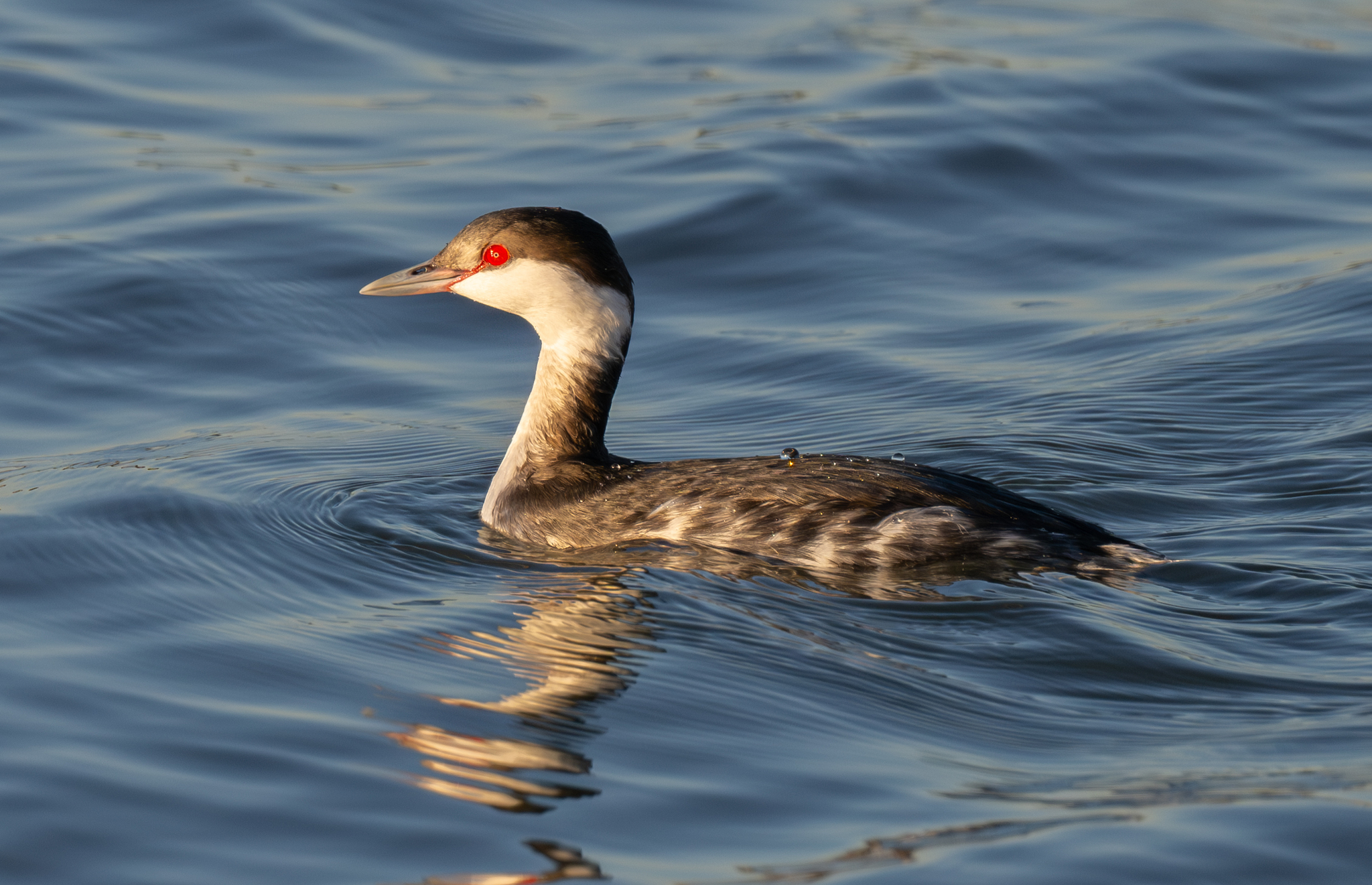
Podiceps auritus
Horns made of feathers
The Horned Grebe, Podiceps auritus, is a relatively small member of the grebe family, measuring 31–38 centimetres. Horned Grebe and Slavonian Grebe are two English names for the same species, not separate birds. Its horns are golden to orange feather tufts projecting from the sides of the head in breeding plumage.
Its natural range spans large parts of northern Eurasia and North America. Breeding is associated with freshwater, while many populations use coastal waters in winter. A broad global range does not make it common on the southern Mediterranean or in the Levant: country, season and local status are essential to interpreting a sighting.
Plumage, age and sex
In breeding plumage, chestnut neck and flanks contrast with a dark head, red eyes and prominent golden tufts. Winter removes the ornaments and brings pale cheeks and throat below a dark cap and grey back. The bill remains relatively short, straight and pointed, very different from the broad bill of a duck.
Males and females look similar and are difficult to separate in the field despite average size differences. Chicks have striped heads, and juveniles gradually approach the nonbreeding appearance. Missing tufts do not identify a female, and a red eye alone is not enough to establish the species.
Careful comparison with Black-necked Grebe
The two species can look very similar in winter. Horned tends to have a flatter or more squared head, a straight and stronger bill, and cleaner white cheeks beneath a sharply defined dark boundary. Black-necked Grebe, Podiceps nigricollis, often has a steeper, more peaked forehead, a finer upturned-looking bill and more grey on the face.
Head shape changes with feather position and viewing angle, so several characters should be combined. Horned is smaller than Red-necked Grebe and lacks the latter’s conspicuous yellow bill base. In rough water or at long range, an unresolved identification is more accurate than a rare-species label without sufficient evidence.
A diver between ponds and coasts
For breeding it uses shallow ponds and lakes combining open water with emergent vegetation such as sedges and reeds. Winter habitat includes coastal seawater and sometimes inland lakes and reservoirs. A bird may remain in a suitable area or move as food availability changes; resurfacing elsewhere does not necessarily mean that another individual has appeared.
Food includes insects and their larvae, crustaceans, small fish and other aquatic prey, with seasonal differences. Rear-positioned feet and lobed toes provide underwater propulsion but make walking on land awkward. The bird needs open water for take-off; an exhausted individual should never be driven to fly simply to test its ability.
Courtship, nesting and chick development
Pair displays include parallel swimming, head shaking, spreading the head ornaments and presenting plants. Partners cooperate in choosing and building a nest of wet vegetation in shallow water, usually among plant cover. Birds are territorial near the nest and may defend the area vigorously, making distant observation preferable to entering the vegetation.
BTO gives a typical clutch of four or five eggs and an incubation period of about 22–25 days. Both parents contribute to care, carrying chicks on their backs and feeding them after hatching. The same reference places fledging at roughly 55–60 days: swimming much earlier does not mean that chicks can leave the wetland by air.
Lebanese records and November expectations
The 2026 Birds of Lebanon guide, covering records through December 2025, treats Horned Grebe as a vagrant, with two records: the Damour river mouth on 20 December 1996, and an artificial pond in Tyre Coast Nature Reserve on 28 September 2004. This is documented rarity, not evidence of annual migration or breeding in the country.
Knowing winter plumage helps distinguish this rare visitor from Black-necked Grebe, which occurs more regularly in Lebanon. Cold November weather alone cannot predict its arrival at a particular site. For a possible sighting, clear side views of the head and bill, together with date, habitat and count, provide useful evidence for specialist review.
A threatened species needs more than a photograph
BTO lists the species globally as Vulnerable, VU. Documented threats include wetland loss and degradation, drought, oil pollution and entanglement in fishing gear. The recent Canadian COSEWIC assessment discusses these pressures on Canadian populations; its local figures must not be presented as numbers for rare Arab occurrences.
Clean water, vegetation and undisturbed resting areas all matter. Boats should not surround birds or separate chicks from their parents, and sensitive nest sites should not be publicised as photography destinations. Dead or entangled birds should be reported to the appropriate authority rather than handled indiscriminately in ways that may cause further harm.
Further reading: Birds of Lebanon, second edition, 2026; British Trust for Ornithology; RSPB; Cornell Lab of Ornithology; Audubon; University of Michigan Animal Diversity Web; COSEWIC status report, Canada, 2023; Alaska Department of Fish and Game.
Photo: Claude Lyneis / iNaturalist, CC0 1.0, Richmond, California, United States, 14 January 2025.