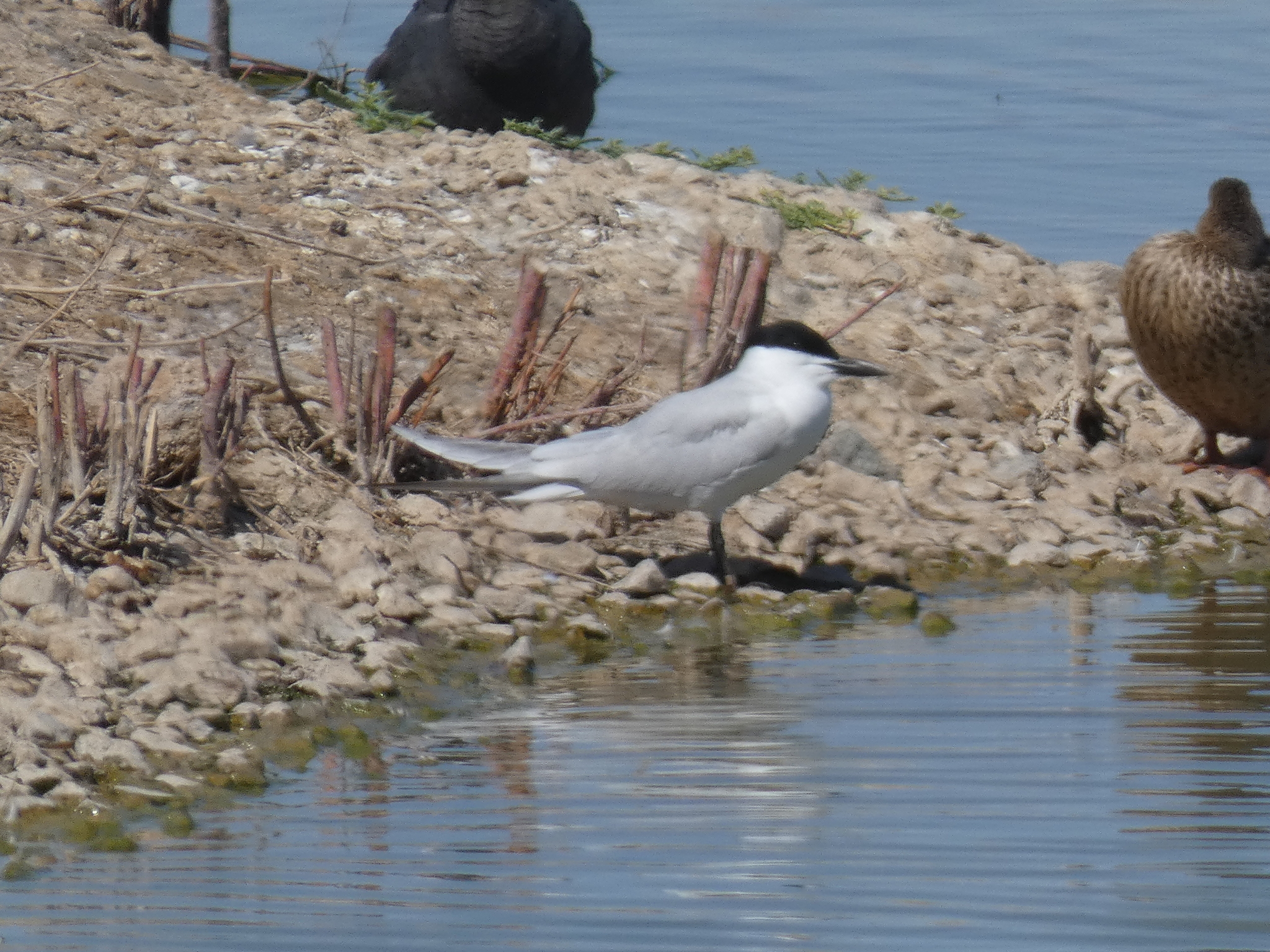
Gelochelidon nilotica
Identity and identification
Gull-billed Tern Gelochelidon nilotica belongs to Laridae; older references use Sterna nilotica. Its robust body, broad wings and short, thick black bill differ from Sandwich Tern’s longer, finer bill. The complete black cap is absent outside breeding plumage.
Habitat and food
It takes insects and small prey from land or near the water surface rather than relying on fish-diving. Open land near lagoons, saltpans and estuaries provides suitable habitat.
Breeding and development
A shallow scrape in sand or mud may contain vegetation. CIESM gives two or three eggs, incubation of 22–23 days and fledging 28–35 days after hatching. These developmental periods do not establish a breeding month in every region.
Arab occurrence and seasonality
Qatar’s current list describes common winter and passage presence, with records throughout the year; it does not assign resident breeding status. Lebanon’s 2020 checklist instead regards it as a rare migrant after additional records, replacing the older vagrant assessment. In November, Qatar observations fit winter presence, while Lebanon’s list does not describe abundant wintering.
Observation and conservation
Shallow water and varied open habitats support feeding. Avoid disturbing islands and low ground that may be used by bird colonies.
CIESM — Guide of Seabirds: Gull Billed Tern · British Trust for Ornithology — BirdFacts: Gull Billed Tern · Ramadan-Jaradi et al. — Updated checklist of the birds of Lebanon, Sandgrouse 42 (2020) · Qatar Bird Observation Group — Qatar Bird List · AviList Core Team — Global Avian Checklist v2026, 20 October 2026
Species illustration: Don Wellmann — CC0 1.0. · 1 · https://creativecommons.org/publicdomain/zero/1.0/