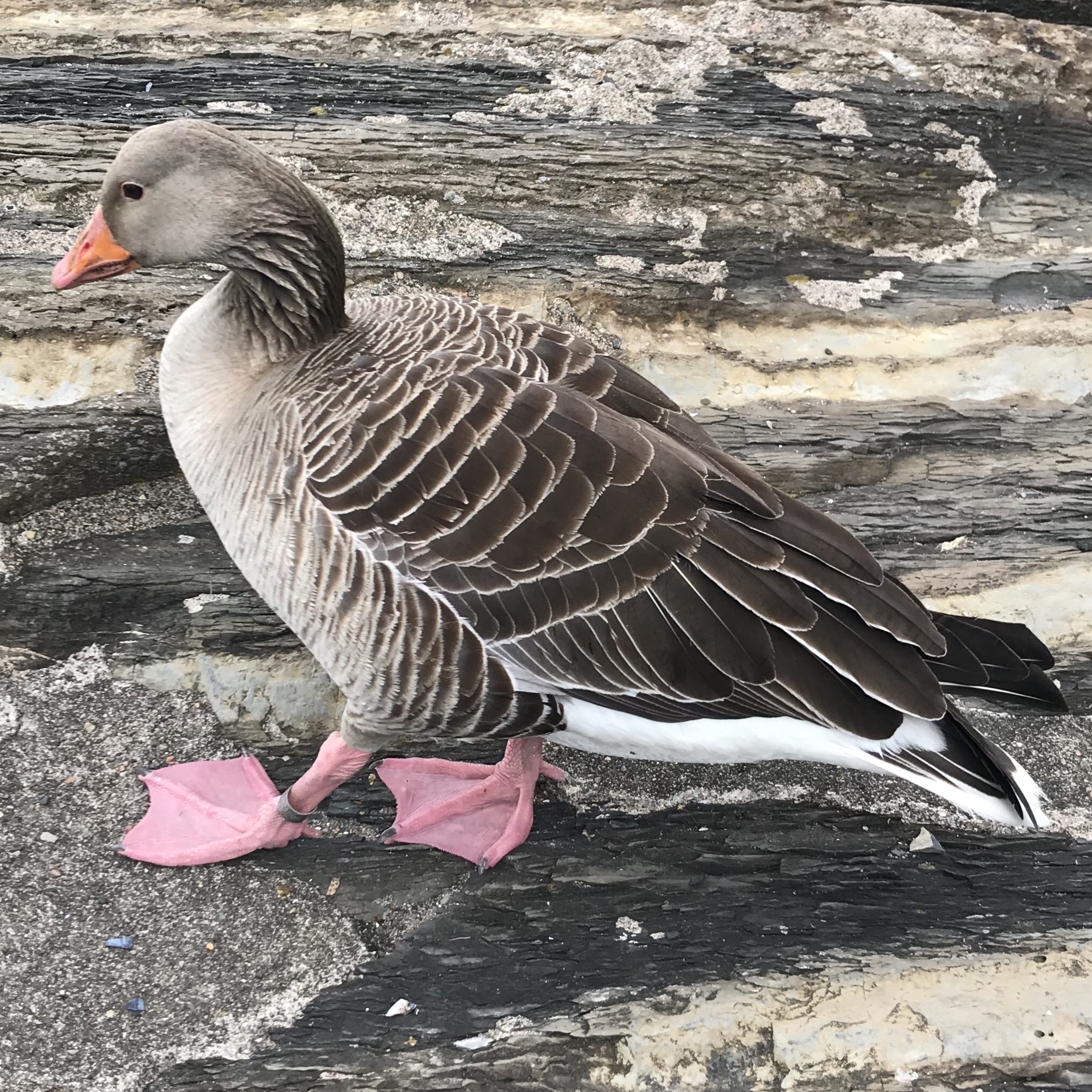
Anser anser — A large wild goose whose regional abundance varies sharply
Identity and identification
Greylag Goose, Anser anser, belongs to Anatidae within Anseriformes, with its scientific name retained in AviList 2026. Arabic sources use names corresponding to grey or ashy goose. This is a large, heavy-bodied bird with a strong neck and head, grey-brown plumage edged paler, and pink legs. The substantial bill may be orange or pink according to population, so bill colour alone is not a definitive identification test.
Age, sex and similar species
Males and females have similar plumage, although males are generally larger; an isolated photograph without comparison seldom establishes sex. Young birds show less developed features in parts of the belly pattern. In flight the pale grey forewing contrasts with darker flight feathers. Adult Greater White-fronted Geese have white at the bill base and strong dark belly barring, but young birds have not developed the complete pattern. Head, bill and wing structure therefore remain important. Domestic, feral and hybrid geese can also resemble wild Greylags; appearance and location alone do not prove natural wild origin.
Habitats, food and behaviour
The species uses freshwater lakes, marshes and floodplains, together with nearby grassland and fields. Food is predominantly plant material, including grasses, aquatic vegetation, grain and available crops. Flocks may leave water to graze and return to rest or roost. Family groups remain associated and join other birds outside the breeding season, whereas nesting pairs defend their immediate space. A tame goose beside an ornamental pond should not automatically be treated as evidence of wild migration.
Breeding and life cycle
Breeding occurs across a broad Eurasian range. A ground nest close to water and vegetation usually contains five to seven eggs. The female incubates while the male contributes protection; goslings soon leave the nest to follow their parents and feed. Replacement of the wing feathers produces a flightless period, increasing the importance of secure water. Resident and migratory strategies differ between populations. The existence of resident geese in a European country does not imply that birds arriving in Iraq belong to a resident population.
Distribution and seasonality in the Arab world
Within the Arab region, Iraq is important in the eastern wintering range, particularly its marshes and other wetlands. Scientific regional reviews also document limited local breeding in southern Iraq, so a single seasonal label cannot describe every bird there. The winter range reaches the northernmost parts of Africa, with strongly variable numbers and regularity. Qatar accounts treat the species as a rare winter visitor, while Lebanon’s 2026 bird guide confirms its vagrant status rather than treating it as a familiar winter goose. November is an appropriate time to watch for arrivals within wintering areas, not a guarantee of occurrence at every Arab lake. Date, locality, behaviour and possible origin should be recorded carefully for observations away from known centres.
Ecological role and conservation
Its global category is Least Concern, LC, but population circumstances differ. Grazing links terrestrial feeding grounds with wetlands. Use of crops can create agricultural conflicts in some regions, without implying damage at every site. Wetland drainage, pollution, disturbance and uncontrolled hunting require evidence-based local management. Quiet roosts connected to feeding grounds are more useful to the birds than repeated pursuit for photographs. Global conservation status does not determine the legality or season of hunting in any country.
References
AviList 2026 — Anser anser.
BTO — BirdFacts: Greylag Goose.
The Wildlife Trusts — Greylag Goose.
Mediterranean Waterbirds Network — Greylag Goose identification account.
Wetlands International — regional breeding-waterbird population estimates, 2017–2018, Iraq synthesis.
Qatar eNature — Greylag Goose.
Ramadan-Jaradi and Itani — Birds of Lebanon: A Photographic Guide to 409 Species, UNDP, second edition, 2026; Ramadan-Jaradi and colleagues — Sandgrouse 42, 2020.
Photo: Dag Endresen — CC0-1.0.