Pluvialis squatarola — An Arctic breeder linked to Arab tidal shores
Identity and identification
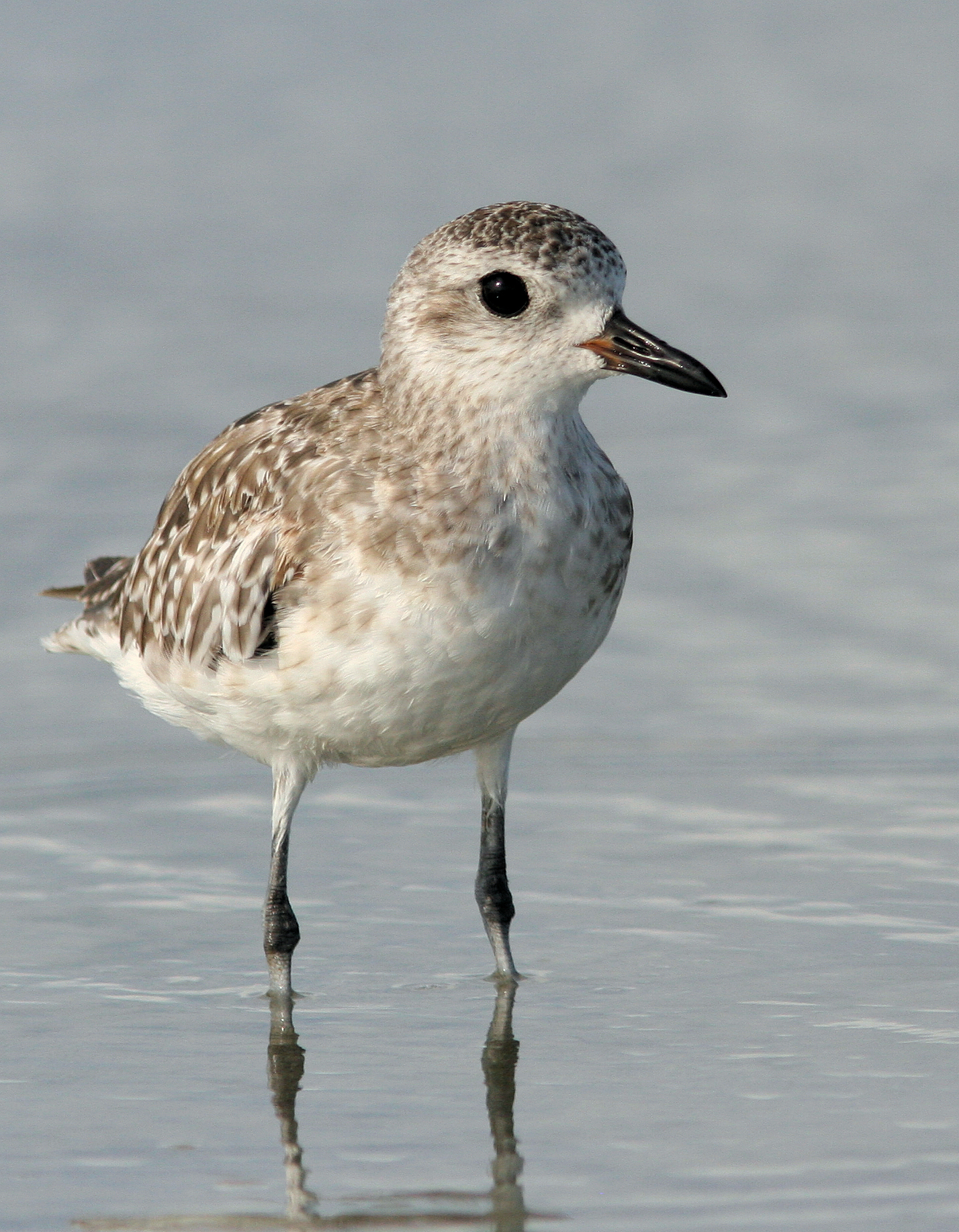
Grey Plover is a member of Charadriidae, retained as Pluvialis squatarola in AviList 2026. Its relatively bulky body, large head, stout black bill and dark legs help establish its identity. Winter birds are mottled grey above and predominantly pale below. The alternative English name Black-bellied Plover describes breeding plumage rather than the appearance most observers encounter on Arab shores in November.
Age, sex and similar species
Breeding plumage includes a black face, breast and belly bordered by white; females generally show less uninterrupted black than males. Individual variation and changing plumage make sexing a distant bird unreliable. Juveniles have yellowish spotting above. Black axillary feathers, visible beneath an open wing, are the decisive feature separating this species from golden plovers in every plumage. Wait for a natural stretch or flight rather than flushing a bird to obtain this diagnostic view. A single grey-looking photograph may not securely establish either age or sex.
Habitats, food and behaviour
Outside the breeding season it uses sandy beaches, tidal mudflats, estuaries and coastal lagoons, occasionally visiting inland waters. It searches visually, advancing and pausing before taking prey from the surface or shallow substrate. Marine worms, crustaceans, molluscs and other invertebrates are important foods. Feeding space changes with the tide, while safe high-tide resting places allow birds to conserve energy when exposed flats disappear. A resting flock is therefore using an essential part of its habitat, not merely occupying an empty beach.
Breeding and life cycle
Breeding takes place on Arctic tundra, not on the Arab coasts used in winter. A shallow ground nest normally contains four eggs. Both parents contribute to care; chicks leave the nest after hatching and find food under parental protection. Migration connects these northern breeding grounds with a sequence of staging areas and temperate or tropical coasts. Individuals and age classes do not all travel at once, so arrivals and departures overlap rather than obeying a single universal date.
Distribution and seasonality in the Arab world
In the Arab world this is primarily a coastal passage migrant and winter visitor, using North African, Red Sea, Gulf and Arabian Sea shores. Aden waterbird accounts document passage and winter occurrence, while Emirati environmental sources describe autumn migration. Lebanese scientific checklists treat it as an uncommon passage and winter bird of the coast and islands, not a resident breeder. November finds many birds on wintering grounds, although movements continue according to locality, weather and tides. Summer presence alone does not prove nesting, and abundance on a Lebanese beach should not be extrapolated to the Gulf or North Africa.
Ecological role and conservation
As an invertebrate predator it forms part of coastal food webs, with survival depending on both feeding and resting habitat. The global assessment changed to Vulnerable, VU, in 2024, a status retained by AviList 2026. Older pages that still display Least Concern are outdated for this purpose. Pressures include coastal habitat loss and degradation, disturbance and hunting along migration routes. Maintaining connected mudflats and high-tide refuges, and avoiding repeated approaches or vehicle disturbance, are practical conservation priorities. Global conservation status does not itself establish local hunting law.
References
AviList 2026 — Pluvialis squatarola.
BirdLife International — IUCN global assessment, 2024; migratory shorebird update, 28 October 2024.
BTO — BirdFacts: Grey Plover.
Ramadan-Jaradi and Itani — Birds of Lebanon: A Photographic Guide to 409 Species, UNDP, second edition, 2026; Ramadan-Jaradi and colleagues — Sandgrouse 42, 2020.
Environment Agency – Abu Dhabi — Environmental Atlas, Life on the Wing.
Mediterranean Waterbirds Network — Guide to the identification of North African waterbirds; Yemen biodiversity clearing-house — Aden waterbirds.
Photo: Andy Wilson — CC0-1.0.