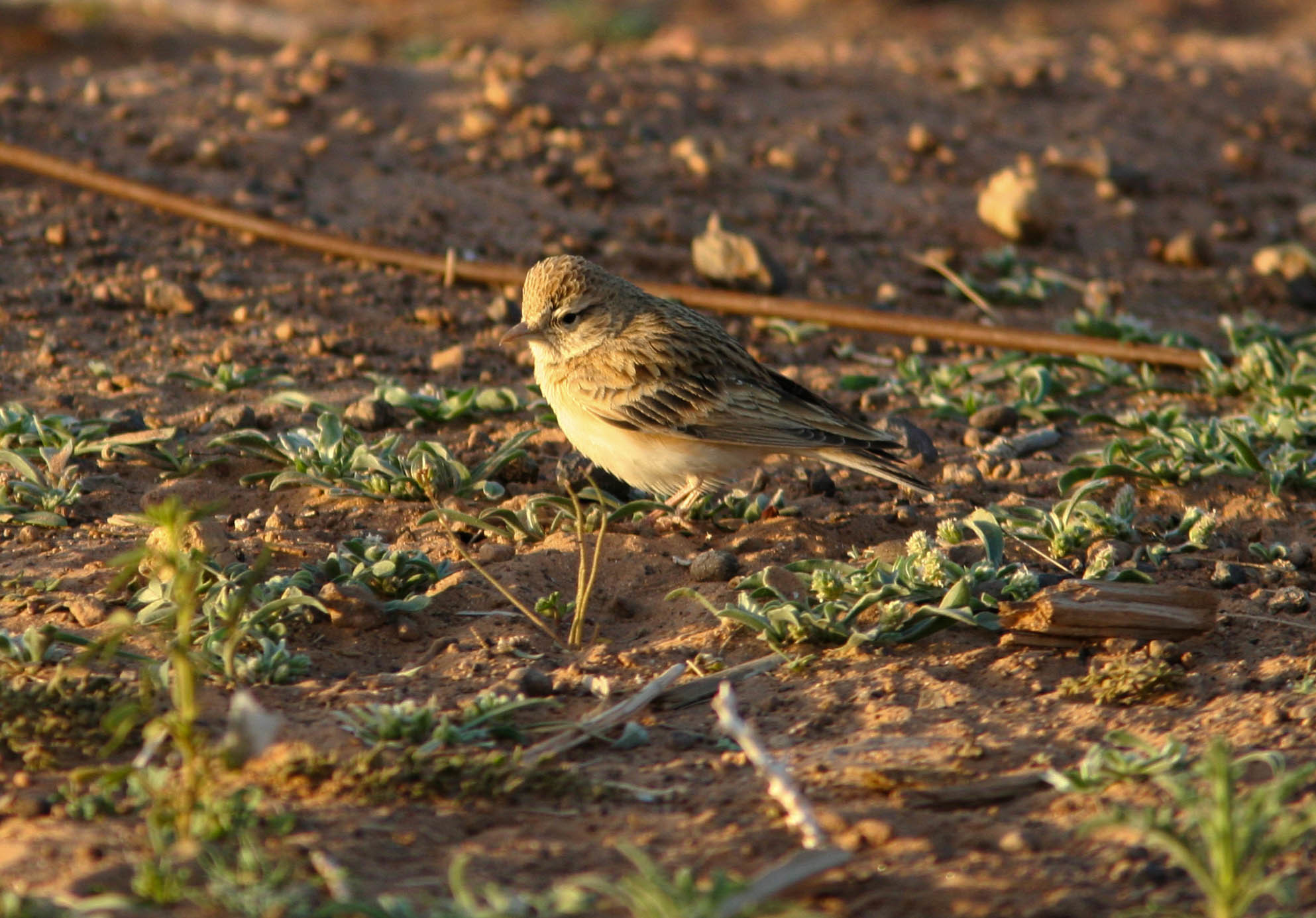
Calandrella brachydactyla
A small bird whose name needs care
The Greater Short-toed Lark, Calandrella brachydactyla, is a small bird linking Mediterranean plains and Arabian deserts with wintering grounds farther south. It measures about 14–15 centimetres. “Greater” is a relative term distinguishing it from other short-toed larks: it is not large compared with a Calandra Lark or Skylark. It belongs to the lark family and spends much of the day on the ground, where its sandy-brown upperparts are difficult to separate from stones and soil.
The scientific name must be understood in its modern sense. Older publications sometimes used broader species concepts that included eastern populations subsequently separated as other species. Not every historical map labelled “short-toed lark” can therefore be transferred automatically to this bird. Nor does its name mean an observer must catch it or photograph its toes. Field identification relies on the combination of shape, plumage and voice.
Identification and similar species
This is a small lark with pale underparts, a short conical bill and a pale eyebrow. The adult breast is less heavily streaked than in many similar larks, with two small dark patches near its sides that vary in prominence. The streaked head and back blend with sparsely vegetated open ground, especially when the bird crouches and hides its breast from view. One patch, which the viewing angle may conceal, is not enough to establish identity.
Comparison with short-toed larks of the genus Alaudala requires care. Those birds tend to have more streaked breasts and differences in build and bill, but changes with age and feather condition limit the usefulness of any single feature. Similar small eastern larks add to the difficulty in some passage areas. The length of feathers on the closed wing, head shape, calls and photographs from several angles all help. It is unsafe to assume that every member of a mixed flock belongs to the same species.
Males and females look broadly similar. Young birds appear more spotted or scalloped because of pale feather edges. These differences do not always permit accurate sexing or ageing at a distance. Some older guides also use “Lesser Short-toed Lark” in a broad taxonomic sense. A modern photograph should not be compared with an old name without checking which species was intended, particularly when documenting an unusual record.
Sparse vegetation and changing food
The bird uses dry steppe, fallow land, lightly vegetated fields and open sandy or gravelly surfaces. It favours space to walk and reach food between plants rather than continuous tall grass. Kuwaiti references describe it on desert ground, dried mudflats and irrigated fields with short, scattered vegetation. Its use of some irrigated farmland does not mean that converting all steppe to intensive agriculture would improve its habitat.
It collects seeds and invertebrates while walking on the ground. Insects become more important during breeding, whereas seeds predominate outside that period. A seemingly suitable field can change when margins are removed, soil is turned or pesticides are applied. Birds present after harvest may be exploiting a seasonal resource, not completing every stage of their life cycle in that field. Feeding and resting can occur at one site while nesting or roosting takes place elsewhere.
Autumn and winter movements
The breeding range extends across parts of northwestern Africa, southern Europe and western and central Asia. Migratory populations travel towards the African Sahel, the Arabian Peninsula and farther towards southern Asia. Migration is especially pronounced in some northern populations, while movements of southern populations differ. Modern taxonomy makes it particularly important not to extend the range eastwards using old maps produced before very similar species were separated.
Birds travel in flocks that can include other small species, and migration occurs both by day and at night. Seeing a flock in November does not establish that it is still heading south: it may already have reached its wintering area. Repeated visits can distinguish a brief stop from longer occupation, provided the observer does not assume that birds seen on two visits are the same individuals. Flock size, date and location are more useful than an undefined claim of “heavy occurrence”.
Pairing and nest construction
The male sings in an aerial display over suitable ground, and birds form breeding pairs. The season starts in spring across many parts of the range, but timing depends on location and conditions. Spanish references describe a local spring-to-summer calendar, which should not be generalised to Arabia, where plant and invertebrate productivity also responds to rainfall. Summer presence in a country does not prove that every bird is breeding, since residents and passage birds may overlap.
The female makes a small hollow or uses an existing one and builds a cup of grasses, roots and softer material, usually sheltered by a short plant. Soil particles and pebbles may reinforce the exposed side. The Saudi reference assigns nest construction and incubation to the female, with both parents feeding the young. This nest is protected by concealment rather than height, making trampling, cultivation and off-road driving dangerous even on apparently empty ground.
Eggs and the growth of chicks
The Saudi account describes three to five eggs and incubation lasting about 11–13 days. Chicks leave the nest at around nine to ten days, then hide nearby before flying at approximately 12–15 days. Some European references extend the clutch range to six eggs. These are different reference ranges, not a rule requiring every nest to contain one fixed number.
Two broods can occur in a season when conditions allow, and parental care remains important after the young leave the nest. Nest departure, flight and independence are three different stages. A healthy youngster should not be removed from the ground merely because its nest is no longer visible: its parents may be close. If an adult carrying food hesitates to approach, withdrawing quietly is better than following it to discover where the chicks are hidden.
Different seasonal roles in Arab countries
Morocco, Algeria and Tunisia form part of the North African breeding range, while migrants also pass through parts of the region. Mauritania, Sudan and Somalia lie within the broader African wintering range, with numbers and sites varying between years. This helps explain November observations: declining numbers on a northern breeding ground can coincide with arrival in Arab lands farther south, rather than indicating permanent local disappearance.
The Middle Eastern range includes populations associated with Sinai, the Levant and Iraq, and is not confined to a coastal migration corridor. Saudi references make a clear distinction: a very common passage migrant, common winter visitor and rare breeding migrant in small numbers. Breeding takes place on irrigated or cultivated land with scattered cover, while winter habitat extends into desert plains. Old estimates of breeding pairs should not be presented as the results of a current census.
Kuwaiti references document abundant passage, summer and winter visits, and breeding. In Oman, the regional review describes common passage and winter occurrence, with scattered breeding reports that should be distinguished from the better-established winter status. These roles are more varied than a brief transit alone. An individual cannot be assigned to a subspecies or country of origin merely because a flock arrives in a familiar season; establishing origin requires tracking or other independent evidence.
Conservation and the value of open land
AviList 2026 records the species as globally Least Concern, LC. Nevertheless, loss of fallow land, agricultural intensification and removal of low vegetation can reduce habitat and food. Protection requires maintaining breeding, stopover and wintering sites together: success in one does not automatically compensate for loss of another. A large flock can indicate birds concentrated around a limited resource rather than abundant habitat across the landscape.
Observe from a field edge or existing track without blocking the flock's direction of movement or repeatedly forcing it to take flight. Avoid playback to attract breeding males and do not publicise nest locations. Record unresolved similar-looking birds separately instead of including them in a confirmed species total. Finally, hunting laws remain independent of global conservation status: a Least Concern category does not determine whether hunting is legal in any particular country.
Photo: Tero Linjama / iNaturalist (CC0 1.0)