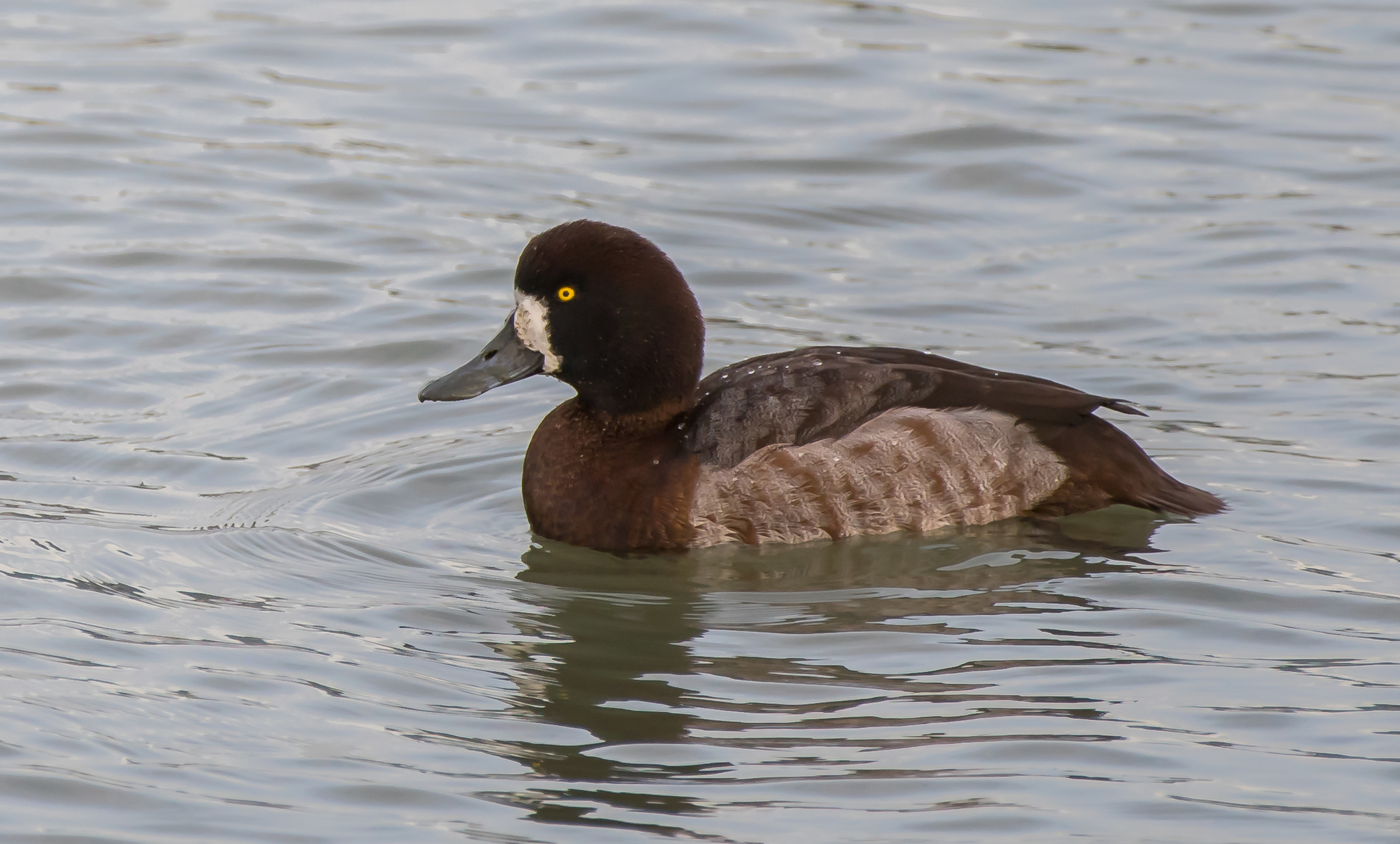
Aythya marila
Identification: a northern diving duck
Greater Scaup, Aythya marila, is a compact diving duck of northern latitudes. The adult male combines a dark head and breast, a finely patterned grey back and white flanks. The broad bluish bill, yellow eye and rounded head complete the impression. Unlike a male Tufted Duck, it does not have a long trailing crest. The head may show green iridescence, but reflected colour changes with light and viewing angle and is not a sufficient identification character.
Females are brown, usually with conspicuous white around the base of the bill. Some female Tufted Ducks also show pale facial markings, so a white patch alone is not diagnostic. Check the bill, head profile and overall build together. Immature and moulting birds lack the clean adult male pattern and deserve particular care. When a bird flies naturally, the long white wing stripe supplies an additional character.
Lesser Scaup is the closest identification problem. Greater Scaup generally has a fuller, more rounded head and broader bill; Lesser Scaup often shows a more peaked rear crown. Posture can change these outlines. A series of views is more useful than one photograph taken while a bird is diving, stretching or compressing its head feathers. Wing pattern and several structural features should support any unusual regional identification.
Habitat and food
During breeding, Greater Scaup uses northern lakes, pools and wet ground near the boreal forest limit and in tundra landscapes. In winter it often gathers on coastal bays, estuaries and lagoons, although inland lakes can also support important numbers. Its association with salt water is therefore seasonal rather than an absolute requirement. Sheltered and exposed coastal situations both occur within its wider winter range.
The bird usually obtains food by diving and swimming below the surface. Molluscs are especially important in winter; insects, crustaceans and plant material also contribute, with diet varying between habitats and seasons. Larger food items may be brought up to be swallowed. A flock can look inactive while many of its members are underwater, so repeated counts help separate genuine changes in abundance from a temporary disappearance beneath the surface.
Breeding and development
The nest is a shallow, down-lined depression, usually close to water, sometimes on an island or among shoreline vegetation. The female selects and builds it. Neighbouring nests can form loose aggregations, but the species should not be imagined as invariably nesting in a dense colony. Pair formation and courtship precede the northern nesting season; male displays include head and body movements rather than a conspicuous song.
BTO gives a typical clutch of 8–11 eggs, female incubation lasting 26–28 days, and fledging at approximately 40–45 days. These are reference ranges, not an exact timetable for every nest. The downy young leave for the water and feed themselves under female supervision. Broods may join together, so a large group of ducklings need not represent the offspring of a single female. The ability to swim soon after hatching should not be confused with independence from safe feeding habitat.
Range and seasonal movements
Greater Scaup breeds across the northern parts of Eurasia and North America. In Europe, Iceland, northern Scandinavia and Russia are important parts of its breeding geography. Many birds move to lower-latitude coasts for winter. The EURING/CMS atlas shows links from Iceland towards western Europe and from Baltic and Russian areas towards the North Sea. Mediterranean waters hold far smaller numbers than the main northwestern European wintering areas.
Males can leave breeding areas for separate moulting sites before the full autumn movement to winter quarters. Available ringing evidence is uneven: many recoveries come from older decades and from hunted birds. It describes real movements but does not prove that every scaup reaching North Africa or Iraq follows the same route. A winter observation establishes a bird's presence at a destination, not its precise breeding origin.
Occurrence in Arab countries
Morocco's rare-bird committee classifies Greater Scaup as a Palearctic accidental visitor in its 2022 report. This differs from the committee's category for a regular winter visitor. Tunisia's Avibase checklist, maintained by Denis Lepage and hosted by Birds Canada, likewise marks it Rare/Accidental. These are country-level rarity assessments, not evidence of nesting or a predictable annual coastal migration.
Iraq has a different documented status: Salim and colleagues' Sandgrouse checklist describes it as a rare winter visitor. That seasonal designation should be retained with its rarity qualification. The available national accounts therefore place Arab observations at the southern margins of this northern duck's range, while distinguishing occasional Maghreb records from rare winter occurrence in Iraq. They do not justify labelling every suitable Arab lagoon a regular wintering site.
Conservation and observation
BTO reports global Least Concern status, but that should not obscure regional decline. A coordinated European study by Marchowski and colleagues, published in 2020, found a substantial fall in northwestern Europe's wintering population between the late 1980s and 2015–2018, alongside a redistribution towards the north and east. Fishing-net bycatch and deterioration of food resources were important concerns. A rise in one country's counts can coexist with a decline across the wider population.
For Arab wetlands, protecting feeding grounds and undisturbed resting water is a useful precaution even where the species is rare. Watch from shore with binoculars or a telescope rather than approaching a flock by boat. Photograph the bill and head from several angles if an unusual record needs documentation, and note the accompanying species. Submit the date, location and identification evidence to the relevant national recording body; an uncertain bird is better left unresolved than assigned a confident but unsupported name.
BTO — Scaup BirdFacts · RSPB — Scaup · Audubon — Greater Scaup · EURING/CMS — Migration Atlas: Greater Scaup · Marchowski et al. — European Scaup trends and Natura 2000 · Commission d’Homologation Marocaine — Report 27 · Salim et al. — Annotated checklist of the birds of Iraq · Avibase — Tunisia checklist
Photo: Claude Lyneis