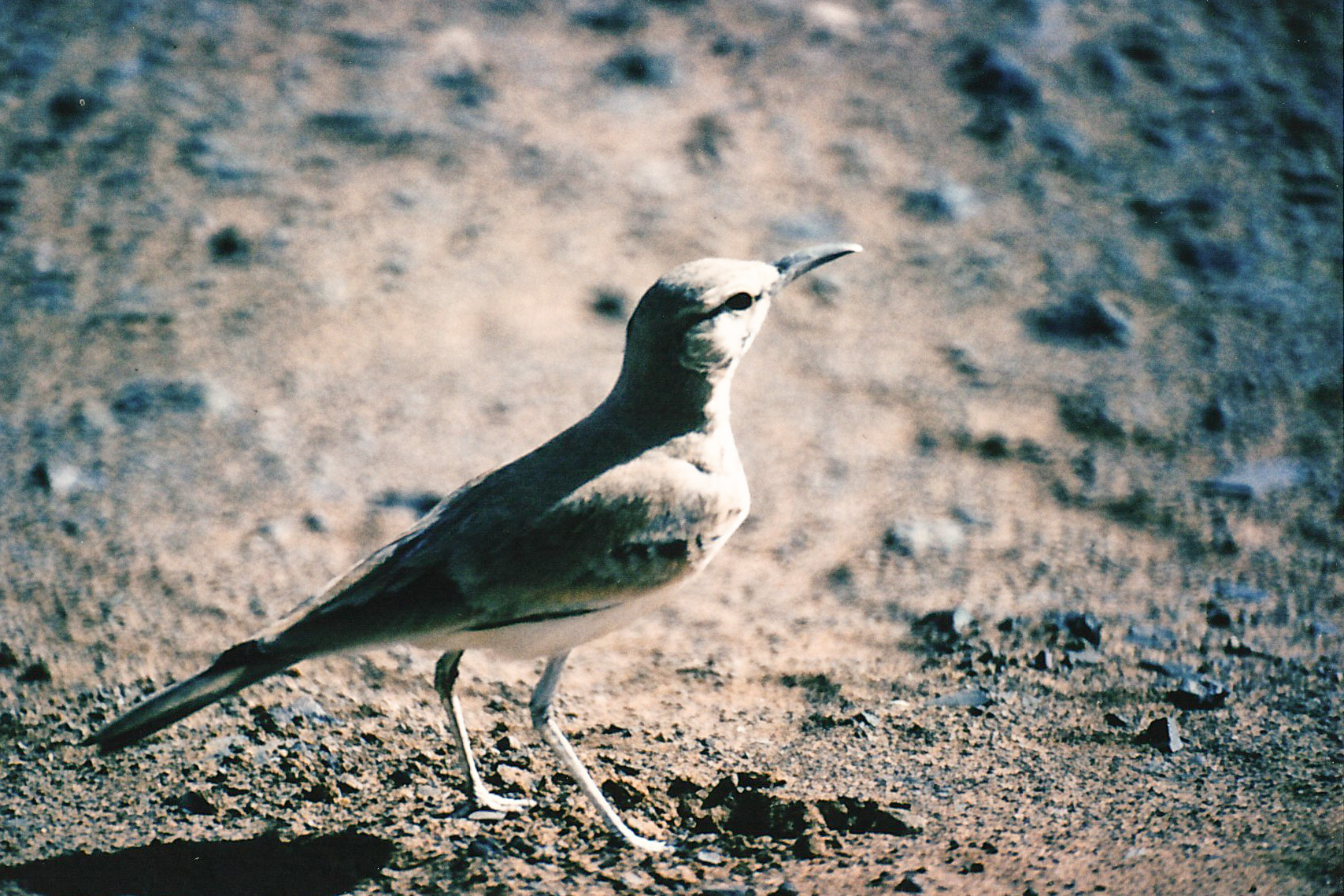
Alaemon alaudipes
Identity and identification
Greater Hoopoe-Lark Alaemon alaudipes belongs to Alaudidae. A long downcurved bill and long legs accompany striking black-and-white wings in flight. Sandy standing plumage conceals that pattern. The hoopoe resemblance concerns the bill, not a crest or membership of the same family. It is placed in the order Passeriformes. The IUCN category carried in AviList 2026 is Least Concern (LC).
Habitat, food and behaviour
Open desert plains with sand, gravel and scattered plants provide habitat. It runs quickly for invertebrates and also takes seeds. Song flights expose the wing pattern. Shade and shrubs influence exposure to extreme heat.
Breeding and parental care
It nests on or close to the ground beside suitable vegetation. Desert field research links nest-site choice with temperature and predation risk. Parents feed the young; rainfall and food influence breeding success, so air temperature alone cannot explain nesting dates.
Range and Arab occurrence
A widespread desert bird, its range crosses North Africa and Arabia into Asia. Saudi and Kuwaiti sources document residence and breeding. Lebanon, by contrast, has exceptionally rare accidental records rather than routine occurrence.
Seasonality and observation
Suitable resident areas support year-round birds with local movements. Moderate November hours permit observation from tracks and roadsides without driving across plains towards birds. Bill and wing-pattern records are more useful than sandy body colour alone.
Ecological role and conservation
Dry-plain degradation, off-road driving and excavation are pressures. Apparently simple desert habitat contains carefully selected feeding and nesting sites. Keeping shrubs and undisturbed ground preserves food, shade and opportunities to breed.
References
State of Kuwait — Fifth National Report to the Convention on Biological Diversity (2014), bird list.
Saudipedia — Greater Hoopoe-Lark.
Tieleman et al. — The Condor 110 (2008), 116–124: nest-site selection in a desert bird.
AviList Core Team — AviList: The Global Avian Checklist, v2026 (20 October 2026).
Photo: Andy Wilson — CC0 1.0.