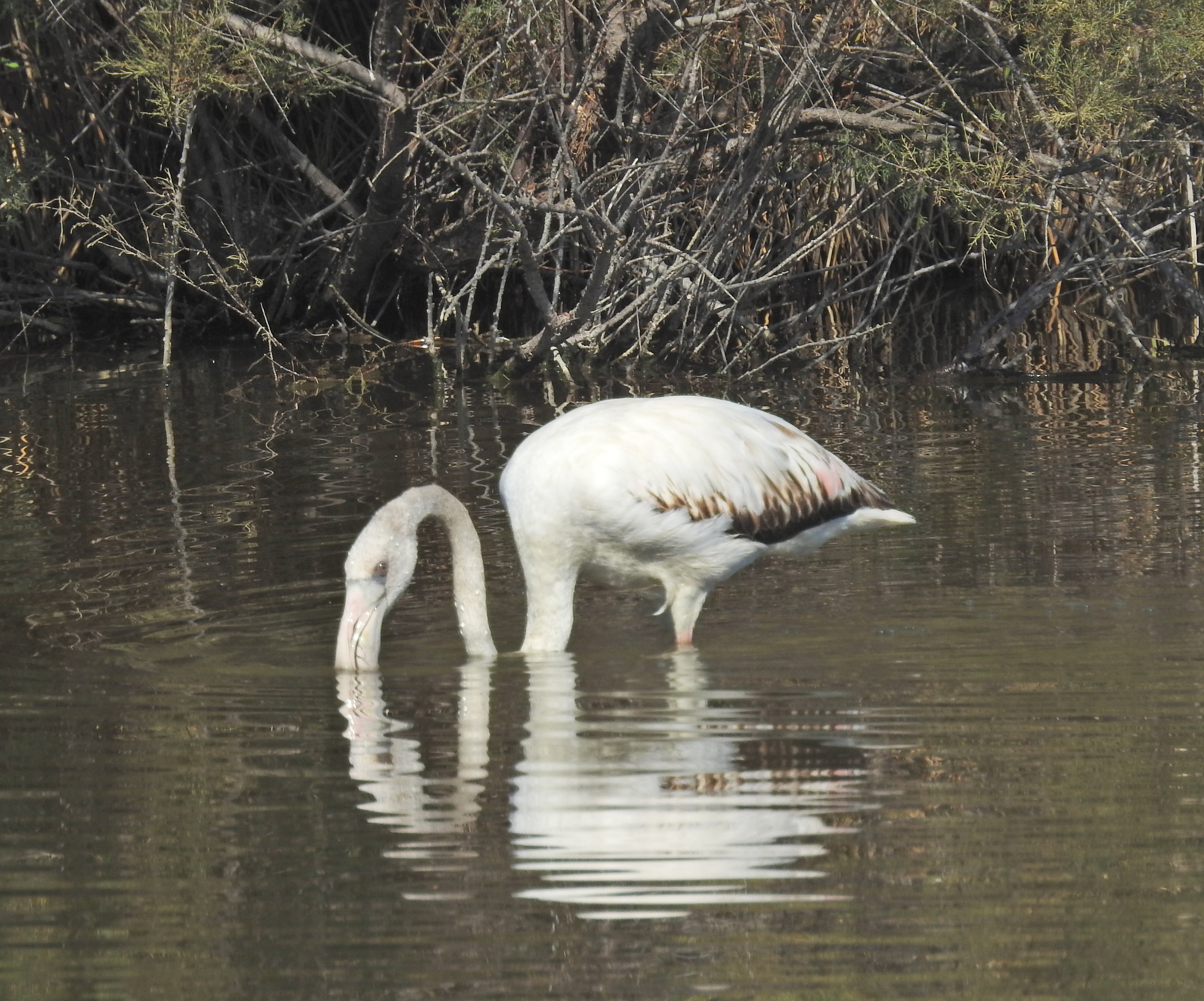
Phoenicopterus roseus
Identity and identification
Greater Flamingo Phoenicopterus roseus belongs to Phoenicopteridae. Long legs and neck accompany a pink bill with a black tip. Adults are whitish pink; young birds are grey. Compared with Lesser Flamingo, it is larger with a paler bill. Pinkness alone is not a reliable identification character. It is placed in the order Phoenicopteriformes. The IUCN category carried in AviList 2026 is Least Concern (LC).
Habitat, food and behaviour
Coastal lagoons, saltpans and shallow lakes provide feeding grounds. It filters small crustaceans, larvae and other aquatic organisms with its inverted bill. Dietary pigments produce its pink colour. Water depth, salinity and prey availability determine where flocks can feed.
Breeding and parental care
Colonies nest on mud mounds topped by a shallow hollow. Usually one egg is incubated by both parents for about 27–31 days. Both feed the chick with a nutritive secretion. Young later gather in crèches before attaining flight at roughly 65–90 days. Local water conditions influence nesting dates.
Range and Arab occurrence
It occurs widely around the Mediterranean, North Africa and Middle East. Abu Dhabi’s Environment Agency documents breeding at Al Wathba, whereas Lebanon’s checklist describes scarce, irregular passage and winter visits. Winter flocks therefore do not by themselves demonstrate a local breeding colony.
Seasonality and observation
Some Gulf sites support year-round birds alongside seasonal concentrations. In November, winter lagoons and saltpans attract mobile flocks. A colony may fail or relocate if water levels or disturbance become unsuitable. Protected viewpoints allow observation without entering crèche areas.
Ecological role and conservation
Conservation depends on functioning wetlands and their water regime. Pollution, altered water levels, power infrastructure collisions and disturbance are pressures. Flocks fly with necks and legs extended; repeatedly forcing them into flight costs feeding and resting time.
References
Ramadan-Jaradi et al. — Updated checklist of the birds of Lebanon, Sandgrouse 42 (2020), 186–238.
Environment Agency–Abu Dhabi — Greater Flamingo and Al Wathba Wetland Reserve.
University of Michigan Museum of Zoology — Animal Diversity Web: Phoenicopterus roseus.
AviList Core Team — AviList: The Global Avian Checklist, v2026 (20 October 2026).
Photo: Nicolás Tamargo — CC0 1.0.