Parus major — Identification, habitats, breeding and occurrence in the Arab region
Identity and recognition
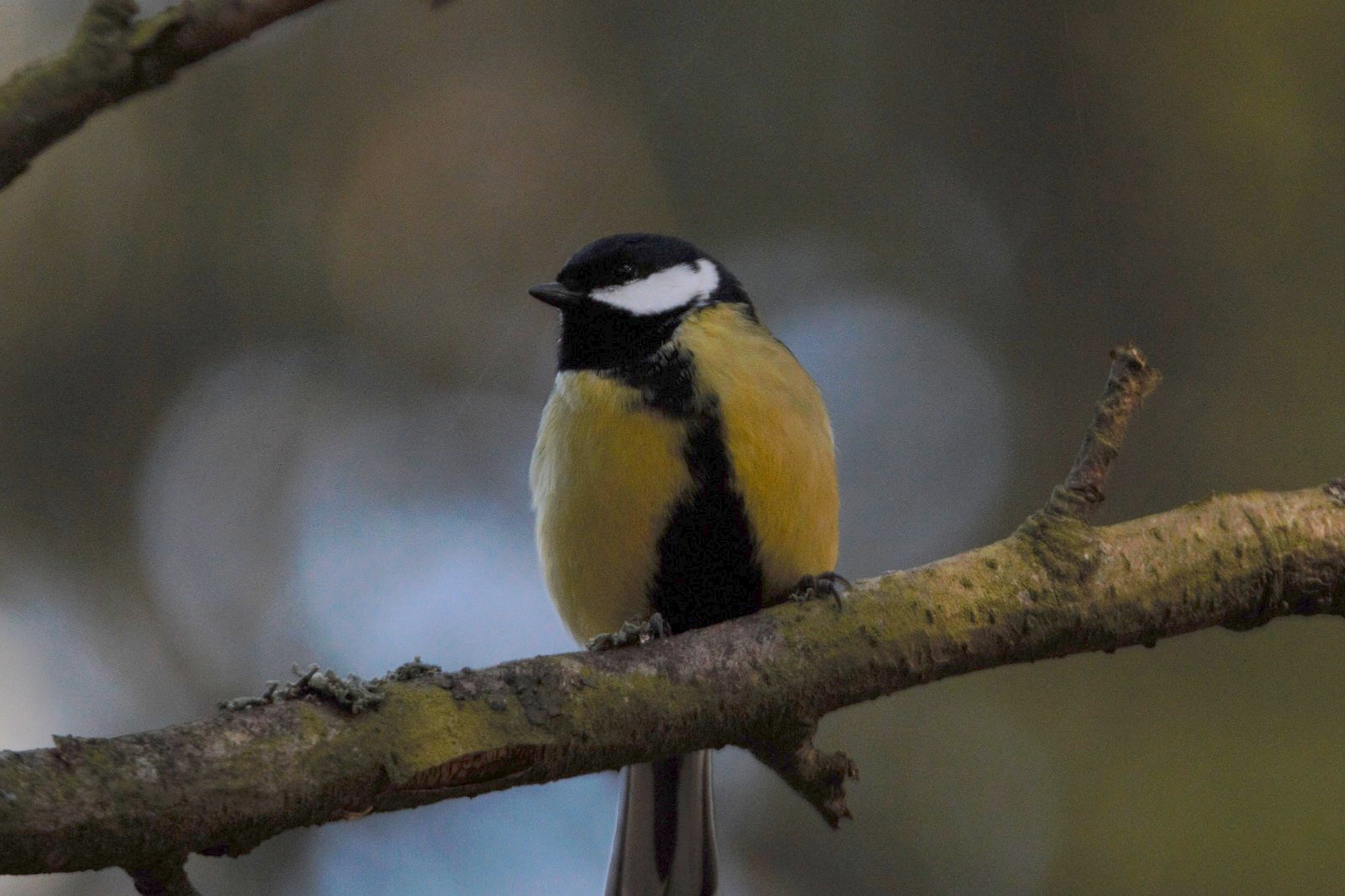
The Great Tit, Parus major, belongs to the family Paridae. Its black head, white cheeks, olive back and yellow underparts crossed by a black central stripe form a distinctive combination. The wings and tail are blue-grey, with a white wing bar. At about 12.5–15 cm long, it is among the larger familiar tits within its range. Identification should use this combination rather than one isolated colour.
Age, sex and similar species
The male usually has a broader black stripe down the underparts than the female. Posture and feather position can alter its appearance in a photograph. Young birds have yellowish cheeks, a less glossy crown and generally softer markings. Blue Tits are smaller and have a blue crown; Coal Tits lack the conspicuous yellow belly and show a white patch on the nape. These differences prevent confusion between the Great and Coal Tits. A distant image that conceals the belly stripe is not a reliable basis for assigning sex.
Habitat, diet and behaviour
Woodland, forest edges, orchards and gardens provide habitat, especially where mature trees supply cavities and food. Birds search leaves, twigs and bark crevices, sometimes feeding on the ground. Insects, their larvae and spiders are important foods, with seeds and fruit becoming more important outside breeding. A bird may hold a food item against a perch with its foot while opening it. Mixed-species flocks occur in winter; song and territorial defence become more prominent during breeding. Its varied calls mean that different sounds need not represent different species.
Breeding and life cycle
Great Tits nest in tree cavities and also use suitable nest boxes. The female builds and incubates, while both parents feed the young. Incubation generally takes approximately 12–15 days, and young remain in the nest for about 16–22 days. These are broad biological ranges, not an identical timetable for every country. Breeding success depends partly on invertebrate availability during chick growth. Observations should avoid opening occupied cavities or disturbing families.
Arab-region distribution and seasonality
Lebanon’s updated checklist, published in 2020, describes a very common resident breeder, from ravines at roughly 300 m to high-elevation tree habitat; recorded breeding extends from late March to late July. Jordan’s checklist also lists it as resident. In north-western Africa its range extends from Morocco to Tunisia, where biodiversity surveys document wooded habitats. Consequently an October sighting in Levantine or Maghreb woodland does not necessarily mark a new migrant’s arrival: the bird may be resident. Its regional seasonal pattern is closely associated with the distribution of suitable wooded habitats.
Ecology and conservation
Insect consumption places the species within woodland and garden food webs, while it is itself prey for other animals. Its global conservation category is Least Concern, not a guarantee that every Arab locality is secure. Removal of mature trees, loss of cavities and reduced insect resources can diminish habitat quality. Retaining varied trees and natural vegetation supports feeding and nesting.
References
Cornell Lab of Ornithology — All About Birds: Great Tit, identification and life history
Ramadan-Jaradi and colleagues — Updated checklist of the birds of Lebanon, Sandgrouse 42 (2020)
Jordan BirdWatch — Jordan Bird List (2020)
CEPF — Catalogue of biodiversity of Oued Maden Key Biodiversity Area, Tunisia
BirdLife Austria — Kohlmeise
British Trust for Ornithology — BirdFacts: Great Tit
Avibase — Parus major taxonomy and distribution
Photo: Jani Kettunen — CC0.