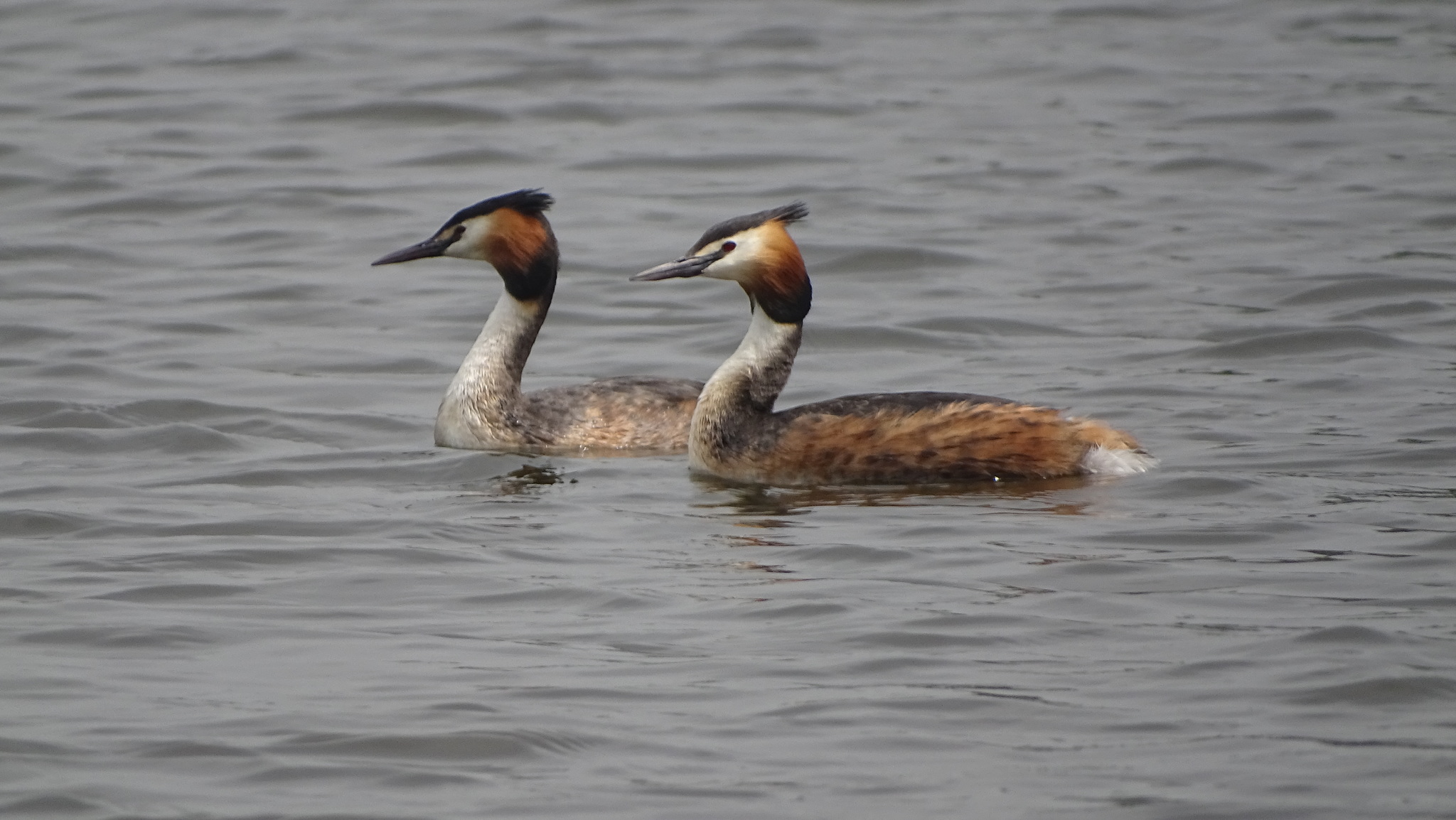
Podiceps cristatus — A lake diver combining local breeding and winter visits
Identity and identification
Great Crested Grebe, Podiceps cristatus, belongs to Podicipedidae within Podicipediformes, not to the duck family despite sharing many lakes with ducks. AviList 2026 retains this scientific name. It sits low in the water, with a long slim neck and pointed, dagger-like bill. Legs positioned far back provide underwater propulsion but make movement on land awkward; swimming and diving are central to its way of life.
Age, sex and similar species
Breeding adults carry a double black crest and chestnut-and-black facial ruff. The sexes look alike, and crest size alone is not a reliable way to sex a bird. Most ornaments disappear in winter, leaving white cheeks and fore-neck beneath a dark cap. Chicks have striped heads and necks, with traces persisting in young birds. The long neck, pointed bill and larger build separate it from Little Grebe. Compared with Black-necked Grebe, its bill is longer and straighter and the head pattern differs. Winter identification should combine head shape, bill and body posture rather than rely on colour alone.
Habitats, food and behaviour
It uses lakes, reservoirs and relatively extensive waters with underwater prey and suitable vegetation for nesting. Outside the breeding season it may move to sheltered coastal water and estuaries. Fish and aquatic invertebrates are captured below the surface, with suitable prey swallowed after capture. Repeated disappearance underwater does not mean that the bird has left the site. Patient observation reveals feeding behaviour without provoking escape. Local abundance depends on water conditions, depth, food and disturbance, not simply the size of a lake.
Breeding and life cycle
Pair displays include facing one another, head movements and, during some phases, presentation of aquatic vegetation. The nest is built from plant material on the water and usually anchored to surrounding vegetation. A typical clutch contains three or four eggs; both parents incubate and care for the young. Small chicks sometimes ride on a parent’s back, a normal behaviour rather than a sign of injury. They learn to dive and receive food before becoming independent. Water-level fluctuations can undermine nests, so the presence of open water alone does not ensure successful breeding.
Distribution and seasonality in the Arab world
Morocco, Algeria and Tunisia support local breeding populations supplemented by winter visitors; wintering birds also reach Libya and Egypt. In the Levant it is incorrect to describe all birds as transient. References document limited breeding in Syria, and Lebanon recorded breeding at Aammiq in 2019 alongside winter use of inland waters. The Lebanese checklist places regular winter occurrence mainly from December to early March. November is consequently a useful time to monitor seasonal change, not a guaranteed winter peak. The updated Kuwait list describes a rare passage and winter bird, while the Environment Public Authority directory also records breeding; this does not imply a widespread resident population. North African lake status therefore cannot simply be transferred to the Gulf. Summer presence alone does not prove nesting; a nest, chicks or documented breeding behaviour is needed.
Ecological role and conservation
The global category is Least Concern, LC, although local populations may be affected. As an aquatic predator it participates in food webs and depends on water quality, accessible prey and stable nesting areas. Pressures include pollution, loss of shoreline vegetation, disturbance, abrupt water-level changes and entanglement in fishing gear. Keep boats and observers away from families, avoid cutting across their route and do not approach floating nests for photographs. Absence from a lake is not by itself evidence of pollution: interpreting the cause requires systematic observation.
References
AviList 2026 — Podiceps cristatus.
BTO — BirdFacts: Great Crested Grebe.
RSPB — Great Crested Grebe.
Mediterranean Waterbirds Network — North African waterbird identification guide.
Ramadan-Jaradi and Itani — Birds of Lebanon: A Photographic Guide to 409 Species, UNDP, second edition, 2026; Ramadan-Jaradi and colleagues — Sandgrouse 42, 2020.
Jordan Journal of Natural History — annotated bird checklist of Syria.
Kuwait Environment Public Authority and IUCN Regional Office for West Asia — Conservation Directory of the Birds of Kuwait; Kuwait Ornithological Rarities Committee — Official Kuwait Bird List, September 2026.
Photo: Andra Waagmeester — CC0-1.0.