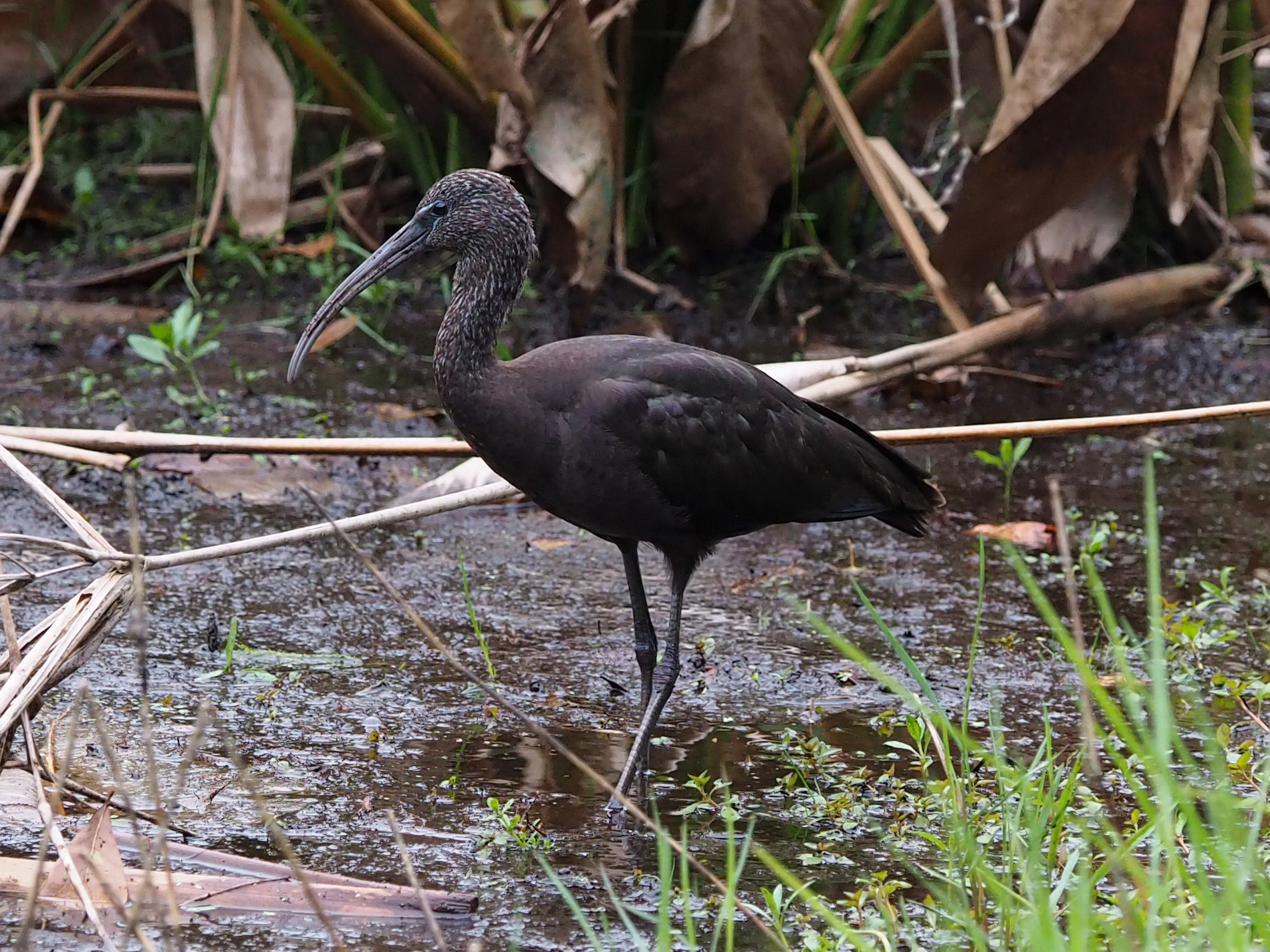
Plegadis falcinellus — an iridescent wetland wanderer
Name and identity
The Glossy Ibis, Plegadis falcinellus, belongs to Threskiornithidae, the ibis and spoonbill family, within Pelecaniformes. This placement follows AviList 2026. Arabic references also use the name al-anuq al-lamiʿ. Its distribution spans parts of Eurasia, Africa, Australasia and the Americas. These widely separated populations do not all share one migration route, and a bird appearing at a new wetland does not establish that the species is resident or breeding there. The Lebanese guide also uses the Arabic name Abu Minjal al-lammaʿ.
Recognition and similar birds
From a distance it looks dark, but good light reveals chestnut body feathers and green-bronze iridescence on the wings. The long, downcurved bill, extended neck and long legs form a distinctive outline. It flies with its neck stretched forward, unlike a heron. Sexes have similar plumage and should not be assigned from an ordinary photograph. Young birds are browner and less glossy, often with pale neck streaking; non-breeding adults also lose some richness. Its feathered head distinguishes it from the Northern Bald Ibis. Apparent blackness alone is not a useful identification.
Habitat, food and behaviour
It uses marshes, shallow pools, flooded ground and wet farmland, including fresh and brackish habitats. Probing soft mud and picking prey from the surface, it takes insects and larvae, worms, molluscs and crustaceans, with other small aquatic prey. Feeding and roosting can be communal, sometimes alongside other waterbirds. Its occurrence near farmland does not quantify an agricultural benefit: what can be established is its place in wetland food webs and its dependence on accessible shallow water and workable mud.
Breeding and movements
It nests colonially, sometimes in mixed heronries. The pair builds a platform of twigs and vegetation in a tree, shrub or reedbed, and both parents contribute to brood care. Breeding timing depends on local conditions, so one regional calendar should not be applied throughout the Arab world. Post-breeding dispersal accompanies seasonal migration in some populations. Ringing studies have connected northern Algerian colonies with other western Mediterranean locations, illustrating why a network of wetlands matters rather than an isolated protected patch.
Arab distribution and November context
Lebanon’s updated photographic guide, published in June 2026, reports localised, irregular summer breeding at Al Mansoura and uncommon passage through coastal and inland wetlands, not regular winter visitation. Kuwait lists uncommon passage and rare winter occurrence, whereas Oman’s database describes abundant passage and winter visitation. Morocco and Algeria have documented breeding sites as well as seasonal movements; breeding at Morocco’s Sebkha Bou Areg was documented in 2024. November therefore provides a winter-wetland context in Oman, not evidence of Lebanese abundance or proof that every North African ibis is a visiting migrant.
Conservation and responsible observation
Globally it is Least Concern, not a guarantee that every local population is secure. Wetland drainage, pollution, pesticides, colony disturbance and killing remain concerns. Protecting reedbeds, water quality, shorelines and roosts supports its habitat needs. Observe without changing the birds’ behaviour; entering a colony for a photograph is inappropriate. Global conservation status does not determine whether hunting is legal in a particular country.
References
AviList Core Team — AviList v2026, 20 October 2026.
Cornell Lab of Ornithology — All About Birds: Glossy Ibis, identification and life history.
Ramadan-Jaradi et al. — Updated checklist of the birds of Lebanon, Sandgrouse 42, 2020.
Kuwait Ornithological Rarities Committee — Kuwait Bird List; Kuwait Birds: Glossy Ibis.
Birds of Oman — national species database.
Blowin’ in the wind: dispersal of Glossy Ibis in the western Mediterranean, 2023.
Azaouaghe & Oujidi — Nidification de l’Ibis falcinelle dans le nord-est du Maroc, Go-South Bulletin 21, 2024.
Ramadan-Jaradi & Itani — Birds of Lebanon: A Photographic Guide to 409 Species, second edition, UNDP, June 2026.
Photo: Zygy — CC0-1.0.