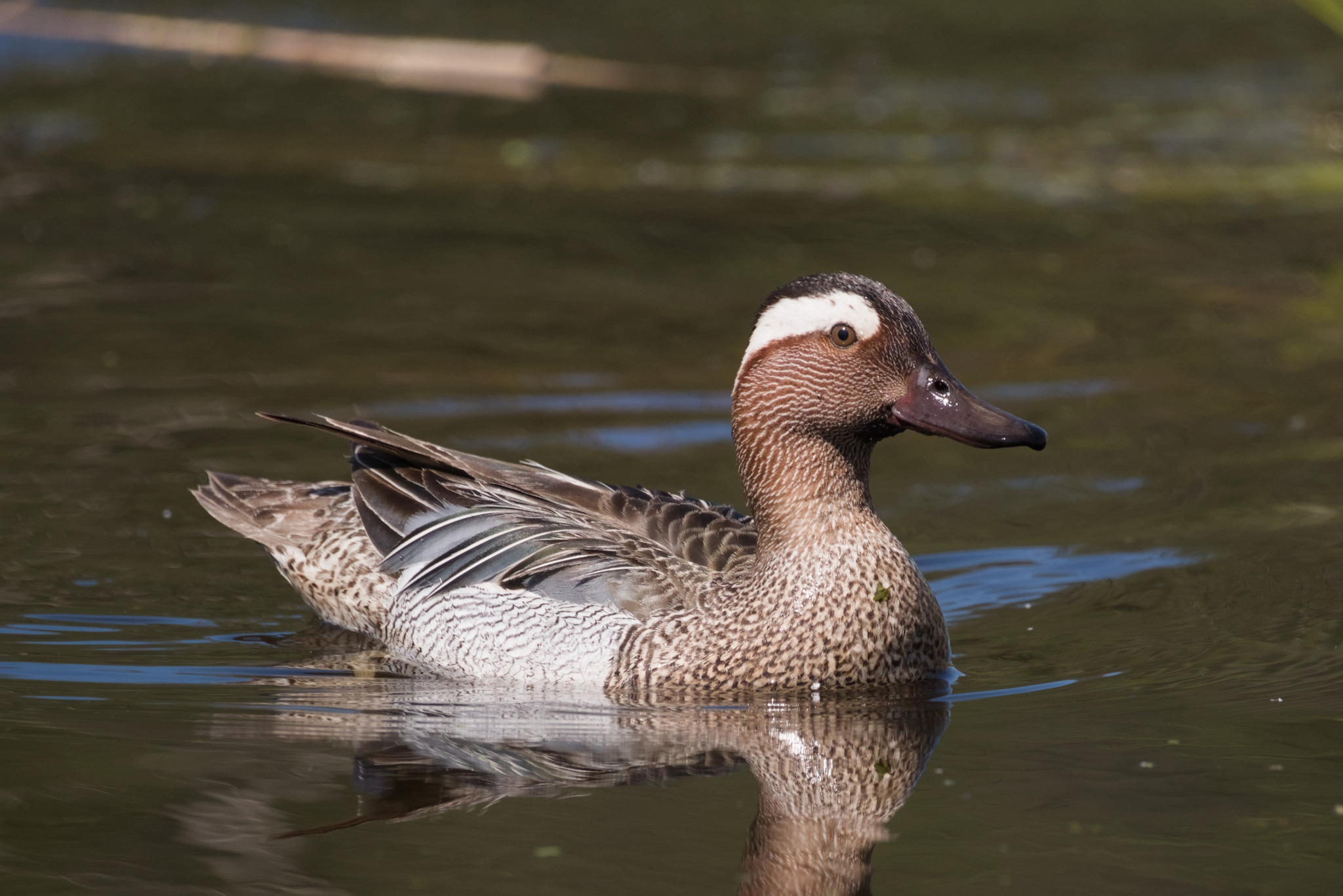
Spatula querquedula
Identity and names
Garganey, Sarcelle d’été in French, is the small migratory duck Spatula querquedula, in Anatidae and the order Anseriformes. Older references may use Anas querquedula for the same species. It is about 39 cm long. The Arabic name “summer teal” reflects its occurrence on northern breeding grounds; it does not mean that it spends the summer in every Arab country or is absent throughout the region in winter.
Identification
A breeding male has a conspicuous long white eyebrow above a brown head, a brown breast, grey flanks and contrasting scapular feathers. Females are mottled brown; strong pale and dark facial lines and a relatively longer, heavier bill help separate them from female Eurasian Teal. Absence of the male’s large white eyebrow does not establish sex: males outside breeding plumage and juveniles are less distinctive. An olive-green wing speculum has narrow white borders. Combine head and bill shape, facial pattern and wing markings rather than identifying a bird from a single feature.
Habitat, food and behaviour
It favours shallow water with vegetated margins: marshes, freshwater lakes, flooded meadows and wet fields. It feeds near the surface by lowering its bill and head, taking insects and aquatic invertebrates, with plant material also included. It does not depend on the deep diving characteristic of diving ducks. Birds may join other ducks at migration stopovers and readily disappear into vegetation. A brief visit with few sightings therefore need not mean a site is unused; equally, a pair in suitable habitat does not by itself establish breeding.
Range and Arab occurrence
Its breeding range extends across Europe and Asia, with wintering populations in sub-Saharan Africa, the Indian subcontinent and Southeast Asia. Arab countries show important seasonal differences. The 2026 Lebanon guide describes widespread, common spring passage from early February to April, much scarcer passage from August to early November, and rare summer breeding. Oman’s published official list instead describes an abundant passage migrant and common winter visitor. Lebanon’s seasonal description should not be transferred to southeastern Arabia, and passage should not be equated with established winter residence at every site. In Kuwait, the local reference describes common passage and rare summer occurrence, including birds in mixed duck flocks at freshwater pools around Jahra.
Breeding and development
The nest is on the ground among grass or low vegetation, sometimes away from the water’s edge. BTO gives a typical clutch of 8–9 eggs and female incubation lasting about 21–23 days. The downy young can move soon after hatching and usually become capable of flight at about 35–40 days. These are approximate developmental intervals, not a fixed calendar shared by every population: weather, water availability and site conditions influence the season. A chick leaving the nest on foot or swimming is not yet necessarily able to fly or independent of its mother.
November and responsible observation
Interpreting a November sighting requires its country, site and date. An early-November Lebanese record may belong to the end of autumn passage, whereas occurrence in Oman is consistent with the winter season. Watch pool margins from a fixed distance with binoculars, recording numbers, behaviour and visible plumage without flushing the birds. A handsome male’s plumage does not establish local breeding. Neither a photograph nor a better view justifies entering reeds or approaching a concealed female. If birds raise their heads anxiously or stop feeding, retreat and keep their route to cover clear.
Conservation
Specialist references report the species as globally Least Concern (LC) on the IUCN Red List. This describes global extinction risk, not the safety of every local population. The Lebanon guide identifies excessive hunting, habitat deterioration, disturbance, pollution and poisoning among pressures. Conserving small wetlands, clean water and connected vegetation protects places where migrants rest and feed during long journeys. Compliance with local protection laws remains necessary regardless of the species’ global category.
References
British Trust for Ornithology — BirdFacts: Garganey; British Waterfowl Association — Garganey; RSPB — Garganey; UNDP / ABCL / Ministry of Environment — Birds of Lebanon: A Photographic Guide to 409 Species, 2026, p. 35; Oman Birds Rarities Committee — Oman Official Birdlist; KuwaitBirds — Garganey.
Illustrative species photograph: Alexey Yakovlev, iNaturalist, CC0 1.0.