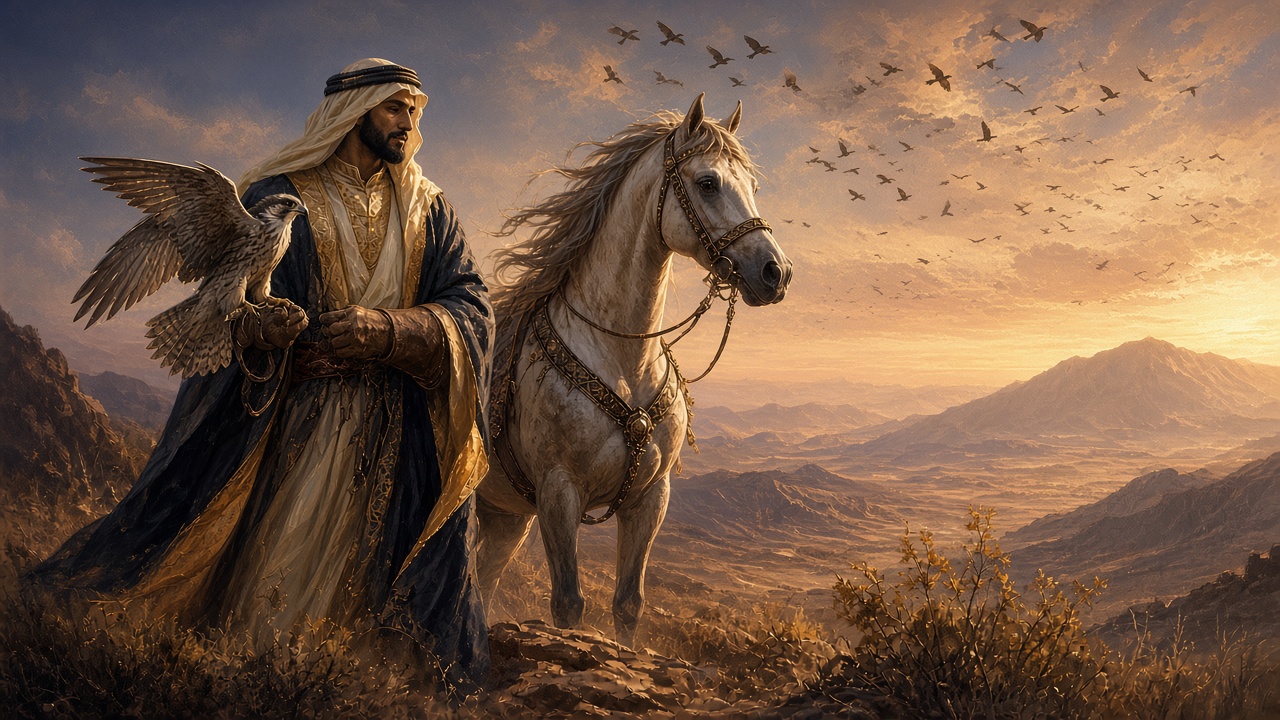
Each autumn, as the air shifts and birds begin their passage over the region’s skies, an old feeling comes back. The maqnas—the traditional hunt outing, with its waiting and its quiet—is more than a day in the open country. It is a cultural word that has long lived in language and in image.
Let us follow the bird on a reverse migration, from our present into heritage. In classical Arabic literature, hunting scenes were never idle decoration; they tested a poet’s power of sight. Those images took shape in the Abbasid age in what are known as tardiyyat—Abbasid hunting poems. One opening by Abu Nuwas is enough to show how he saw the scene: he sets out before the clear brightness of morning, before the dark hens begin to cluck, while night is still wrapped in its own hide—pitch-black, as if its dye had not yet been stripped away.
Here the hunt is not cast as an act but as a pure visual moment: night withdrawing, the horse rising. Abu Nuwas then turns to the tools of the chase—the horse that carries him, and a hound whose household lives by the animal’s labor, whose deep-set jaws and long cheek mean gazelles meet only hardship in the drive.
Beside falcon and hound, the Arabs also hunted with cheetahs—a practice that left its mark in descriptions of the leap and the strike.
Today a magazine reader may never go out into the open country, and may settle for an image on a screen or a poem in an old book. Even so, the feeling stays near: a yearly rhythm that binds Arab memory to the paths of birds over desert and plain. Classical poetry did not invent that feeling; it gave it a high language, and so it became a store we return to whenever the sky begins to move.
In that sense, maqnas grows wider than the outing itself. It may mean a family inheritance told at leisure, a literary image learned at school, or the distance that opens between “season news” and “reading heritage.” Contemporary readers bring scientific pictures of migration routes, and that gives the old text a second life. The poem that described the hawk or the horse celebrated precision and attention—the qualities that give a relationship with nature its depth.
Arab hunting verse was not always a cry in the wild; often it was directed silence: waiting, watching, a slow account of detail. Autumn, with its migrants, gives that silence a natural stage—flocks passing, colors shifting, distances that remind us wildlife is larger than the moment of capture.
From poem to maqnas, from the tardiyya to the sense of migrants in the sky, one cultural thread runs on. In the Arab imagination the hunt was always larger than a passing act; it was a way of looking, a rhythm, and one of literature’s frontiers in facing the world. When the flocks pass overhead, that old rhythm still sounds in memory—like a journey that never quite ends.