Aythya nyroca — A Near Threatened chestnut duck linking Arab breeding wetlands with winter lakes
Identity and recognition
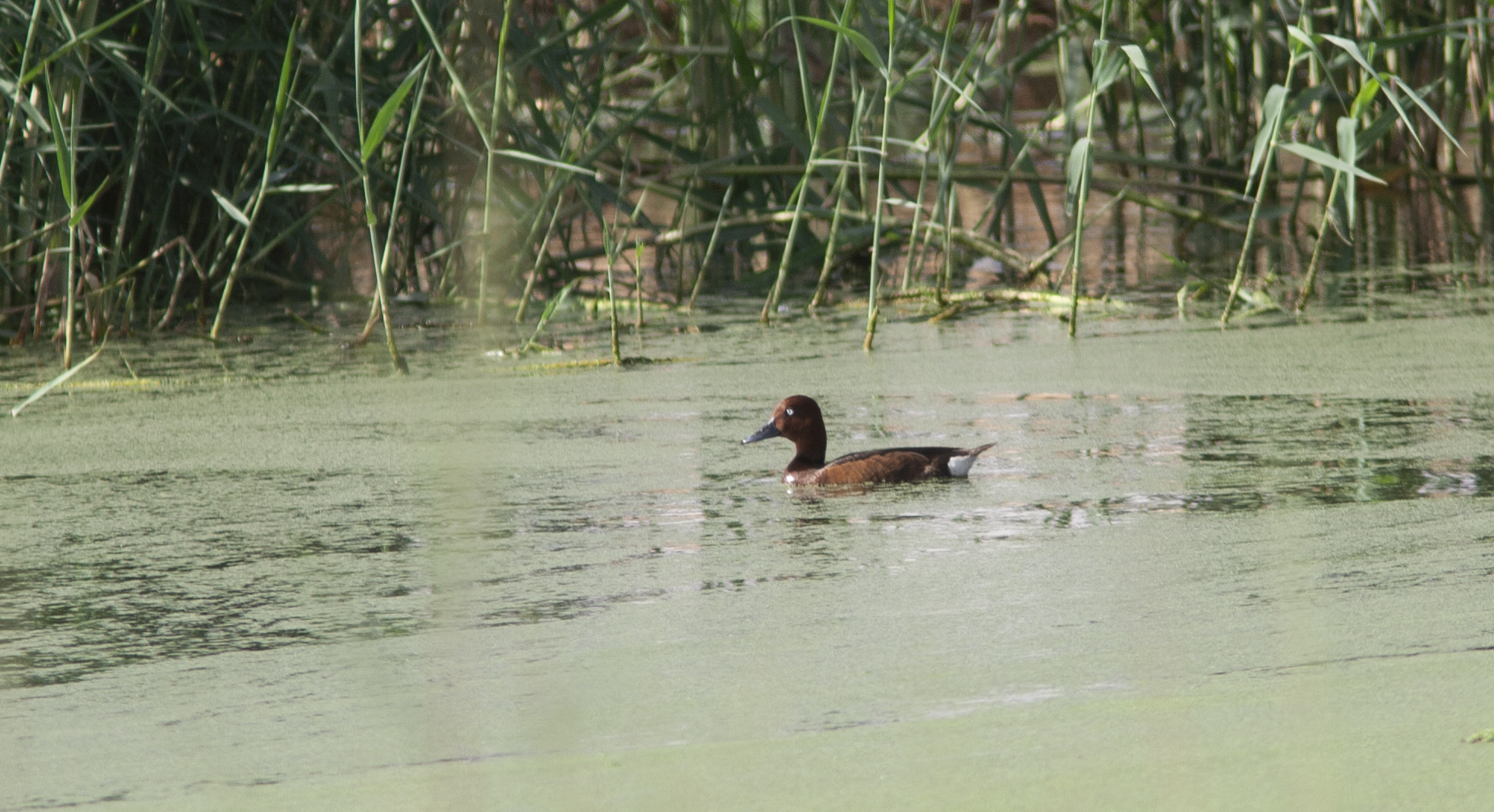
The Ferruginous Duck, Aythya nyroca, is a diving duck in the family Anatidae. The male combines rich chestnut plumage, a darker back and a very pale, almost white iris. Its crown is slightly peaked and its bill dark grey. White undertail-coverts and a broad white wing stripe in flight are important recognition features. At approximately 38–42 cm long, it is smaller and less bulky than some accompanying diving ducks.
Age, sex and similar species
Females share the general pattern but are duller and have brown eyes. Juveniles resemble females, with duller brown plumage and less clean white on the belly and undertail. A dark eye therefore does not rule out the species. The male Common Pochard has a grey body and black breast, while Tufted Ducks possess a conspicuous crest. Female diving ducks and some hybrids can complicate identification: head and bill shape, eye colour, undertail and wing pattern should be considered together rather than as interchangeable single clues.
Habitats, diet and behaviour
Shallow freshwater rich in submerged and floating plants, with reedbeds or dense marginal cover, is favoured habitat. Some brackish pools are also used. It feeds by diving and taking food near the surface, consuming seeds, roots and other aquatic plant material alongside invertebrates. Its tendency to remain near vegetation can make it difficult to detect even on a large lake. Outside breeding it may associate with other diving ducks. Open-water gaps among plants supply feeding, swimming and resting space; the combination of cover and accessible water is important.
Breeding and life cycle
Nests occur close to water in dense vegetation, on plant platforms or on floating islets. Biological references give a usual clutch of 7–10 eggs, incubation of approximately 25–28 days and flight at around 55–60 days. Research published in 2021 examined fifty nests at Algeria’s Lake Tonga during 2016 and 2017, linking breeding outcomes to nest-site characteristics and nest density. Some females deposited eggs in other nests of their own species, helping explain exceptionally large egg totals. The lake is consequently a breeding habitat, not merely a winter refuge.
Arab-region distribution and seasonality
Its Arab distribution includes different seasonal roles. It breeds at Algerian wetlands including Tonga, while BirdLife identifies Egypt’s Lake Nasser as an important wintering area. Lebanon’s 2020 checklist records scarce September–March passage and winter birds, with occasional non-breeding summer visitors. In Iraq, a study published in 2011 documented nests and families at Dalmaj marshes during May 2010. Autumn therefore connects regional breeding populations with arrivals from farther away, while a summer sighting alone need not indicate an active nest.
Ecology and conservation
The global category is Near Threatened, reaffirmed by BirdLife in an August 2026 publication. Pressures include wetland loss, vegetation degradation, altered water conditions, drought and excessive hunting. Survival depends on connected breeding, stopover and wintering sites rather than protection of one lake alone. Suitable water regimes, varied vegetation and quiet areas support feeding and nesting. Watching from a distance avoids forcing birds into flight for photographs, particularly at small sites where disturbance can repeatedly interrupt their activities.
References
BirdLife International — Across continents: The journey of the Ferruginous Duck (26 August 2026)
BirdLife Cyprus — Ferruginous Duck
CMS / AEWA — International Single Species Action Plan for the Ferruginous Duck (2006)
Global Ecology and Conservation — Nest site selection and breeding ecology of the Ferruginous Duck in Algeria (2021)
Ramadan-Jaradi and colleagues — Updated checklist of the birds of Lebanon, Sandgrouse 42 (2020)
Ararat and colleagues — breeding records in Iraq, Sandgrouse 33 (2011)
Mediterranean Waterbirds Network — Ferruginous Duck identification
Libyan Birds — Aythya nyroca
Photo: Tero Linjama (terolinjama) — CC0-1.0.