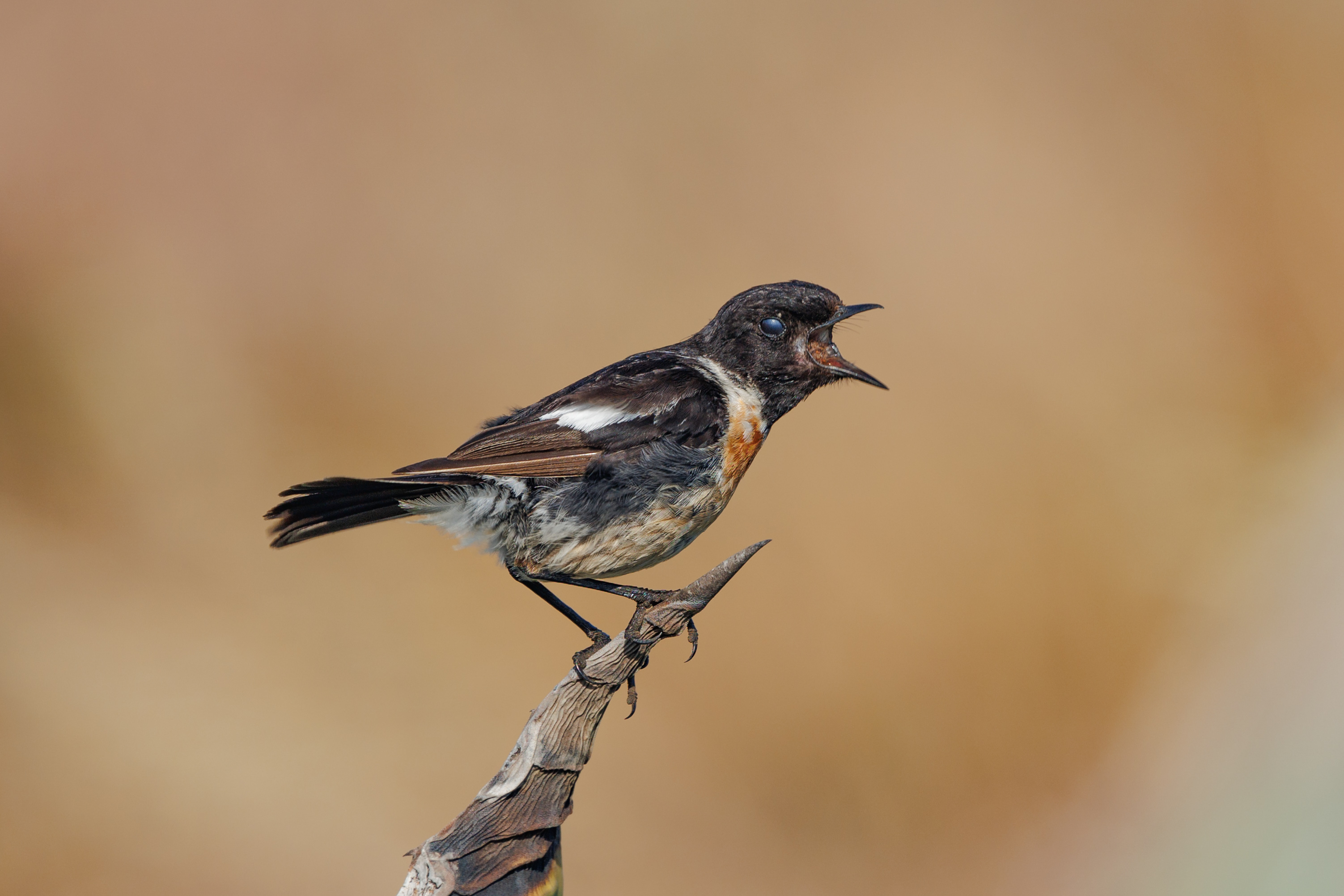
Saxicola rubicola — Identification, habitats, breeding and seasonal occurrence in the Arab region
Identity and recognition
The European Stonechat, Saxicola rubicola, is a small member of the flycatcher family Muscicapidae. Older publications sometimes treated stonechats within a broader species; modern taxonomy separates European, Siberian and African stonechats, each with its own distribution. A male has a very dark, often black-looking head, white neck-side patches, an orange-red breast and a mottled brown back. Females are duller, with a brown head and back and an orange-tinged breast. Feather condition and lighting also alter a male’s apparent contrast.
Age and similar species
Juveniles are mottled. Adult age cannot generally be established precisely from appearance alone, and moult and feather wear change visible patterns. Sex or age should not be assigned from a distant, unclear photograph. The Siberian Stonechat, Saxicola maurus, can be similar: no single white patch is sufficient for identification. Plumage features, locality, season and reliable photographic provenance should be considered together. Whinchats usually show a conspicuous pale eyebrow. Clear observations of several features are more useful than a first impression of colour.
Habitat, food and behaviour
European Stonechats use open country with grasses, low scrub, agricultural margins and slightly elevated lookout perches. A bird often watches from a shrub top or plant stem before dropping to seize a small prey item. Insects and other invertebrates dominate the diet, supplemented by fruit or seeds. Exposed perching and wing movements make the species noticeable; its short calls suggest two stones striking together, explaining the English name. A mixture of low vegetation and open space suits this bird.
Breeding and life cycle
The nest is low or on the ground, hidden in dense vegetation. British records typically show five or six eggs and two or three broods, with female incubation around fourteen days and young leaving after roughly 14–15 days. These are British reference observations; dates and brood numbers vary among populations. Breeding in the bird’s area of origin must also be distinguished from winter occurrence in the Levant: a bird wintering in a Lebanese field may nest elsewhere.
Arab-region distribution and seasonality
Lebanon’s 2020 checklist describes a common passage migrant and winter visitor from mid-September to late April, using open mountain habitats and Aammiq. Jordan’s list records passage and winter presence, whereas Oman’s 2020 list describes an uncommon passage migrant. Some European populations move south towards North Africa; residency and migration vary among populations. Late October falls within the period of arrival and winter residence in the Levant, where birds use grassland and low scrub.
Ecology and conservation
By consuming invertebrates and serving as prey, the Stonechat belongs to open-country food webs. Its global category is Least Concern in the scientific reference used here, not a separate assessment of every Arab locality. Removal of rough grass and scrub and fragmentation of suitable habitat can reduce feeding and nesting opportunities; severe winters have affected European populations. Retaining grassy margins and scattered shrubs preserves its habitat structure without converting open land into dense woodland.
References
British Trust for Ornithology — BirdFacts: Stonechat
RSPB — Stonechat
Ibis — European Stonechat plumage study (2024), DOI: 10.1111/ibi.13252
Jordan BirdWatch — Jordan Bird List
Ramadan-Jaradi and colleagues — Updated checklist of the birds of Lebanon, Sandgrouse 42 (2020)
Oman Bird Records Committee — Oman Bird List, version 7.10 (2020)
SongBird Survival — Stonechat
Photo: Hobbyfotowiki — CC0 1.0.