Gulosus aristotelis
A diver of rocky coasts
The European Shag, Gulosus aristotelis, belongs to the cormorant family and is closely associated with rocky shores and islands rather than inland lakes. Measuring 65–80 centimetres, it has an elongated body, slender neck, conspicuous tail and narrow, hook-tipped bill. Adults can look black at a distance, but good light reveals a green sheen. This is a species in its own right, not simply a small Great Cormorant.
Older references call it Phalacrocorax aristotelis. Its populations include Atlantic and Mediterranean forms; the subspecies desmarestii inhabits the Mediterranean and Black Seas. Geography therefore matters when comparing photographs and breeding calendars. A bird photographed beside the North Atlantic does not necessarily represent the appearance or seasonal timing of every Mediterranean shag.
Age, sex and the seasonal crest
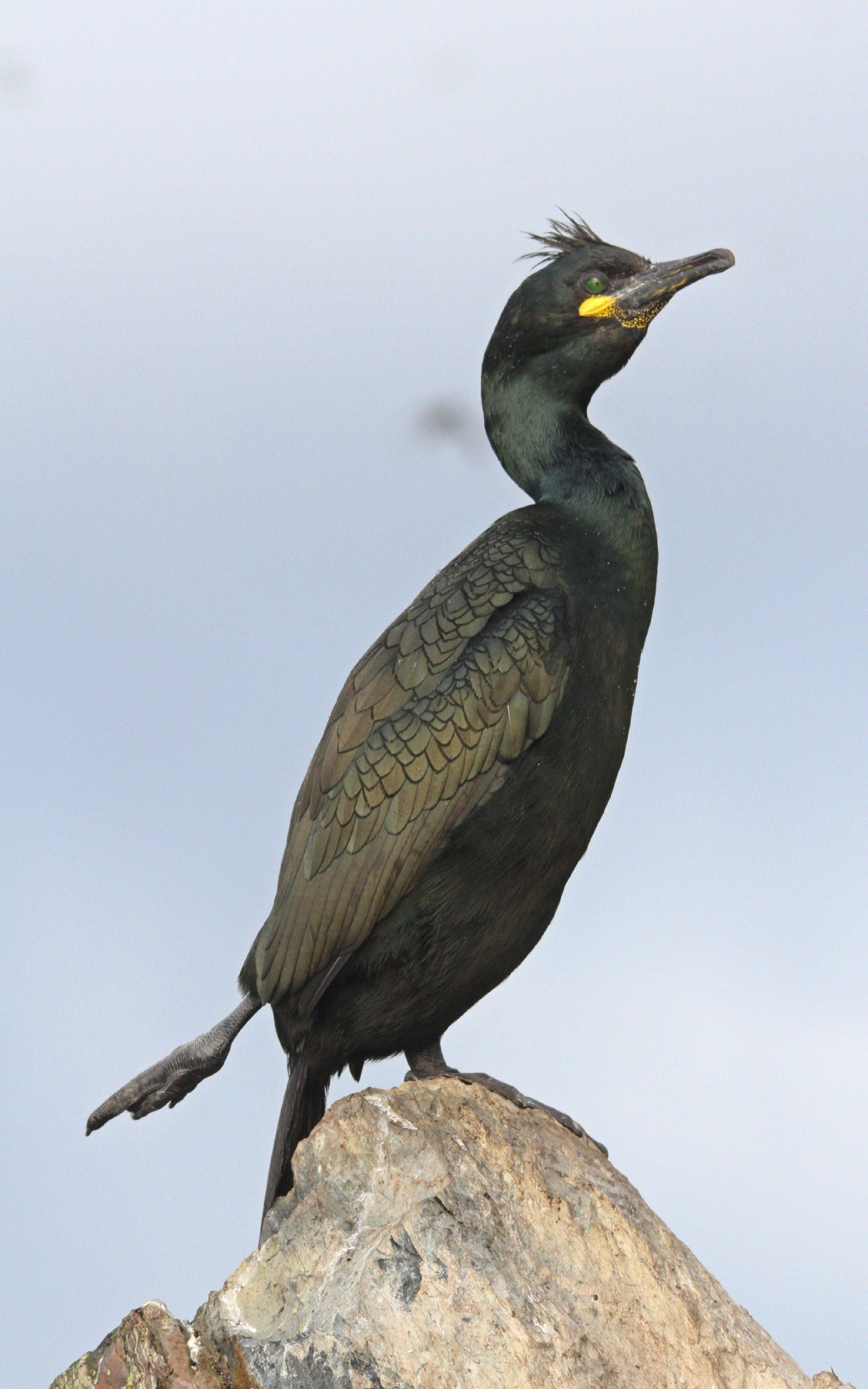
An adult has a dark neck, green eye and a small yellow area at the gape. During courtship, its plumage becomes glossier and a curved tuft develops on the forehead. The crest is seasonal, not a feature required at every sighting. Males and females have similar plumage, although males average larger. Apparent size in a single photograph is insufficient to establish sex.
Young birds differ from adults in their brown upperparts and paler underparts. Juvenile Mediterranean birds can have very pale bellies and pale-edged wing coverts. A pale belly does not identify a female, nor does brown plumage automatically indicate another species. Age, lighting and wet feathers all alter appearance, making the shape of the head and bill as important as colour.
Separating it from Great Cormorant
Great Cormorant, Phalacrocorax carbo, is generally more heavily built, with a larger head, heavier bill and broader neck. European Shag has a steeper forehead, a finer bill and only a small yellow gape area. Adult Great Cormorants show more obvious white around the throat and face and may carry a white thigh patch in breeding plumage. Several features together provide a safer identification than one alone.
Juveniles are harder to separate because both species may have pale bellies. Study the head in profile, the thickness of the bill relative to the head and the bird’s shape when it takes off naturally. A marine rock is not conclusive evidence, since Great Cormorants also use coasts. Recording a distant bird as an unidentified cormorant is preferable to certainty unsupported by the view.
Food and daily habitat
The shag pursues fish by diving from the sea surface, usually in coastal waters over rocky or sandy bottoms. Prey varies geographically and seasonally and includes bottom-associated fish as well as schooling species. Birds may feed alone or in groups. Water alone does not make a suitable habitat: access to food and secure resting places both matter.
Between diving trips, birds rest on rocks and may spread their wings. These intervals should not be interrupted by repeated approaches from boats or visitors. Some Mediterranean feeding areas are associated with seabed habitats such as seagrass meadows. Protecting a shag colony consequently involves the surrounding feeding waters, not simply leaving one nesting cliff undeveloped.
Nests, eggs and dependent chicks
Shags nest in crevices, caves and rocky ledges, often in colonies. The male selects a site and makes head and neck displays during courtship. Nests include materials such as seaweed and twigs, and both partners contribute to parental care. The season begins at different times among regions and years. Mediterranean birds may prepare to breed before winter rather than waiting for spring.
A typical clutch contains about three eggs. Both parents incubate for approximately a month, and the chicks hatch naked and helpless. British Trust for Ornithology data give a usual fledging interval of 48–58 days after hatching, a reference range rather than a fixed timetable for every Arab colony. Leaving the nest does not make a youngster safe to approach: developing flight and diving skills remain vulnerable to disturbance.
Arab distribution and the November scene
The Atlantic range reaches Morocco, while Mediterranean colonies occur in Algeria, Tunisia and Libya. Libya’s wintering-waterbird atlas documents island breeding rather than treating the species as widespread across all wetlands. The same reference describes occurrence on Egypt’s Mediterranean coast as accidental or possibly a rare winter visit, not common nationwide residency.
Many populations are resident or make limited movements, but residency does not mean that every bird occupies the same rock throughout the year. The Mediterranean Science Commission’s guide places the beginning of laying in late November at some sites, with considerable variation and breeding continuing into later months. November can therefore bring dispersed birds, returns to colonies and early breeding activity, rather than simply the arrival of winter visitors.
Conservation and responsible observation
European Shag is globally classified as Least Concern, LC, but this does not exclude local declines. Threats include accidental capture in fishing gear, oil pollution, disturbance of colonies and coastal development. Prolonged storms and reduced prey availability can also make feeding difficult. A species-wide category and the prospects of a small colony vulnerable to losing its nesting site describe different scales.
Watch from a distance that allows birds to rest and continue normal behaviour. Avoid landing on breeding islands or taking boats into nesting caves. Useful records include date, numbers, approximate age classes and sea conditions, without turning precise nest locations into crowded destinations. An extinction-risk category is not permission to hunt; reserve restrictions and local rules remain separate obligations.
Further reading: British Trust for Ornithology BirdFacts; SEO/BirdLife species guide; CIESM seabird guide; Atlas of Wintering Waterbirds of Libya 2005–2010; Spanish Virtual Encyclopaedia of Vertebrates; BirdLife International.
Photo: Giorgio Zavattoni / iNaturalist (CC0 1.0), Vardø, Norway, 6 April 2026.