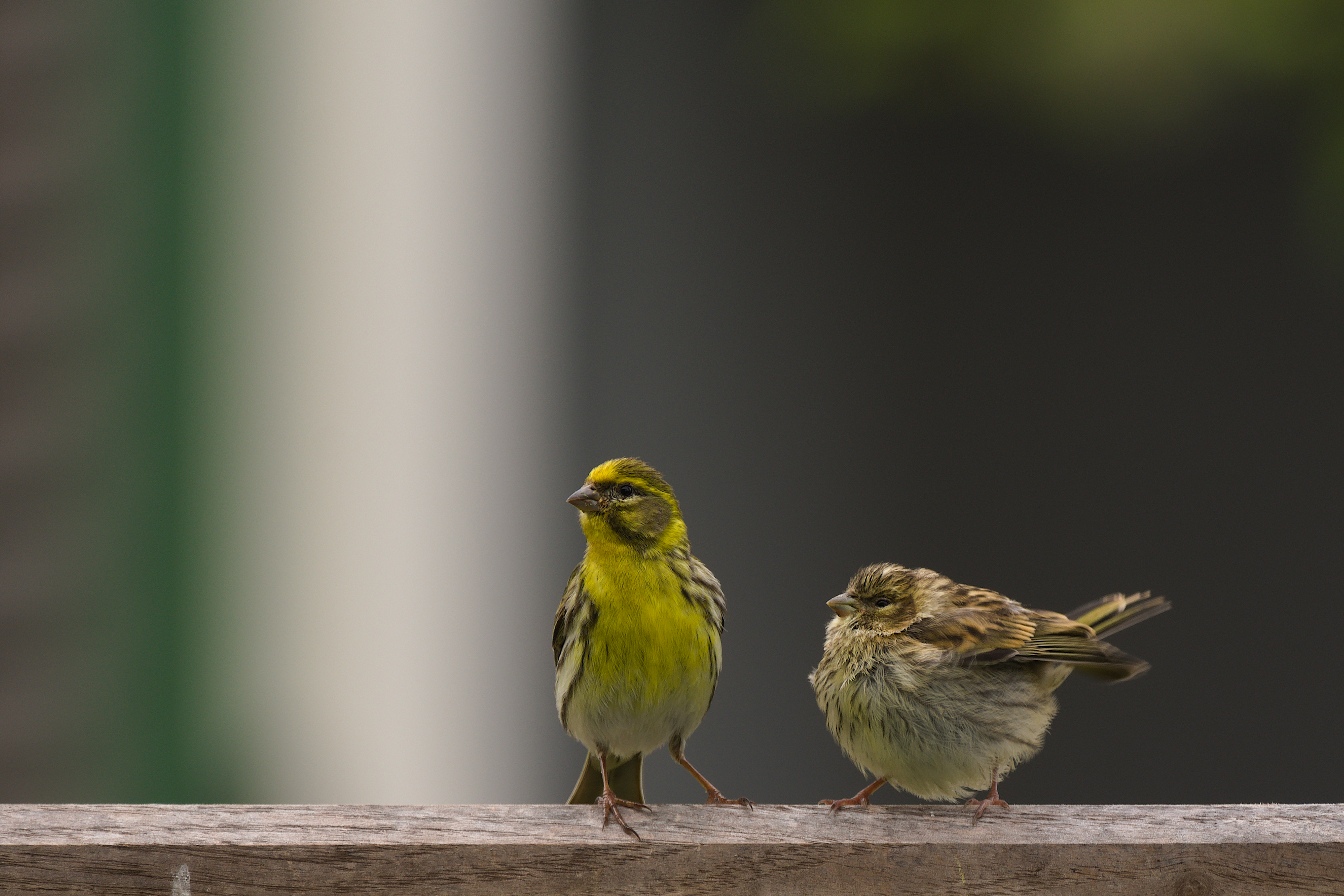
A yellow orchard songbird: recognition, breeding and winter occurrence of the European Serin
Identity and recognition
The European Serin Serinus serinus is a very small finch, with a compact body, short comparatively stout bill and forked tail. Males show lemon-yellow on the face, breast and rump, with streaking on the back and flanks. Females are browner and less yellow; juveniles resemble them and lack the conspicuous yellow underparts. The yellow rump is visible in flight, while the rapid, continuous song adds a useful behavioural cue. Arabic references use al-Na’ar al-Urubbi, with minor spelling variants referring to the same species.
Distinguishing similar birds
It must be distinguished from the Syrian Serin Serinus syriacus, a separate Levantine species, and Eurasian Siskin Spinus spinus. Conspicuous streaking and the very short bill help identify European Serin. Siskin has a relatively longer, finer bill, yellow tail sides and, in males, a black cap. The two serins resemble one another, so combined views of head, wings and rump, together with voice, are preferable to judging yellow colour alone. A small yellow bird in Lebanon’s mountains is not automatically Syrian Serin.
Habitat, food and behaviour
Gardens, orchards, parks and woodland edges provide habitat, particularly where song and nest trees occur beside seed-bearing ground vegetation. Food includes seeds, buds, small plant parts and invertebrates. Birds may feed among short herbs before returning to trees. Populations range from resident through partially migratory to migratory, with migration more pronounced farther north. EURING connects some European winter movements with northwest Africa and records conspicuous autumn migration across Europe in October.
Breeding and annual cycle
The female constructs a small compact nest in a tree or shrub, using outer branches or a sheltered position near the trunk. Three or four eggs are usual. BTO summarises incubation at about 11–13 days and the nestling period at 13–18 days. More than one brood is possible. Breeding schedules vary with climate and altitude.
Arab-region distribution and seasonality
A study published in 2016 confirmed breeding at Anjar, Lebanon, during spring 2015 through nest and young-bird evidence. Lebanon’s 2020 checklist describes common winter occurrence in coastal orchards, low hills and the Beqaa, with autumn passage in October and November. Syria’s 2025 review records resident breeding in the west and winter occurrence in Al-Jazira and the Euphrates region. Jordan confirms winter-visitor status while leaving possible residency uncertain. Morocco’s 2017 checklist lists resident breeders and winter arrivals.
Ecology and conservation
The current global category is Least Concern and must remain distinct from the conservation-sensitive status of Syrian Serin. Its ecological role involves seed and invertebrate consumption within networks of gardens and orchards. Excessive weed removal and herbicide use reduce food-producing plants; retaining diverse ground vegetation alongside suitable nesting trees is helpful. Observing nests from a safe distance and documenting food delivery to young provide stronger breeding evidence than the presence of a singing male or a lone bird in spring.
References
AviList — The Global Avian Checklist, v2026
BTO — BirdFacts: Serin
RSPB — Serin
Vogelbescherming Nederland — Europese kanarie
EURING/CMS — Migration Atlas: European Serin
Ramadan-Jaradi, Serhal & Ramadan-Jaradi — First confirmed breeding of the European Serin in Lebanon, Sandgrouse 38, 2016
Ramadan-Jaradi et al. — Updated checklist of the birds of Lebanon, Sandgrouse 42, 2020
Aidek et al. — An Annotated Checklist of the Birds of Syria, 2025
Jordan BirdWatch — Jordan Bird List
Bergier et al. — Liste des oiseaux du Maroc, 2017
Photo: Romzig — CC0-1.0.