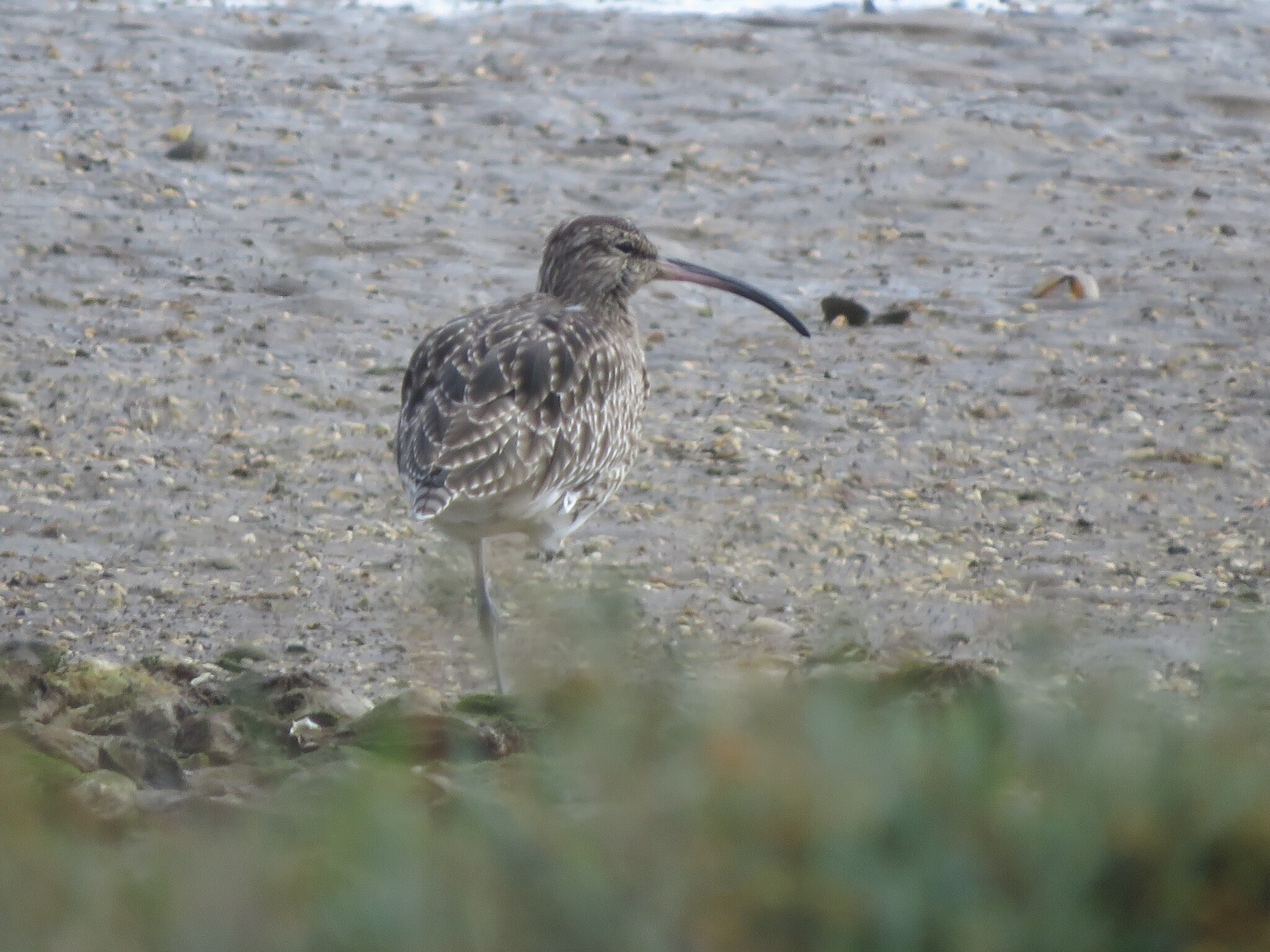
Numenius phaeopus
Name and taxonomy
Eurasian Whimbrel, Numenius phaeopus, belongs to Scolopacidae within Charadriiformes. Lebanon’s 2026 guide calls it karawan al-maa al-saghir; Kuwait’s reference uses karawan al-ghayt. It is not a stone-curlew, which belongs to another family: an Arabic common name alone is insufficient for identifying records or photographs.
AviList 2026 recognises Eurasian Whimbrel separately from the American Hudsonian Whimbrel, Numenius hudsonicus. This account concerns the Eurasian species, breeding in parts of the northern Old World and spending the non-breeding season on its coasts, rather than movements or numbers of the American species.
Identification
It is streaked grey-brown with pale underparts. The long down-curved bill is shorter than Eurasian Curlew’s and bends more noticeably towards the tip. A pale central crown stripe lies between two dark crown bands, above a pale eyebrow. Shape and head pattern help identify it in mixed wader flocks.
Flight reveals a pale back and rump and barred tail, with faster wingbeats than the larger curlew. Rapid repeated whistles are useful when details are hard to see. The sexes look broadly alike, and plumage colour does not establish sex. Age assignment needs clear feather detail; a distant image may identify the species without establishing age or sex.
Habitat, food and behaviour
Outside breeding it uses estuaries, intertidal mudflats, mangrove edges and sandy or rocky shores. It probes mud or picks prey from the surface, taking worms, crustaceans and other small animals. Feeding can occur by day or night according to access to food.
Birds may disperse while feeding and gather at shared resting places, sometimes with other species. The coast functions as connected habitat: exposed mud supplies food at low tide and higher safe ground at high tide. Eating invertebrates places it within coastal food webs, while migration links northern and warmer ecosystems.
Breeding and chick development
It breeds in the north during the warmer season on open ground with low vegetation, including tundra. Territorial behaviour includes aerial displays; the nest is a shallow depression among plants. Cryptic eggs and chicks offer concealment in relatively exposed surroundings rather than an elevated tree nest.
BTO records a typical clutch of four eggs, within three to five, with both parents incubating for usually 27–28 days. Downy chicks are mobile and can leave the nest site, while still needing parental care and protection. The reference gives about 35–40 days to flight, a different stage from leaving on foot. These are reference ranges, not an identical timetable for every nest.
Migration and Arab occurrence
Its Eurasian breeding range is patchy across the north, followed by non-breeding movements to Old World coasts. Arab occurrence primarily concerns passage and winter visitation rather than regular nesting on these shores. North African, Red Sea, Gulf and Arabian Sea coasts fall within its regional occurrence, with varying numbers and lengths of stay.
Lebanon’s guide records scarce passage and winter visitation on coasts and islands. Kuwait describes common passage but rare winter and summer visitation; Oman’s database describes abundant passage and winter visitation. November therefore offers opportunities, particularly on Omani shores, with different expectations in Kuwait and Lebanon. Dated records with numbers and habitat clarify local patterns better than generalising from one bay.
Conservation and responsible watching
Older references list Least Concern, LC, for Whimbrel under the broader pre-split concept. AviList 2026 supplies no separate Red List category in the split Eurasian species’ record, so the earlier category is not presented as a new assessment. Protecting feeding and resting sites remains important where reclamation, oil pollution and disturbance reduce usable coast.
Wait outside feeding routes and keep access to resting ground open. If your approach makes birds raise their heads or stop feeding, increase the distance. A photograph obtained without forcing flight preserves natural behaviour and leaves energy for migration and daily needs.
References
AviList Core Team — AviList v2026, 20 October 2026, Numenius phaeopus and Numenius hudsonicus.
Ramadan-Jaradi & Itani — Birds of Lebanon, second edition, UNDP, June 2026, p.152.
BTO — BirdFacts: Whimbrel, biology and identification.
Australian Museum — Whimbrel, updated 28 July 2023.
Kuwait Birds — Whimbrel; Birds of Oman — species database.
Convention on Migratory Species — Numenius phaeopus, distribution.
Photo: Dominique — CC0 1.0.