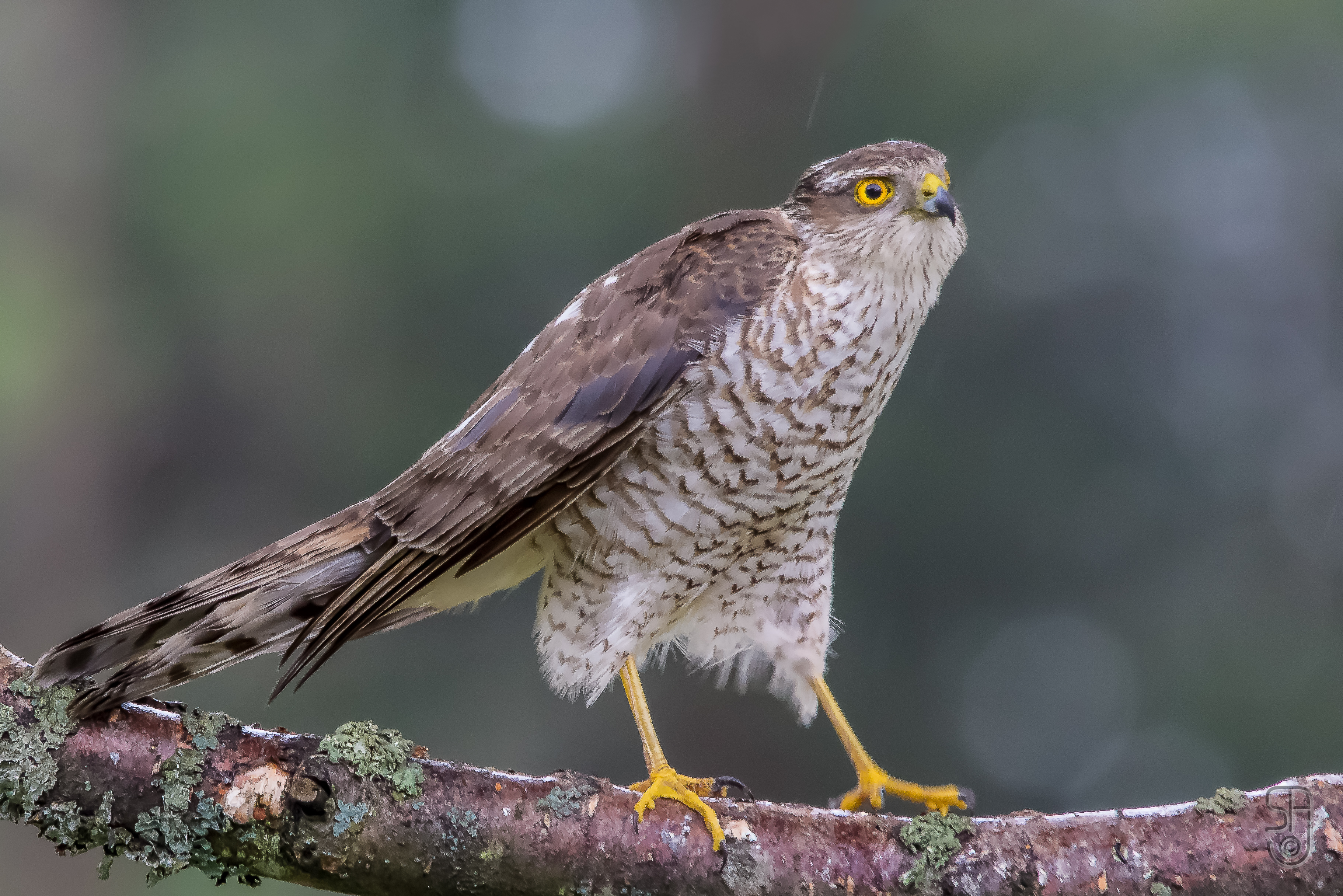
Accipiter nisus — An agile bird hunter alternating wingbeats and glides, with females markedly larger than males
Identity and recognition
The Eurasian Sparrowhawk, Accipiter nisus, is a raptor of the family Accipitridae; AviList 2026 retains this scientific name. Arabic references also call it bashiq al-asafir. A fast predator specializing chiefly in birds, it has relatively short, broad wings and a long, nearly square-ended tail that aid manoeuvring among trees. Rapid wingbeats alternate with brief glides, contrasting with a buzzard’s prolonged soaring. Its populations extend from Europe and northwestern Africa across much of Asia, with northern birds migrating south.
Age, sex and similar species
Females are substantially larger than males, an important distinction when interpreting prey size and apparent body size. Adult males have blue-grey upperparts and pale underparts barred orange-brown; females are generally brown-grey above with darker barring below. Juveniles are brown above, with differing lower-body markings and sometimes a clear pale eyebrow. Confusion can arise with Levant Sparrowhawks or larger goshawks; body, tail and wing proportions and underwing detail are useful comparisons. Pale eyes and legs and a long tail assist identification, but a combination of features is more reliable than size alone.
Habitat, food and behaviour
Woodland, forest edges, gardens and tree-rich farmland provide habitat, with cover allowing a concealed approach. The bird flies low beside bushes or buildings before suddenly striking, sometimes pursuing prey into open ground. Small and medium-sized birds form almost its entire diet; smaller males generally take smaller prey than females. Captures may be plucked in a sheltered place. Concentrations of small birds attract sparrowhawks to gardens, where alarm calls may precede the raptor’s appearance. This is part of the natural predator–prey network in such habitats.
Breeding and life cycle
A stick nest is built in a tree within suitable breeding habitat. British nest records typically indicate one brood of four or five eggs, female incubation lasting approximately 33 days, and fledging at roughly 27–31 days after hatching. These are reference values that vary with conditions and population. Nestlings depend on food supplied by their parents, linking habitat quality to sheltered trees and accessible prey. Migratory individuals use winter grounds separate from their nesting range.
Arab-region distribution and seasonality
Lebanon’s 2020 checklist records common passage from September to early November and March to early May, with small wintering numbers in mountains and the Beqaa from November to late February. Jordan’s list combines common passage and wintering with local residence. Saudi references describe uncommon but widespread passage in September–October and March–April, and winter presence from November to February. In Kuwait it is an uncommon passage migrant and winter visitor associated with suitable wooded sites. Northwestern Africa also supports the subspecies punicus from Morocco to Tunisia, according to AviList. Late October thus falls within passage and the approach of wintering in the Levant and Gulf, alongside differing resident populations.
Ecology and conservation
Sparrowhawk research illuminates relationships between raptors, prey and contaminants moving through food chains. British studies documented historical decline caused by organochlorine pesticides that thinned eggshells, followed by recovery as their use diminished. Kuwait’s reference identifies indiscriminate shooting as a local threat. AviList 2026 records global Least Concern, while local population health requires its own monitoring. Protecting trees and movement routes and reducing exposure to poisons helps retain this predator within its natural system.
References
AviList Core Team — The Global Avian Checklist, v2026
RSPB — Sparrowhawk
British Trust for Ornithology — BirdFacts: Sparrowhawk
Naturalis Biodiversity Center — Birds of Europe: Eurasian Sparrowhawk
Ramadan-Jaradi and colleagues — Updated checklist of the birds of Lebanon, Sandgrouse 42 (2020)
Jordan BirdWatch — Jordan Bird List (2020)
KuwaitBirds / Biodiversity East — Eurasian Sparrowhawk
Boland and Al-Suhaibany — The Birds of Saudi Arabia (2020), species account reproduced by KSA Nature
Photo: Stein Arne Jensen — CC0-1.0.