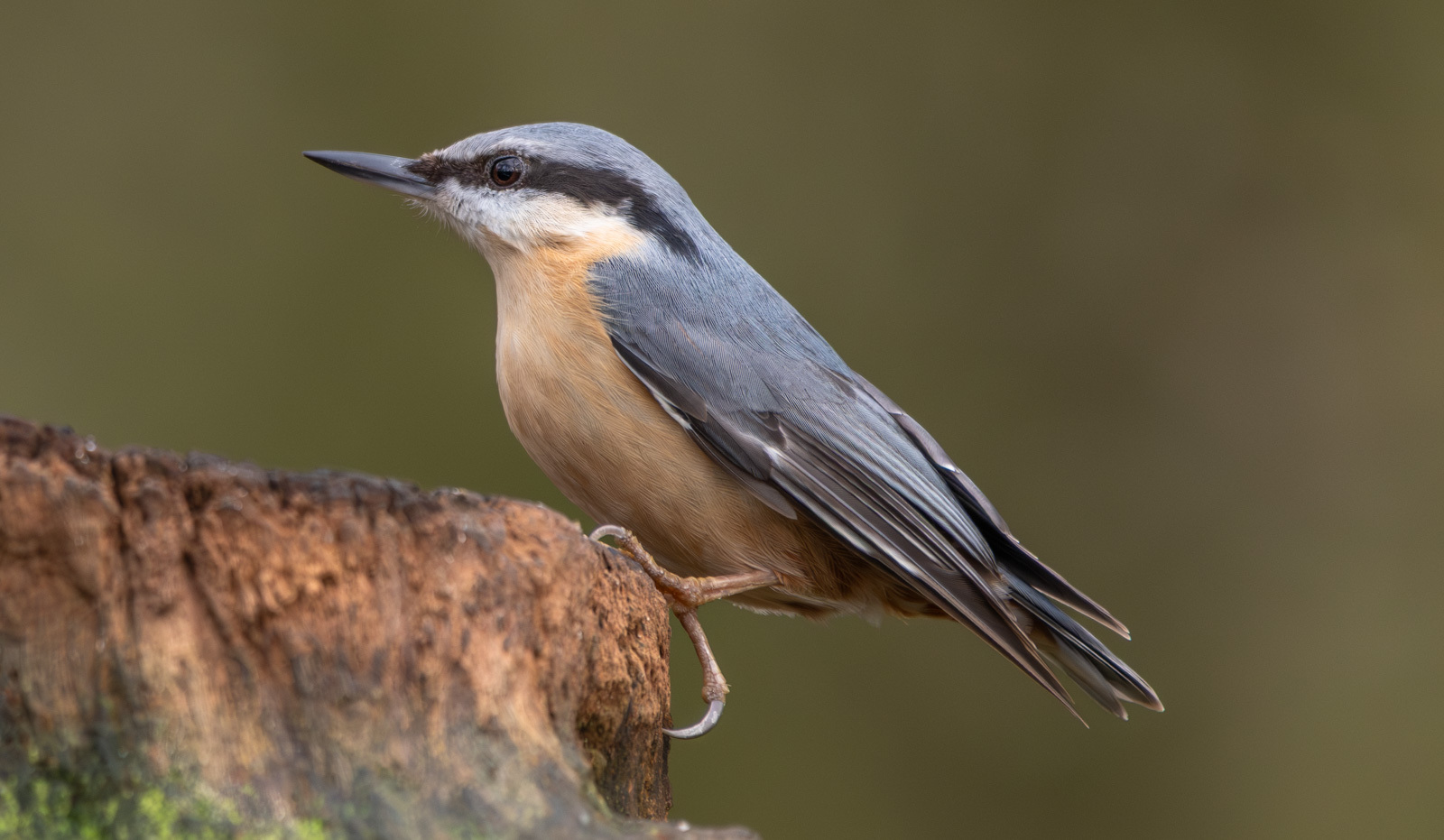
Sitta europaea
Identity and names
A compact bird moving headfirst down a trunk offers an excellent introduction to the Eurasian Nuthatch, Sitta europaea. It belongs to Sittidae within the passerines, and is called Sittelle torchepot in French and خازن البندق الأوراسي in Arabic; the Lebanese guide also uses the Arabic name كاسر الجوز الأوروبي. At approximately 14 cm long, with a wingspan around 24 cm, it is small enough to disappear behind a branch. Its powerful bill and short tail give it a distinctive outline.
Identification
The upperparts are blue-grey, with a dark line passing through the eye and pale cheeks and throat. Underparts vary geographically from whitish to buff, with warmer chestnut on the flanks and beneath the tail; males often have richer flank colour. Colour alone is therefore a poor guide to sex or subspecies. Treecreepers are browner and finely patterned above, with slender curved bills. Western Rock Nuthatch, Sitta neumayer, is a different species: compare the tail, underparts and habitat rather than relying on the shared dark eye-stripe.
Habitat and food
Mature woodland offers both feeding surfaces and nesting cavities. Deciduous and mixed woods, wooded parks and old orchards can be suitable where large trees remain. The bird searches bark and branches for insects, larvae and spiders, using its feet to move in different directions. Seeds and nuts become particularly important outside the breeding season. Hard items can be wedged in a crevice and hammered open, while food is also cached. This seasonal flexibility helps explain its generally resident way of life.
Range and Arab occurrence
Its range spans much of temperate Eurasia and reaches Morocco, where resident occurrence is recorded in the global assessment. Arab occurrence is nevertheless localized, not a continuous belt across North Africa and Arabia. The 2026 Birds of Lebanon guide describes a very rare, localized breeding resident in woodland and forest. That is quite different from its account of the widespread Western Rock Nuthatch. A familiar nuthatch seen on a Lebanese cliff should consequently not be assigned to Sitta europaea merely because it has a blue-grey back.
Breeding and development
The nest occupies an existing cavity, often a natural tree hole or an old woodpecker excavation. The female can narrow the entrance with mud and lay bark fragments inside. BTO gives a typical clutch of 6–8 eggs, female incubation of 16–17 days and a nestling period of roughly 24–25 days. Both parents feed the young. These are useful developmental references, not a Lebanese breeding calendar. Leaving the cavity is a stage in development and should not automatically be interpreted as complete independence.
November and responsible observation
November is a good time to watch how woodland birds handle and store seeds. A resident encountered then need not have just arrived on migration. Remain on existing paths, allow the bird to move between trees and record habitat as well as plumage. A photograph showing the tail and flanks is more informative than a distant silhouette. Do not open cavities, remove bark or disturb a cache to obtain a closer view. Repeated visits made quietly can reveal more than pursuit of a single individual.
Conservation
The species is globally Least Concern, a category that does not describe the security of every small population. Retaining mature trees, natural cavities and connected woodland protects its essential resources. The Lebanese guide identifies habitat loss, degradation, disturbance and climate change as pressures. A global range extending across continents cannot compensate for the disappearance of an isolated local wood. Management should retain safe old trees and varied woodland structure rather than treating every dead branch or hollow trunk as material to remove.
References
British Trust for Ornithology — BirdFacts: Nuthatch; RSPB — Nuthatch; Oiseaux.net — Sittelle torchepot; BirdLife International / IUCN — Sitta europaea; UNDP / ABCL / Ministry of Environment — Birds of Lebanon, 2026, p. 338; GBIF — Sitta europaea.
Photo: Gordon Best