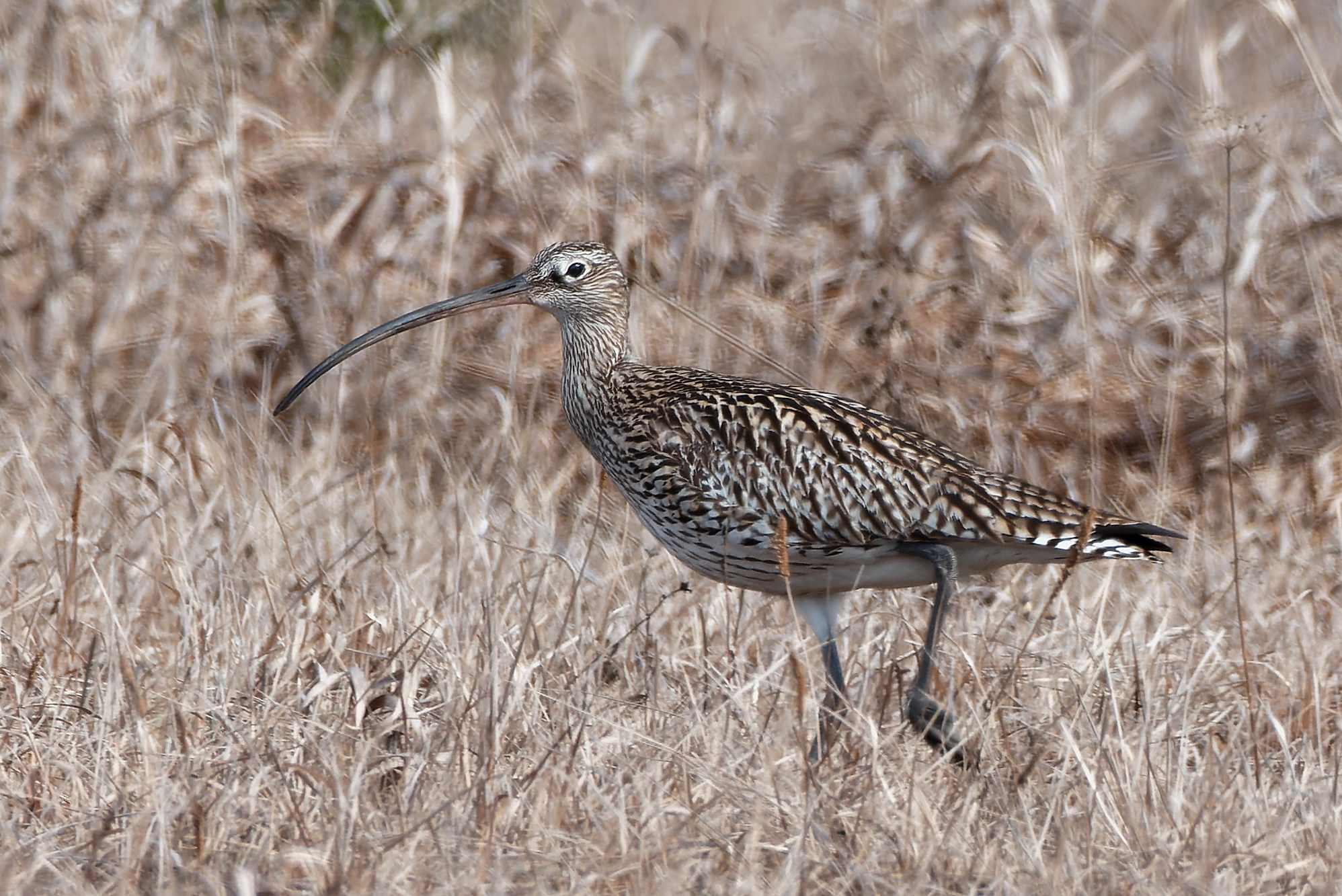
Numenius arquata — a long-billed visitor to winter shores
Name and classification
The Eurasian Curlew, Numenius arquata, belongs to Scolopacidae within Charadriiformes. AviList 2026 retains this name and lists its global status as Near Threatened. Arabic sources use “large water curlew” as well as “Eurasian curlew”. The shortened word “curlew” can be ambiguous in local names, making the scientific name valuable when checking photographs and older records. This is a large wading bird, not one of the songbirds that may carry a similar vernacular name.
Identification, age and sex
Its most conspicuous feature is a long bill curving smoothly downwards, combined with streaked brown plumage, a long neck and long legs. Sexes look similar, but females generally have longer bills; overlap prevents reliable sexing from bill length alone. Young birds can be shorter-billed and should not automatically be reassigned to another species. The Eurasian Whimbrel, Numenius phaeopus, is usually smaller and shorter-billed, with a stronger head pattern and pale central crown stripe. Use the whole structure, head markings and bill together, rather than one distant photograph.
Between mudflats and meadows
Outside the breeding season it favours tidal flats, estuaries and sheltered coasts, also using nearby fields and meadows. Its bill probes for worms, molluscs and crustaceans, while surface prey is also taken. Feeding opportunities shift with the tide, making safe high-water roosts essential when mudflats disappear underwater. A long coastline is not necessarily suitable habitat: reclamation can remove productive mud, while repeated disturbance can deprive birds of rest even where feeding grounds remain intact.
Breeding and life cycle
Breeding extends across much of Eurasia in wet meadows, marshy ground and open landscapes. The nest is on the ground and both parents incubate. Chicks leave the nest early and move and feed under parental supervision before they can fly; a chick on the ground is therefore not necessarily abandoned. Drainage and early mowing can reduce breeding success. Many birds move towards warmer coasts afterwards. Non-breeding individuals may remain south of the breeding range in summer, which is not evidence of local nesting.
Arab autumn and winter distribution
In Kuwait it is a prominent winter visitor and passage migrant, with some summering birds but no implication of breeding. Oman’s database describes abundant passage and winter occurrence. Moroccan surveys document winter use of coastal lagoons and estuaries, including Sidi Moussa–Oualidia; winter records are also documented at Aden in Yemen. Lebanon differs sharply: its 2026 guide treats it as a coastal vagrant. Early November is therefore relevant to suitable Gulf and North African shores, but present-day abundance at any particular site requires a current count, not recycled historical totals.
Why protection matters
Its Near Threatened status reflects concerns including habitat loss and degradation, killing, disturbance and pressures on breeding grounds. Feeding flats and roosts need protection together. For an observer, repeated retreat or interrupted feeding means more distance is needed. Chasing a flock for a flight photograph is not responsible observation. Winter presence does not imply permission to hunt: applicable law is a separate, country- and date-specific question.
References
AviList Core Team — AviList v2026, 20 October 2026.
British Trust for Ornithology — BirdFacts: Curlew and Whimbrel.
RSPB — Curlew; Wash Wader Research Group — Curlew.
BirdLife International — Migratory bird of the month: Eurasian Curlew, July 2024; Aden Important Bird Area account.
Ramadan-Jaradi et al. — Updated checklist of the birds of Lebanon, Sandgrouse 42, 2020.
Kuwait Ornithological Rarities Committee — Kuwait Bird List; Kuwait Birds: Eurasian Curlew.
Birds of Oman — national species database.
Waders wintering in Morocco: national population estimates and trends, Wader Study Group Bulletin 96, 2001; Phenology of waders in the Sidi Moussa–Walidia coastal wetlands, 2009.
Ramadan-Jaradi & Itani — Birds of Lebanon: A Photographic Guide to 409 Species, second edition, UNDP, June 2026.
Photo: Лариса Артемьева — CC0-1.0.