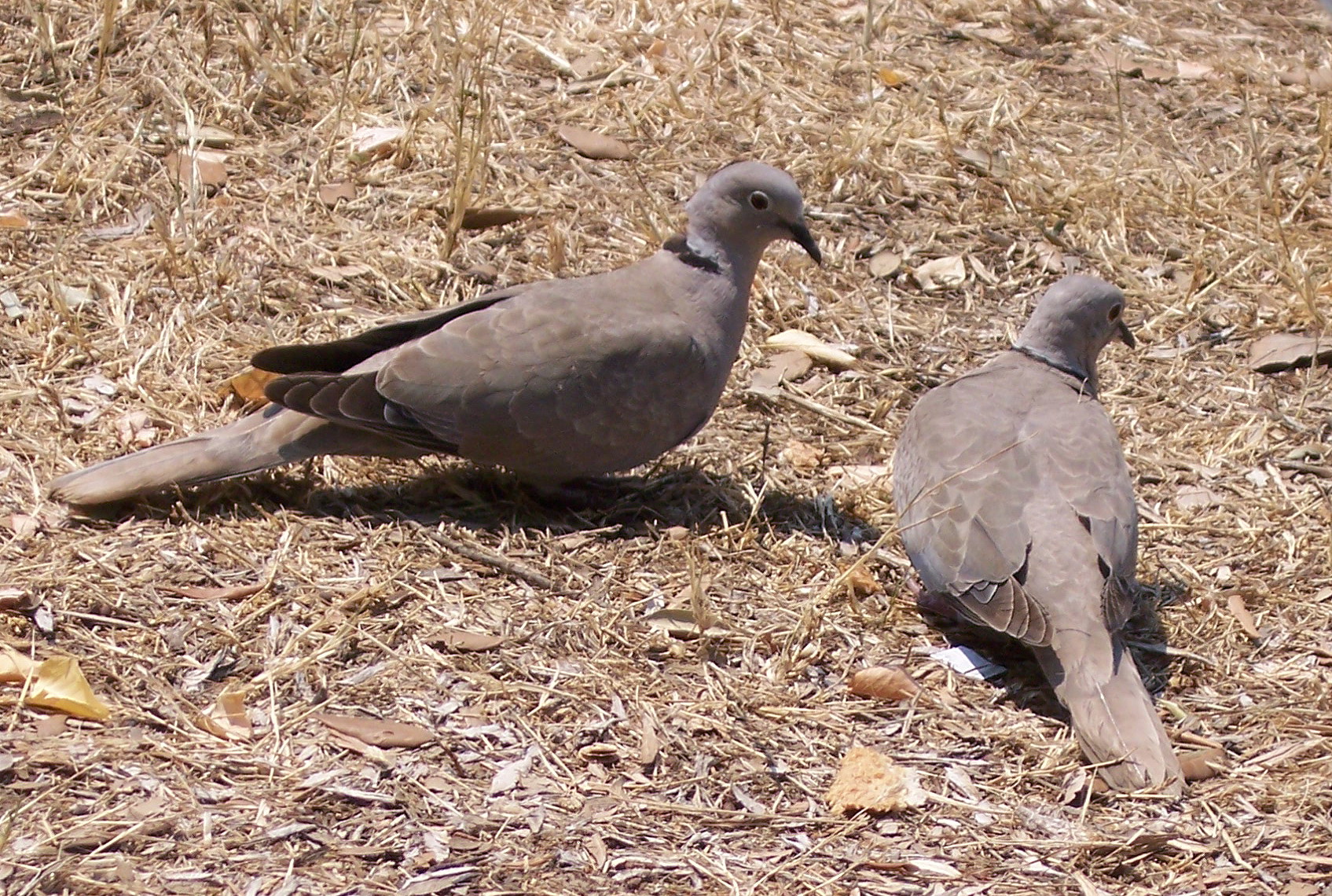
Streptopelia decaocto — Identification, habitats, breeding and occurrence in the Arab region
Identity and recognition
The Eurasian Collared Dove, Streptopelia decaocto, belongs to the pigeon and dove family Columbidae. Its overall grey-buff plumage carries a black half-collar across the back of the neck. It has a dark bill, reddish eye and a long tail with conspicuous white outer and terminal areas. The flight feathers are darker than much of the wing. Its apparently simple colouring varies with light, so the collar, tail pattern and voice together are more useful than an isolated shade of grey.
Age, sex and similar species
Males and females look very similar and cannot reliably be sexed from colour alone. Juveniles may lack a complete collar and show pale feather edges. The European Turtle Dove has warmer, patterned upperparts and a striped neck patch. The smaller, warmer-coloured Laughing Dove has a speckled patch on the front of the neck instead of this rear half-collar. The Collared Dove’s repeated three-part coo contrasts with the Turtle Dove’s purring voice. A young bird without a collar should therefore be assessed using body shape, tail and wings, not rejected solely on that missing feature.
Habitat, diet and behaviour
Villages, towns, farms and orchards provide habitat; trees, water and grain within human-used landscapes are valuable resources. Seeds and grain dominate its diet, supplemented with some fruit, plant material and invertebrates. Much food is collected on the ground. Birds may gather around feeding resources and away from nesting territories. Males coo from elevated perches and perform breeding displays. Success close to people does not make all open land suitable: food and places to rest and nest still matter.
Breeding and life cycle
The nest is a simple twig platform, with the male bringing material and the female assembling it. A clutch commonly contains two eggs. Both parents incubate and care for the young. Incubation lasts roughly two to under three weeks; young usually leave the nest after approximately another two to three weeks. Exact ranges differ between references and populations. Repeated broods are possible under favourable conditions, but their number and timing are not identical in every country.
Arab-region distribution and seasonality
In Lebanon and Jordan the species is a resident breeder, so an autumn sighting does not necessarily indicate migration. Saudi sources describe widespread occurrence in human-associated habitats, with limited presence in the western highlands. The UAE national assessment, conducted in 2019 and published in 2021, describes a widespread resident that increased alongside agriculture and irrigation. Breeding can occur throughout the year there, peaking in March–May. Breeding peaks elsewhere vary with local conditions. In Morocco, fieldwork in 2018–2019 linked records to settlements and farmland within the study area.
Ecology and conservation
The global conservation category is Least Concern. The UAE assessment also assigned Least Concern nationally, with an increasing trend; these are distinct assessment scales. A grain consumer and prey for predators, the dove participates in local food webs. Habitat changes, disturbance or disease can affect particular populations. Abundance does not establish that hunting is legal: local legislation determines species, seasons and conditions. Recording breeding birds, nests and habitats helps monitor expansion and identify important sites.
References
Cornell Lab of Ornithology — All About Birds: Eurasian Collared-Dove, life history
Naturalis — Birds of Europe: Streptopelia decaocto
IPM Centers — Eurasian Collared-Dove identification
Saudipedia — يمام مطوق (2023)
Ramadan-Jaradi and colleagues — Updated checklist of the birds of Lebanon, Sandgrouse 42 (2020)
Jordan BirdWatch — Jordan Bird List (2020)
UAE National Red List — Streptopelia decaocto, assessment 2019, publication 2021
African Journal of Ecology — Moroccan elevational study, field surveys 2018–2019
British Trust for Ornithology — BirdFacts: Collared Dove
Photo: Beyond silence — PD-self.