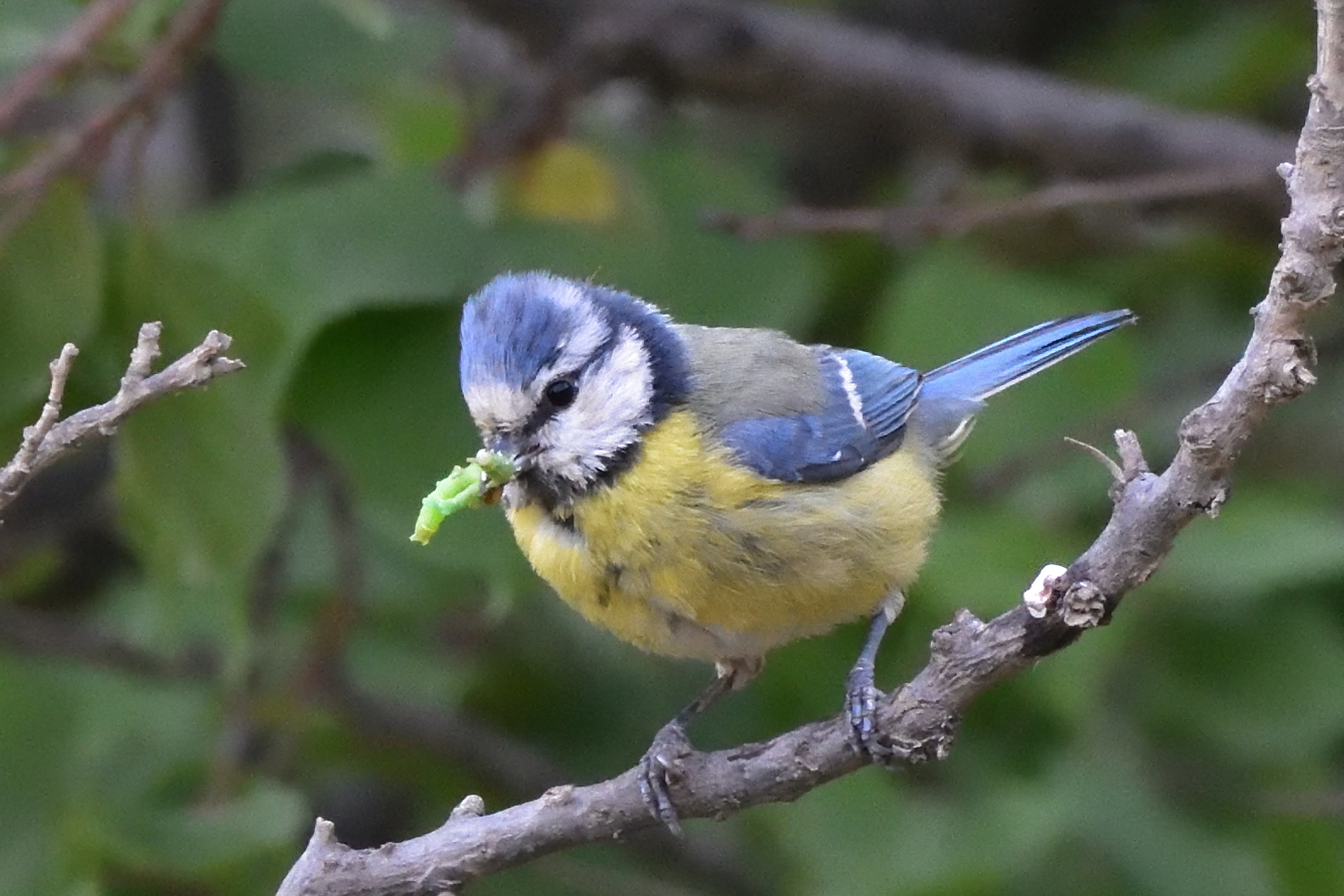
Cyanistes caeruleus
Identity and names
The Eurasian Blue Tit, Cyanistes caeruleus, is a small member of the tit family Paridae and the order Passeriformes. Its French name is Mésange bleue; Arabic references use “blue tit”, with “Eurasian” distinguishing it from its African relative. It is about 11–12 cm long, with a wingspan around 18–19 cm and a mass near 11 g. Older books place it in Parus, so Parus caeruleus denotes the same species rather than another bird.
Identification
Adults combine a blue crown, wings and tail with a greenish back, yellow underparts and white cheeks crossed by a dark eye stripe. A narrow dark mark may run down the belly, unlike the conspicuous broad stripe of the larger Great Tit. The sexes look similar, although males tend to be brighter; colour alone is an unreliable field test of sex. Juveniles have duller plumage, a greener crown and yellowish cheeks. In shade, check the whole facial pattern rather than judging a single blue feather.
Habitat, food and behaviour
Broadleaved woodland, wooded valleys, orchards, parks and tree-filled gardens provide feeding places and cavities. The bird searches leaves, buds and fine branches for small invertebrates, frequently hanging upside down. Caterpillars are especially important for growing chicks; seeds and other plant foods supplement the adult diet outside the breeding season. Autumn and winter birds may travel with other tits in mixed feeding parties. A short burst of movement through several trees is therefore not necessarily directed migration, and a feeder visit is only one part of its feeding activity.
Range and Arab occurrence
Its main range covers much of Europe and western Asia, but abundance in a European garden is no guide to its status in an Arab country. The 2026 Lebanon guide describes a rare resident breeder, increasing over the preceding decade, a scarce winter visitor and an even scarcer passage migrant. Woodland and river valleys are relevant Lebanese habitats. In Morocco, the familiar breeding blue tit is the African Blue Tit, Cyanistes teneriffae. The Moroccan checklist treats Eurasian Blue Tit as a doubtful accidental visitor, not a widespread resident; old broadly defined “blue tit” records require taxonomic care.
Breeding and development
A tree hole or suitable nest box holds the nest. BTO gives a typical clutch of 8–10 eggs, female incubation of 13–14 days and fledging after 18–21 days from hatching. These reference values are not measurements of every Lebanese population. Both parents bring food to the young, whose dependence continues beyond their first flight. Nesting is generally concentrated in spring and linked to food availability; the laying date varies with locality and conditions. A bird examining a cavity is not sufficient evidence that eggs or chicks are present.
November and responsible observation
November offers a chance to follow feeding parties through woodland without assuming that every individual has arrived from abroad. In Lebanon, resident birds and seasonal visitors must be distinguished at the population level; one brief sighting cannot establish origin. Record the date, habitat, number and diagnostic plumage, and photograph from an established path if possible. Do not tap nest boxes, open cavities or repeatedly play calls. Leave birds uninterrupted access to vegetation, especially during cold or wet weather when feeding time matters.
Conservation
The global IUCN category reported in AviList 2026 is Least Concern. This does not imply equal security everywhere or permission to capture the birds. The Lebanon guide identifies wildfire and climate change among pressures. Retaining old cavity-bearing trees, varied native vegetation and insect-rich foliage helps conserve both nesting and feeding opportunities. Avoid unnecessary insecticide use. Where feeders already operate, careful hygiene matters because congregation can spread disease; feeders are not a substitute for an intact, diverse habitat.
References
AviList Core Team — The Global Avian Checklist, v2026; British Trust for Ornithology — BirdFacts: Blue Tit; The Wildlife Trusts — Blue Tit; UNDP / ABCL / Ministry of Environment — Birds of Lebanon, second edition, 2026, p. 273; Bergier et al. — Liste des oiseaux du Maroc, 2017; Avibase — Eurasian Blue Tit.
Photo: Лариса Артемьева