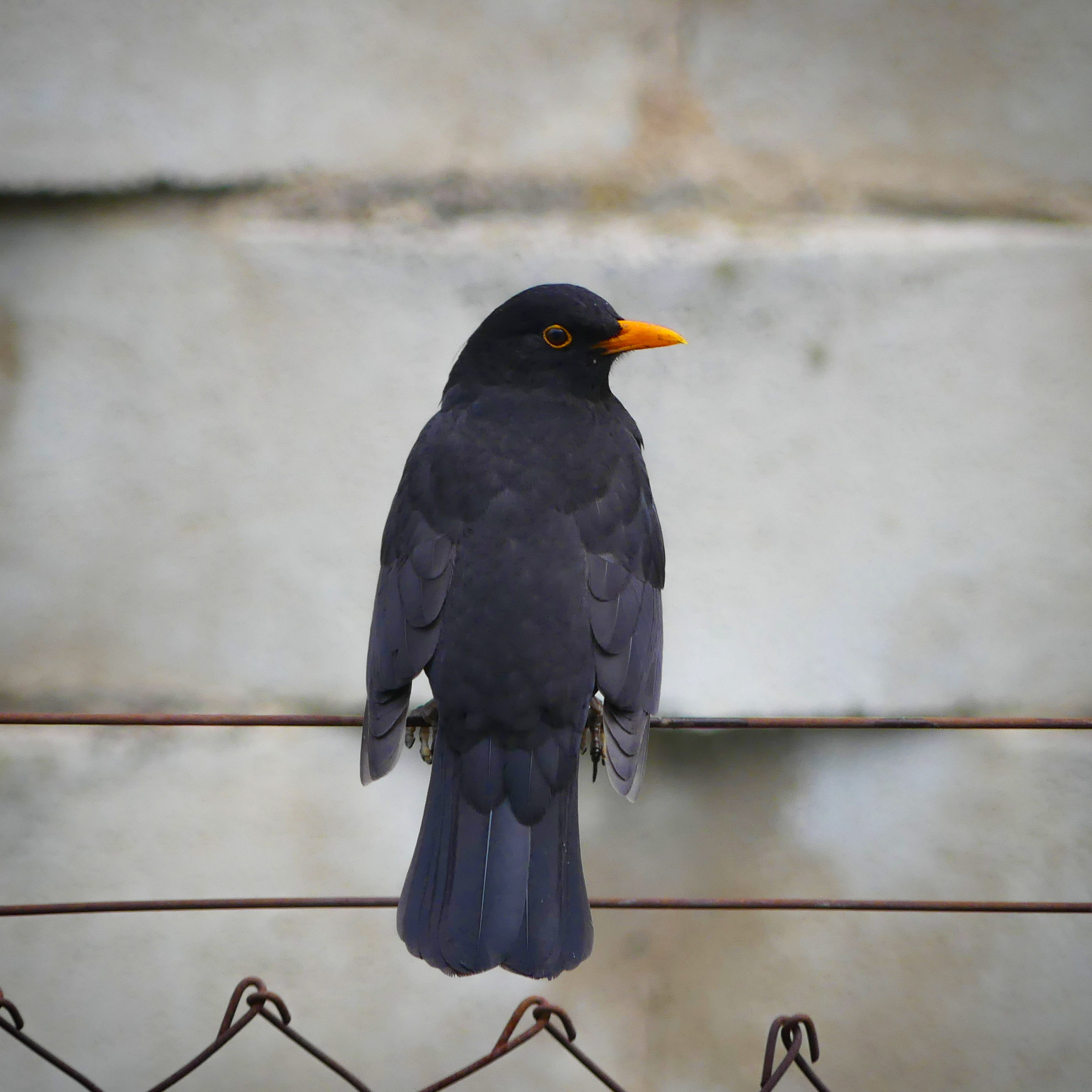
Turdus merula — Identification, habitats, breeding and occurrence in the Arab region
Identity and identification
The Common Blackbird, Turdus merula, is a thrush approximately 24–25 cm long. Adult males are black, usually with a yellow or orange bill and yellow eye-ring. Females are brown with a paler throat and subdued breast markings. Juveniles are brown and mottled: brown plumage alone does not identify a female. Young males may retain dark bills and relatively brown wings. Compared with a starling, the tail is long. On the ground, hopping or short runs alternate with pauses.
Similar species and taxonomy
Ring Ouzel generally shows a pale breast crescent and feather edges that make its wings appear paler; immature birds with a weak crescent need care. Starlings have shorter tails and pointed wings. This account includes North African blackbirds within Turdus merula rather than converting subspecies differences into separate species. The Indian, Tibetan and Chinese Blackbirds separated by modern taxonomies are excluded.
Habitat, diet and voice
Woodland, scrub, orchards, gardens and urban green spaces are suitable where ground-feeding opportunities and nearby cover coexist. Blackbirds turn leaves and search soil for earthworms, insects and other invertebrates, adding fruit when available. Diet varies with season, habitat and soil moisture. Rich, fluting song is often delivered from an elevated perch; sharp alarm calls sound very different. Breeding birds defend territories, whereas several may gather at a fruit source without forming a nesting colony.
Breeding and life cycle
The female builds a substantial cup of plant material strengthened with mud and lined with finer material, in a bush, tree or sheltered position. A typical clutch contains 3–4 eggs, with variation, and incubation lasts roughly 12–14 days. Both parents feed chicks, which leave the nest after about two weeks. Multiple broods are possible, and parental care continues after fledging. A Moroccan study documented breeding in apple orchards and adjacent woody vegetation at Ait Ayach. Such local work illustrates why breeding calendars should be related to habitat rather than copied automatically from European accounts.
Arab distribution and seasons
Blackbirds are not merely Arab-region winter visitors. Resident breeding populations occur in Morocco, Algeria and Tunisia, and in parts of the Levant and northern Iraq. In Lebanon the species is a common resident, supplemented by smaller numbers of passage and winter birds between mid-October and mid-March. Jordan illustrates an altitudinal contrast: Wadi Faynan receives winter visitors, whereas higher Wadi Dana supports residents. Breeding has also been recorded in Egyptian oases, so Egypt cannot be described solely as a migration destination. Qatar records are rare, unlike the situation in Mediterranean resident areas. Globally, some northern populations move south in autumn while others remain, and migrants may join places already occupied by local blackbirds.
Ecology and conservation
Blackbirds consume invertebrates, disperse seeds of some fruits and provide food for raptors and other predators. Their global category is Least Concern, but local trends differ. Pressures include hedge and ground-cover removal, pesticides, collisions and cat predation. Retaining dense shrubs and safe leaf litter and avoiding nest disturbance supports the species. Success in some cities does not mean every population is insensitive to habitat change.
References
BTO — BirdFacts: Blackbird
RSPB — Blackbird
Woodland Trust — Blackbird
Ramadan-Jaradi and colleagues — Updated checklist of the birds of Lebanon, 2020
University of Reading — Birds of Faynan, Past and Present
OSME — Region List 10.2, passerines
El Hassani and colleagues — Breeding Performances of the European Blackbird in Morocco, 2021
Djemadi and colleagues — Biometric data of North African Blackbird, 2019
BirdLife International — Algeria country species factsheet
Photo: WikiPokos — CC0 1.0.