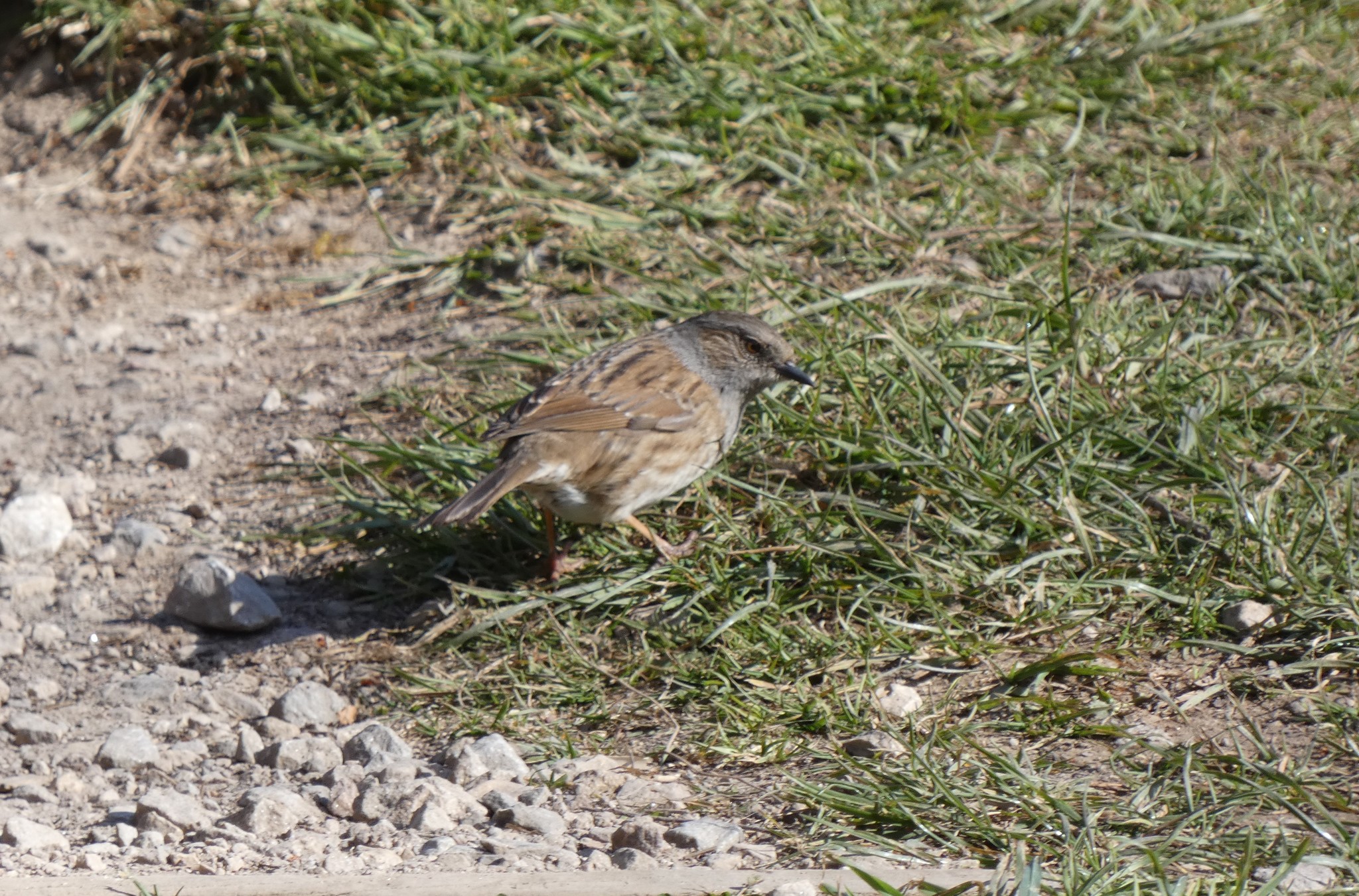
Prunella modularis — A discreet visitor beneath the shrubs
Name and identity
Dunnock is Prunella modularis, called Usfur al-shawk in the Lebanese guide. It belongs to Prunellidae within Passeriformes, not to the sparrow family despite its similar size, brown plumage and the English folk name “hedge sparrow”. AviList 2026 retains the same scientific name. Its native range extends across Europe towards the Urals and adjoining areas, with some populations migrating to the Mediterranean, North Africa and Middle East. Human introduction established it in New Zealand, unlike the natural migratory arrival of birds in the Levant.
Identification
Adults have a grey head and breast, a streaked brown back, a fine pointed dark bill and pinkish-brown legs. The sexes have similar plumage; juveniles are more strongly streaked and show less obvious grey on the head and breast. The slender bill distinguishes it from House Sparrow’s heavy conical bill, and it lacks the male sparrow’s strong head pattern. Other accentors also require attention: Siberian Accentor, for example, has a more contrasting head and a stronger eyebrow. Watching it walk beneath vegetation reveals a slim, discreet bird rather than a typical sparrow.
Habitat, food and behaviour
Dense scrub, hedges, gardens with a rich lower layer and woodland edges provide suitable habitat. It searches near the ground for beetles, flies, ants, spiders and other small invertebrates, also taking small seeds. Quick movements through litter and soil keep it close to cover into which it can retreat. Calls are thin; a breeding male may climb to an exposed branch to sing. Retaining shrubs and leaf litter provides feeding and hiding places: a garden stripped of every weed and fallen leaf is not necessarily better habitat for birds.
Breeding and parental care
The female builds a concealed cup nest in a shrub or dense vegetation and lays blue-green eggs. BTO records a typical clutch of four or five, incubated by the female for 14–15 days; young leave approximately 12–15 days after hatching. The female feeds the chicks and male participation varies with the mating system; care continues after departure. Birds may form a monogamous pair, or a female may associate with more than one male; additional social arrangements occur. Its breeding life therefore cannot always be reduced to a fixed pair. Broods may be repeated within the season. These reference breeding facts are not evidence of nesting in Lebanon, where it is classified as a passage and winter visitor.
Distribution and migration in the Arab region
The 2026 Lebanese guide describes it as a common passage migrant and winter visitor using low scrubby slopes and woodland undergrowth. November is therefore an appropriate time to search quietly along vegetation edges, rather than only among sparrow flocks. Migratory populations reach North Africa and the eastern Mediterranean, but broad range does not mean equal abundance among countries. Kuwait’s checklist treats it as a vagrant, with only a few accepted records, so it should not be described as a familiar winter visitor throughout the Gulf. Clear photographs of the head, bill and breast, accompanied by date and location, help document observations away from its usual areas.
Ecological role and conservation
AviList 2026 conservation data place it globally in Least Concern. Local pressures include removal of hedges and scrub, habitat simplification and illegal hunting; abundance and weather responses vary regionally. It contributes to food webs as an invertebrate consumer and prey, without this implying an unmeasured level of agricultural pest control. Retaining diverse low vegetation and avoiding nest disturbance are practical priorities. Winter photographers can wait at a distance that allows natural feeding rather than repeatedly flushing birds from cover.
References
AviList Core Team — AviList v2026, 20 October 2026.
Ramadan-Jaradi & Itani — Birds of Lebanon: A Photographic Guide to 409 Species, second edition, UNDP, 2026.
Kuwait Ornithological Rarities Committee — Kuwait Bird List.
British Trust for Ornithology — BirdFacts: Dunnock.
New Zealand Birds Online — Dunnock: identification, ecology and breeding systems.
Royal Society for the Protection of Birds — Identifying small brown garden birds.
Photo: David Sankey — CC0 1.0.