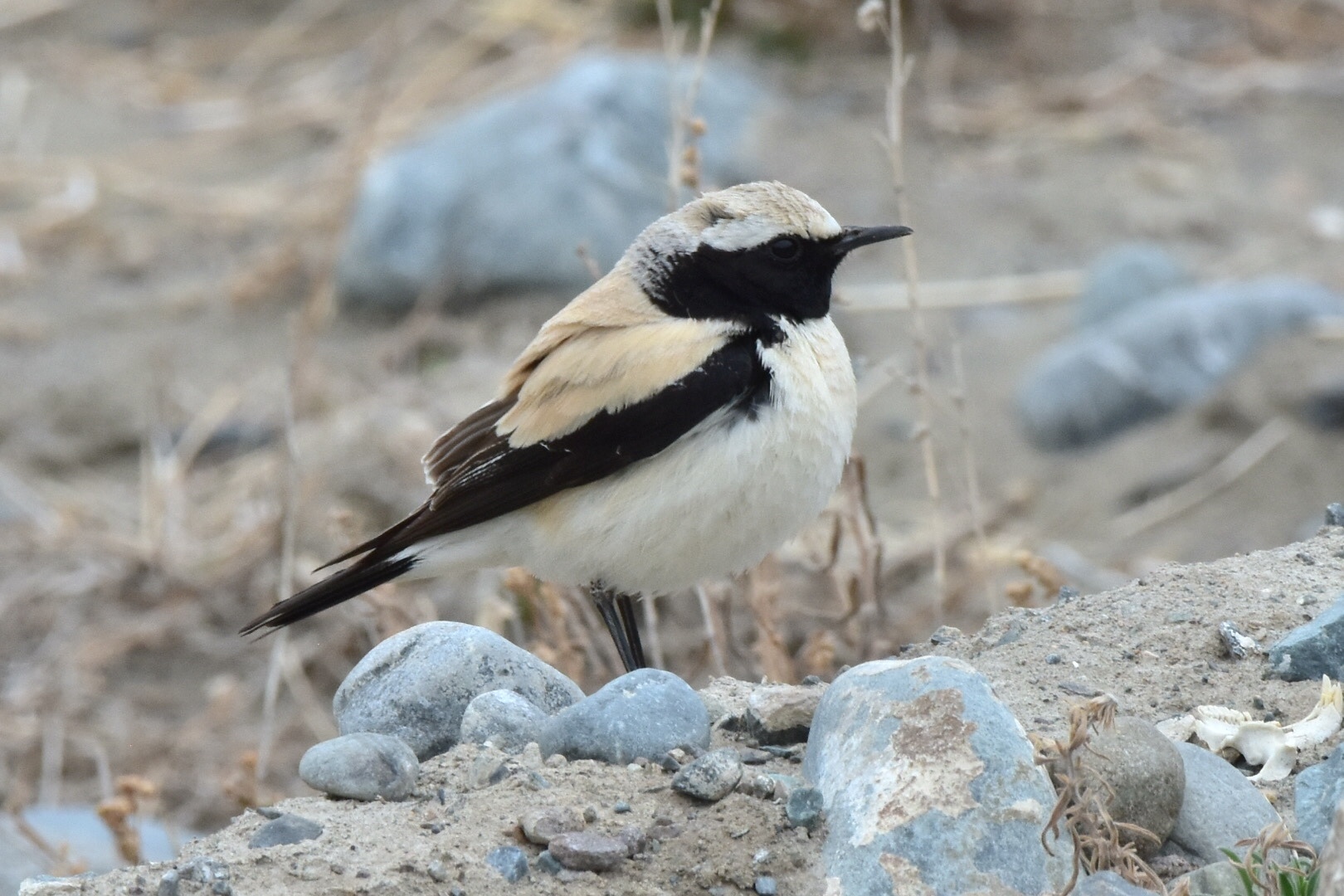
Oenanthe deserti
Identity and identification
Desert Wheatear Oenanthe deserti belongs to Muscicapidae. Males combine a black face and throat with sandy upperparts; females are duller. A mostly black tail with only a restricted white base is important, unlike the broader black-and-white patterns of other wheatears. Tail position can hide diagnostic features. It is placed in the order Passeriformes. The IUCN category carried in AviList 2026 is Least Concern (LC).
Habitat, food and behaviour
Desert, gravel plains and dry open land with sparse plants provide habitat. From a stone or shrub it drops onto ground insects and other invertebrates, sometimes making short aerial sallies. Shelter and shade provide rest; desert adaptation does not mean equal activity throughout midday heat.
Breeding and parental care
A concealed nest occupies a cavity, space beneath a rock or suitable burrow. Invertebrates feed growing nestlings, and care continues after nest departure. Food and seasonal conditions influence breeding in arid habitats; European or Asian calendars should not be imposed on every Arab desert.
Range and Arab occurrence
Its North African and Asian range includes Arab deserts, with both resident and migratory populations. Lebanon’s checklist describes scarce irregular autumn passage and rare spring passage, rather than widespread residence. Parts of Arabia receive wintering birds.
Seasonality and observation
November suits observation in desert wintering areas, while following most usual Lebanese autumn passage. Views of spread tail, face and wings improve identification. Location and date matter because age and sex reduce the value of colour alone.
Ecological role and conservation
It consumes invertebrates and feeds desert raptors. Loss of scattered vegetation, land levelling and off-road driving are pressures. Retaining rocks and plant patches preserves food, shade and nesting places in terrain that may look empty but supports varied life.
References
Ramadan-Jaradi et al. — Updated checklist of the birds of Lebanon, Sandgrouse 42 (2020), 186–238.
Royal Commission for AlUla — Birds of AlUla, Desert Wheatear.
AviList Core Team — AviList: The Global Avian Checklist, v2026 (20 October 2026).
Photo: Лариса Артемьева — CC0 1.0.