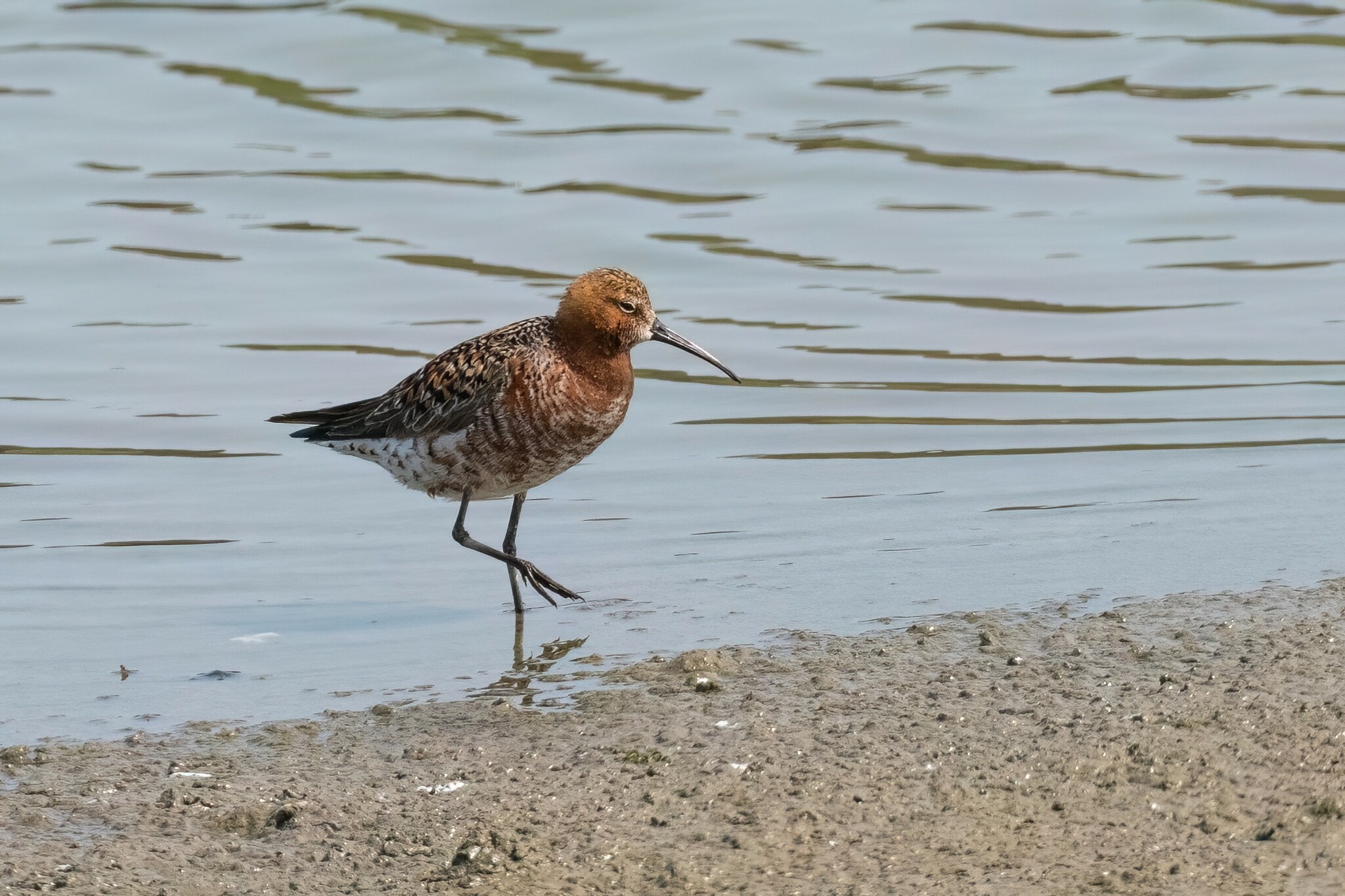
Calidris ferruginea
Identity and identification
Curlew Sandpiper is الطيطوى النهقية in Arabic and Bécasseau cocorli in French. Calidris ferruginea belongs to Scolopacidae, order Charadriiformes. About 18–23 cm long, it combines a slender body, relatively long black legs and a long downcurved bill. Despite the reference to a curlew in its English name, it is a small sandpiper rather than one of the large curlews.
Breeding adults have rusty-red underparts; winter birds are grey above and whitish below. Juveniles lack the extensive red of summer adults and show pale feather fringes. Sexes are similar, so colour alone does not establish sex. Winter Dunlin is a particular confusion species. Longer legs, a fine curved bill, upright posture and white rump help distinguish Curlew Sandpiper. Dunlin has a dark centre to the rump, whereas this bird shows a clear white patch in flight. Bill length alone is insufficient because viewing angle and individual variation affect appearances.
Habitat, food and behaviour
It breeds in Arctic tundra, then uses mudflats, estuaries, shallow lakes, saltpans and fresh or brackish wetlands during migration and winter. It often mixes with other sandpipers and follows falling water to newly available feeding areas. Coastal use does not exclude inland wetlands.
The bill probes mud or picks surface invertebrates, including worms, molluscs, crustaceans and insect larvae. Its legs allow feeding in slightly deeper water than some smaller sandpipers, but shallow water and accessible mud remain central. Flocks also need safe resting places when the tide covers feeding ground. A site may lose value even where its mudflat survives if the roost is constantly disturbed.
Breeding and development
Breeding is concentrated in northern Siberia, with eggs placed in a ground scrape on tundra. The typical clutch is four; the female incubates and cares for the young. An Australian government synthesis gives 19–21 days of incubation and flight around two weeks after hatching. These are general estimates, not guaranteed intervals for every nest; other references describe information on first flight as limited.
Chicks leave the nest site quickly and feed themselves while the female continues tending them. Walking and early self-feeding should be distinguished from full flight ability. Arab occurrences do not establish breeding: regional presence involves passage or wintering far from the Arctic nesting grounds.
Range and Arab occurrence
Non-breeding destinations extend to Africa, southern Asia and Australasia, linked by long migrations requiring a chain of stopping places. Lebanon’s 2026 guide lists a scarce passage migrant on coasts and wetlands. Oman’s official list records an abundant passage migrant and winter visitor. Arab wetlands therefore perform different functions, from a Mediterranean stopover to a winter destination on Omani shores. Local abundance does not establish global security. Kuwait’s committee list describes a common passage and summer visitor; summer presence in these waders does not establish nesting.
What November means
In November, a bird may be wintering or completing a movement stage, depending on population and locality. Omani observations fit established winter status; repeated presence is needed before calling a Lebanese site a regular wintering location. Record tides, numbers and accompanying species, with photographs showing shape and rump when naturally visible. Do not chase a flock simply to obtain a white-rump flight photograph.
Conservation and responsible observation
The current global category is Vulnerable (VU). It was uplisted from Near Threatened in the 2024 update following a global decline exceeding 30% over three generations. Threats include coastal habitat loss and reclamation, wetland degradation and disturbance, alongside local pressures such as illegal hunting. Effective protection connects feeding and resting places along migration routes rather than concentrating on one site alone. Watch from a safe margin with binoculars and leave gathering areas quiet, especially when rising water restricts the available space.
References
BirdLife International — Curlew Sandpiper species factsheet and 2024 Red List update; British Trust for Ornithology — BirdFacts: Curlew Sandpiper; Australian DCCEEW — Consultation on Species Listing Eligibility and Conservation Actions: Calidris ferruginea, 2023, reproductive ecology; Audubon — Curlew Sandpiper; UNDP / ABCL / Ministry of Environment — Birds of Lebanon, second edition, 2026, p. 160; Oman Birds Rarities Committee — Official Bird List, seasonal table; Kuwait Ornithological Rarities Committee / AbdulRahman Al-Sirhan — Annotated Arabic checklist, 20 September 2026.
Illustrative species photograph: Adam Jackson, iNaturalist, CC0 1.0.