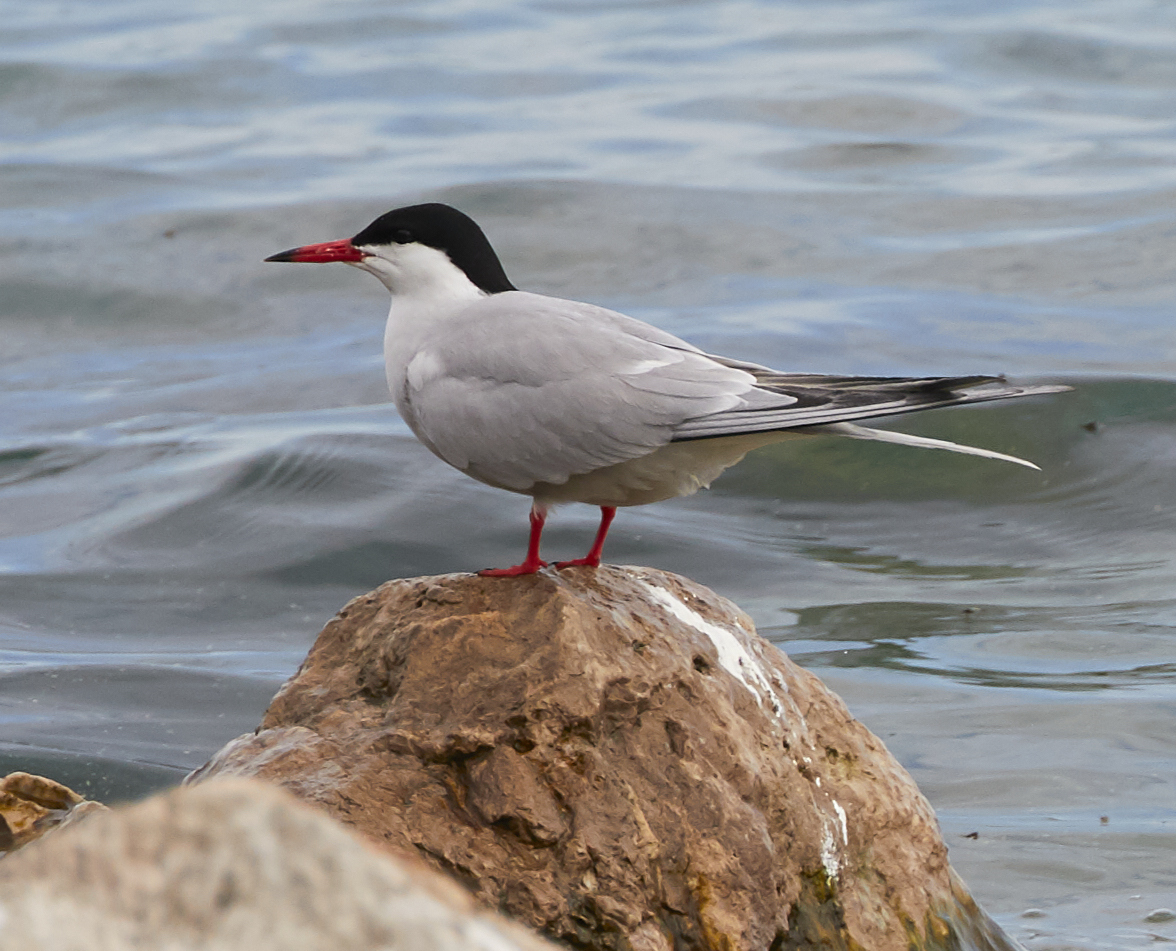
Sterna hirundo
Identity and names
Common Tern, Sterne pierregarin in French, is Sterna hirundo, a species in Laridae and the order Charadriiformes. About 35 cm long, it is slender and long-winged with a forked tail. “Common” describes relative abundance over a broad range, not a guarantee of plentiful birds in every country or season. Nor is it exclusively marine: rivers, lakes and other inland waters are important, particularly across parts of its breeding range.
Identification
Breeding birds have silvery-grey upperparts, a black cap, pale cheeks and a pointed red or orange-red bill, often with a black tip. The outer wing is darker than the inner wing and the tail distinctly forked. Outside breeding, the forehead turns white and bill and legs become darker. Markings vary with age and population, so bill colour alone cannot confirm identity. The sexes look similar. Comparing juveniles or moulting birds with Arctic, White-cheeked and other terns requires attention to structure and wing, tail and head patterns rather than one briefly glimpsed feature.
Habitat, food and behaviour
It searches for food over sheltered coastal waters, estuaries, lakes and rivers, sometimes hovering before dropping bill-first towards the water. Small fish are important prey, alongside other aquatic animals according to availability. Sandy beaches, islands and open shores provide resting places, and breeding birds often form colonies. A fishing tern need not be close to its nest: birds move between feeding, resting and breeding sites. Conservation therefore needs to consider more than a single point on a map, including both water quality and quiet shores.
Range and Arab occurrence
It breeds across large parts of Europe, Asia and North America, with populations moving south to different wintering areas. Lebanon’s 2026 guide describes common passage along coasts and islands and says it formerly bred on the Palm Islands; that wording does not establish continued breeding today. The Kuwaiti reference describes an uncommon passage migrant, with no confirmed nesting within Kuwaiti territory. Oman’s official list gives common passage and uncommon winter occurrence. Presence in the northern Gulf therefore does not automatically imply the same seasonal pattern as the Sea of Oman or eastern Mediterranean.
Breeding and development
The nest is usually a simple ground site; specially prepared platforms are also used in some conservation programmes. BTO gives a typical clutch of 2–3 eggs, incubation of about 21–22 days and fledging at about 22–28 days after hatching. Downy chicks can move before they can fly but still need feeding and protection. These are approximate reference intervals affected by conditions, not evidence of a particular country’s breeding calendar. Carrying a fish or wearing breeding plumage does not by itself establish a new colony; breeding requires clear evidence obtained without disturbing nests.
November and responsible observation
In November, Common Tern may occur as a winter visitor at some Omani sites, but it should not automatically be described as a common winter bird on every Arab coast. Record country, site and date, and obtain views of head and wing patterns without approaching. Keep away from resting birds and their route to the water rather than flushing them: repeated displacement reduces feeding and resting time. On islands, obey paths and local restrictions, avoiding landings beside groups that may contain nests or camouflaged chicks. Do not feed birds or use calls to lure them into a photographic position.
Conservation
It is globally Least Concern (LC), yet individual colonies can suffer despite its wide distribution. The Lebanon guide identifies disturbance, oil spills, fish poisoning, pesticides and avian influenza; the Kuwaiti reference highlights marine oil pollution. Keeping breeding and resting places quiet and protecting waters that support prey is more useful than preserving the shoreline’s appearance alone. If dead or injured birds are found, report them without touching them or gathering around them; do not infer disease or cause from one photograph.
References
British Trust for Ornithology — BirdFacts: Common Tern; KuwaitBirds — Common Tern; UNDP / ABCL / Ministry of Environment — Birds of Lebanon, 2026, p. 202; Oman Birds Rarities Committee — Oman Official Birdlist.
Illustrative species photograph: David Bird, iNaturalist, CC0 1.0.