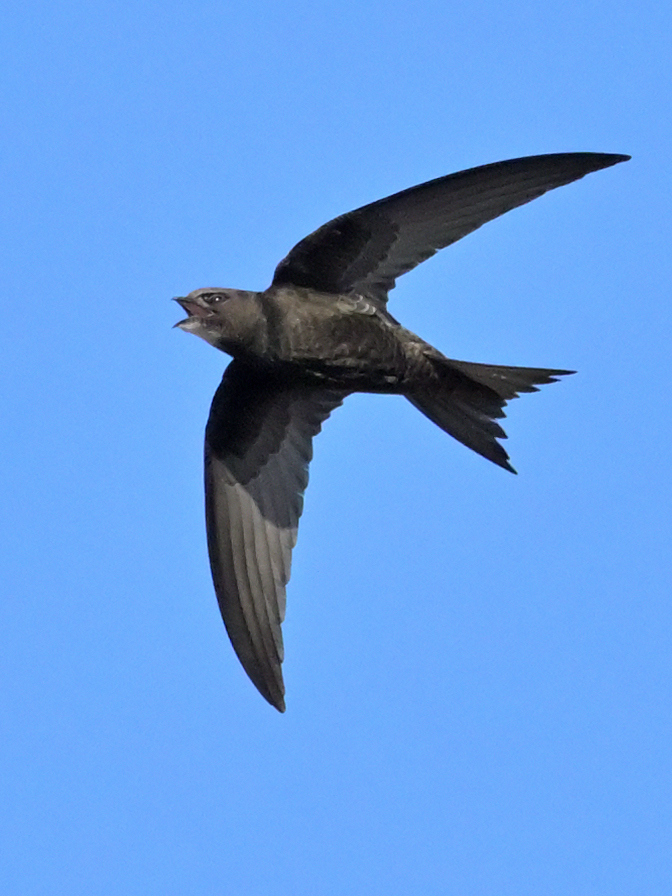
Apus apus
Identity and identification
Common Swift Apus apus belongs to Apodidae. A dark body, long sickle-shaped wings and forked tail accompany a limited pale throat patch. It is not a swallow. Separation from Pallid Swift is difficult in harsh light, which can make dark plumage look pale. It is placed in the order Apodiformes. The IUCN category carried in AviList 2026 is Least Concern (LC).
Habitat, food and behaviour
Most activity occurs in flight, catching insects and windborne spiders. It ranges over towns, farmland and water according to food and weather. Screaming groups around buildings are prominent during breeding. Swifts do not feed on grain and should not receive bread during rescue.
Breeding and parental care
Nests occupy building or rock cavities. BTO gives a typical two or three eggs, incubated by both parents for about 18–24 days. Young remain around 37–56 days before flight; insect supply and weather influence duration. An occupied cavity must not be sealed during renovation.
Range and Arab occurrence
It breeds in Europe, North Africa and parts of Asia, migrating to sub-Saharan Africa. Lebanon has abundant migrant breeders and passage birds. Conspicuous summer city flocks do not imply winter residence.
Seasonality and observation
Lebanese nesting runs from March to July, with passage in February–April and June–November. November numbers differ from summer flocks, and confusion with other swifts is possible. Record head, throat and wing details alongside date.
Ecological role and conservation
Loss of nesting cavities and declines in aerial insects are pressures. Renovations respecting occupied nests and suitable nesting provision help when food remains available. A grounded swift should never be thrown into the air; injury or weakness requires expert assessment.
References
Ramadan-Jaradi et al. — Updated checklist of the birds of Lebanon, Sandgrouse 42 (2020), 186–238.
British Trust for Ornithology — BirdFacts: Swift.
AviList Core Team — AviList: The Global Avian Checklist, v2026 (20 October 2026).
Photo: Luis Ferreira — CC0 1.0.